Consider a GaAs semiconductor at room temperature (T = 300 K). The bandgap energy is Eg...
Consider a GaAs semiconductor at room temperature (T = 300 K). The bandgap energy is Eg = 1.42 eV. The electron-to-hole effective mass ratio is me*/mh*=0.134. It is given that the separation between the Fermi level (located in the bandgap) and the top of the valence band is 4 times the separation between the bottom of the conduction band and the Fermi level. Find the ratio of the electron concentration in the conduction band to the hole concentration in the valence band.
Homework Answers


Add Answer to:
Consider a GaAs semiconductor at room temperature (T =
300 K). The bandgap energy is Eg...
(0) If in GaAs, the Fermi level is 0.30 eV below the conduction band. [10] calculate the thermal equilibrium electron and hole concentration at room temperature. Bandgap of CaAs is 1.42 eV, the effective density of states of the conduction band at 300K i
 (0)If in GaAs, the Fermi level is 0.30 eV below the conduction band. [10] calculate the thermal equilibrium electron and hole concentration at room temperature. Bandgap of CaAs is 1.42 eV, the effective density of states of the conduction band at 300K is 4.7x10 cm and the effective density of states of the valence band is 7x10¹ cm³.L213(11)Identify and illustrate with required equations and diagrams, how energy and momentum are conserved in band to band transitions in indirect band gap...
(2) In a semiconductor with an energy gap Eg between the valence and the conduction bands we can take Ef (the Fermi ene...
 (2) In a semiconductor with an energy gap Eg between the valence and the conduction bands we can take Ef (the Fermi energy) to be halfway between the bands (see figure below): Conduction band Energy gap Eg Valence band Semiconductor a. Show that for a typical semiconductor or insulator at room temperature the Fermi- Dirac factor is approximately equal to exp(-E 2kBT). (Typical Eg for semi-conductors ranges from about 0.5eV to 6eV at T-293K.) b. In heavily doped n-type silicon,...
Consider the semiconductor CuInSe2. Its bandgap is 1.0 eV, and the effective masses of electrons and...
Consider the semiconductor CuInSe2. Its bandgap is 1.0 eV, and the effective masses of electrons and holes are .09 me and .72 me, respectively. If the material is doped such that the Fermi energy is .1 eV above the valence band edge, determine: (a) the number of electrons in the conduction band per cubic centimeter and (b) the number of holes in the valence band per cubic centimeter.
Consider a semiconductor material X, with the following parameters at a room temperature of 300K: Energy...
Consider a semiconductor material X, with the following parameters at a room temperature of 300K: Energy bandgap of Eg = 1.15 ev, density of states at the Conduction band edge of Nc = 4.8e+23, effective density of states at the Valance band edge of Nv = 1e+25, drift mobilities of the electrons and holes, ue and uh, such that ue =0.4 and uh = 0.02. (1) What is the intrinsic concentration and conductivity of 'material x' at room temperature 300K?...
A wire is made of an intrinsic semiconductor whose bandgap is 1.0eV. The wire is 0.05microns...
 A wire is made of an intrinsic semiconductor whose bandgap is 1.0eV. The wire is 0.05microns in diameter and 1 micron long. Electrons have a mobility of 1000/cm V-sec and holes have a mobility of 200/cm V-sec. The effective mass of an electron in the conduction band is 1.2 and that of a hole in the valence band is 0.6. The semiconductor operates at room temperature. a. What is the probability of finding an electron at an energy 0.5eV above...
Silicon at at T-300 K contains acceptor atoms at a concentration of Na-5x10A15 cmA-3. Donor atoms are added forming an n type compensated(counter doped) semiconductor such that the fermi level is 0.2...
 Silicon at at T-300 K contains acceptor atoms at a concentration of Na-5x10A15 cmA-3. Donor atoms are added forming an n type compensated(counter doped) semiconductor such that the fermi level is 0.215 eV below the conduction band edge 4. a. What concentration of donor atoms were added. b. What were the concentration of holes and electrons before the silicon was counterdoped c. What are the electron and hole concentrations after the silicon was counter doped.
Silicon at at T-300 K...
Silicon at at T-300 K contains acceptor atoms at a concentration of Na-5x10A15 cmA-3. Donor atoms are added forming an n type compensated(counter doped) semiconductor such that the fermi level is 0.215 eV below the conduction band edge 4. a. What concentration of donor atoms were added. b. What were the concentration of holes and electrons before the silicon was counterdoped c. What are the electron and hole concentrations after the silicon was counter doped.
Silicon at at T-300 K...
Silicon at at T-300 K contains acceptor atoms at a concentration of Na-5x10A15 cmA-3. Donor atoms are added forming an n type compensated(counter doped) semiconductor such that the fermi level is 0.2...
 Silicon at at T-300 K contains acceptor atoms at a concentration of Na-5x10A15 cmA-3. Donor atoms are added forming an n type compensated(counter doped) semiconductor such that the fermi level is 0.215 eV below the conduction band edge 4. a. What concentration of donor atoms were added. b. What were the concentration of holes and electrons before the silicon was counterdoped c. What are the electron and hole concentrations after the silicon was counter doped.
Silicon at at T-300 K...
Silicon at at T-300 K contains acceptor atoms at a concentration of Na-5x10A15 cmA-3. Donor atoms are added forming an n type compensated(counter doped) semiconductor such that the fermi level is 0.215 eV below the conduction band edge 4. a. What concentration of donor atoms were added. b. What were the concentration of holes and electrons before the silicon was counterdoped c. What are the electron and hole concentrations after the silicon was counter doped.
Silicon at at T-300 K...
Please explain part b in details thx! Question 2 At 300 K, the bandgap of GaP is 2.26 eV and the effective density of states at the conduction and valence band edge are 1.8 x 1019 cm23 and 1.9 x 10¹⁹...
 Please explain part b in details thx!
Question 2 At 300 K, the bandgap of GaP is 2.26 eV and the effective density of states at the conduction and valence band edge are 1.8 x 1019 cm23 and 1.9 x 1019 cm3, respectively. (a) Calculate the intrinsic concentration of GaP at 300K (7 marks) Calculate the GaP effective mass of holes at 300K. (b) (8 marks) (c The GaP sample is now doped with donor concentration of 1021 cm3 with...
Please explain part b in details thx!
Question 2 At 300 K, the bandgap of GaP is 2.26 eV and the effective density of states at the conduction and valence band edge are 1.8 x 1019 cm23 and 1.9 x 1019 cm3, respectively. (a) Calculate the intrinsic concentration of GaP at 300K (7 marks) Calculate the GaP effective mass of holes at 300K. (b) (8 marks) (c The GaP sample is now doped with donor concentration of 1021 cm3 with...
GaAs laser (a) The degenerate occupation of the conduction and valence bands with electrons and holes...
 GaAs laser (a) The degenerate occupation of the conduction and valence bands with electrons and holes helps to maintain the laser requirement that emission must overcome absorption. Explain how the degeneracy prevents band-to-band absorption at the emission wavelength of 867 nm (b) Assuming equal electron and hole concentrations, and same effective masses for electrons and holes, calculate the minimum carrier concentration n -p for population inversion in GaAs at 300 K. The intrinsic carrier concentration at 300 K in GaAs...
(Optional, 12 bonus points) Consider a imensional semiconductor with a band structure as shown in...
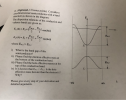 (Optional, 12 bonus points) Consider a imensional semiconductor with a band structure as shown in the diagram. The dispersion relations of the conduction and valence bands are given as: Ew.c where Ew.c>Ew, i) What is the band gap of this ii) Please find the electron effective mass at iii) Please find the hole effective masses at the iv) It is known that Ew,v
 (2) In a semiconductor with an energy gap Eg between the valence and the conduction bands we can take Ef (the Fermi energy) to be halfway between the bands (see figure below): Conduction band Energy gap Eg Valence band Semiconductor a. Show that for a typical semiconductor or insulator at room temperature the Fermi- Dirac factor is approximately equal to exp(-E 2kBT). (Typical Eg for semi-conductors ranges from about 0.5eV to 6eV at T-293K.) b. In heavily doped n-type silicon,...
 A wire is made of an intrinsic semiconductor whose bandgap is 1.0eV. The wire is 0.05microns in diameter and 1 micron long. Electrons have a mobility of 1000/cm V-sec and holes have a mobility of 200/cm V-sec. The effective mass of an electron in the conduction band is 1.2 and that of a hole in the valence band is 0.6. The semiconductor operates at room temperature. a. What is the probability of finding an electron at an energy 0.5eV above...
 Silicon at at T-300 K contains acceptor atoms at a concentration of Na-5x10A15 cmA-3. Donor atoms are added forming an n type compensated(counter doped) semiconductor such that the fermi level is 0.215 eV below the conduction band edge 4. a. What concentration of donor atoms were added. b. What were the concentration of holes and electrons before the silicon was counterdoped c. What are the electron and hole concentrations after the silicon was counter doped.
Silicon at at T-300 K...
Silicon at at T-300 K contains acceptor atoms at a concentration of Na-5x10A15 cmA-3. Donor atoms are added forming an n type compensated(counter doped) semiconductor such that the fermi level is 0.215 eV below the conduction band edge 4. a. What concentration of donor atoms were added. b. What were the concentration of holes and electrons before the silicon was counterdoped c. What are the electron and hole concentrations after the silicon was counter doped.
Silicon at at T-300 K...
 Silicon at at T-300 K contains acceptor atoms at a concentration of Na-5x10A15 cmA-3. Donor atoms are added forming an n type compensated(counter doped) semiconductor such that the fermi level is 0.215 eV below the conduction band edge 4. a. What concentration of donor atoms were added. b. What were the concentration of holes and electrons before the silicon was counterdoped c. What are the electron and hole concentrations after the silicon was counter doped.
Silicon at at T-300 K...
Silicon at at T-300 K contains acceptor atoms at a concentration of Na-5x10A15 cmA-3. Donor atoms are added forming an n type compensated(counter doped) semiconductor such that the fermi level is 0.215 eV below the conduction band edge 4. a. What concentration of donor atoms were added. b. What were the concentration of holes and electrons before the silicon was counterdoped c. What are the electron and hole concentrations after the silicon was counter doped.
Silicon at at T-300 K...
 Please explain part b in details thx!
Question 2 At 300 K, the bandgap of GaP is 2.26 eV and the effective density of states at the conduction and valence band edge are 1.8 x 1019 cm23 and 1.9 x 1019 cm3, respectively. (a) Calculate the intrinsic concentration of GaP at 300K (7 marks) Calculate the GaP effective mass of holes at 300K. (b) (8 marks) (c The GaP sample is now doped with donor concentration of 1021 cm3 with...
Please explain part b in details thx!
Question 2 At 300 K, the bandgap of GaP is 2.26 eV and the effective density of states at the conduction and valence band edge are 1.8 x 1019 cm23 and 1.9 x 1019 cm3, respectively. (a) Calculate the intrinsic concentration of GaP at 300K (7 marks) Calculate the GaP effective mass of holes at 300K. (b) (8 marks) (c The GaP sample is now doped with donor concentration of 1021 cm3 with...
 GaAs laser (a) The degenerate occupation of the conduction and valence bands with electrons and holes helps to maintain the laser requirement that emission must overcome absorption. Explain how the degeneracy prevents band-to-band absorption at the emission wavelength of 867 nm (b) Assuming equal electron and hole concentrations, and same effective masses for electrons and holes, calculate the minimum carrier concentration n -p for population inversion in GaAs at 300 K. The intrinsic carrier concentration at 300 K in GaAs...
 (Optional, 12 bonus points) Consider a imensional semiconductor with a band structure as shown in the diagram. The dispersion relations of the conduction and valence bands are given as: Ew.c where Ew.c>Ew, i) What is the band gap of this ii) Please find the electron effective mass at iii) Please find the hole effective masses at the iv) It is known that Ew,v
Most questions answered within 3 hours.
-
Where is the error in this code sequence?
String s1 = "Hello";
String s2 = "ello";...
asked 10 months ago -
Financial data for Joel de Paris, Inc., for last year
follow:
Joel de Paris, Inc.
Balance...
asked 10 months ago -
Consider this reaction:
Al2(SO4)3 (aq)+ BaCl3
(aq) Al2Cl6 (aq)- +
3BaSO4(s) . What is the...
asked 10 months ago -
Suppose that Savneet is considering increasing her
recent random sample from 20 car rentals to 40...
asked 10 months ago -
Trucks arrive at an unloading terminal at an average rate of 120
per hour.
Trucks arrive...
asked 10 months ago -
Why are methanol and ethanol completely soluble in water while
octanol is not very little soluble....
asked 10 months ago -
A facilities manager at a university reads in a research report
that the mean amount of...
asked 10 months ago -
When the CuSO4 is rehydrated by adding water to the anhydrous
compound, is this an endothermic...
asked 10 months ago -
A ray of sunlight is passing from diamond into crown glass; the
angle of incidence is...
asked 10 months ago -
A block of mass 0.249 kg is placed on top of a light, vertical
spring of...
asked 10 months ago -
how do the kidneys compensate in the presences of acidosis
a) trigger hyperventilate
b) reserve acid...
asked 10 months ago -
Question 501 pts
The rental rate of capital to the firm increases. Which of the
following...
asked 10 months ago