Collisions of the molecules in a sample of gas with the walls of the container are...
Collisions of the molecules in a sample of gas with the walls of the container are responsible for the gas’s observed .
Homework Answers
A gas gas consist of the large number of minute particles, called the molecules.
These molecules are in a state of the constant rapid motion in all possible directions colliding in a random manner with one another and with the walls of the container.
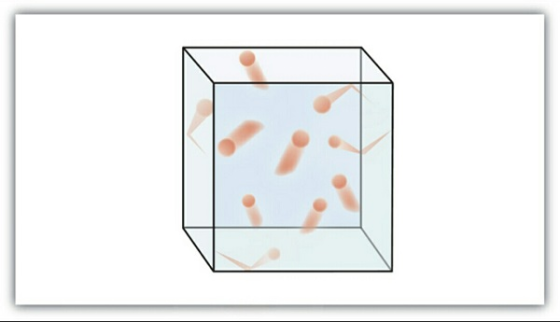
The molecular collisions are perfectly elastic so that there is no net loss of the energy when the gas molecule collide with with one another or against the walls of the container. The kinetic energy may be transferred from one molecule to another molecule but it i not converted into any other form of the energy such as heat.
There are no attractive forces between the molecules or between the walls of the container and gas molecules. The molecules move completely independent of one another.
The pressure of the gas is due to bombardment of the molecules on the walls of the container.
The kinetic energy (EK) for an individual atom can be calculated by the following equation:
EK = 1\2 m v2
where, m is the mass and v is the velocity of the molecule.
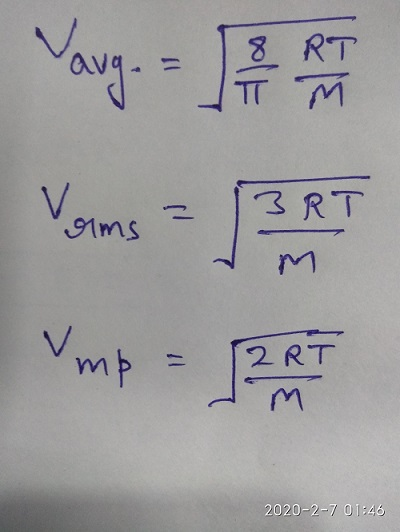
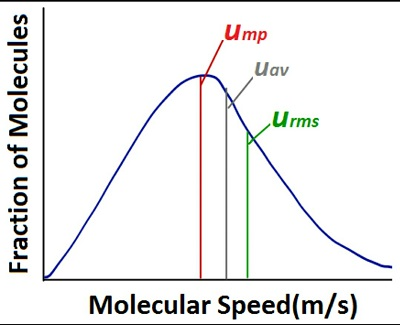
The molecules possesses the average speed( Vavg), root mean speed (Vrms) and most probable (Vmp) velocity.
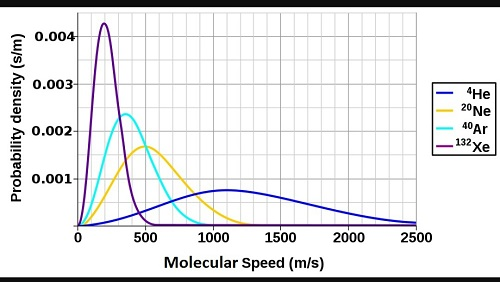
Molecular speed distribution of noble gases is shown below as :
The collision takes place among the gaseous molecules and between the container wall and gaseous molecule is responsible for a reaction to happen.
Add Answer to:
Collisions of the molecules in a sample of gas with the walls of
the container are...
A 1.16 mol sample of Xe gas is confined in a 27.6 liter container at 17.1...
 A 1.16 mol sample of Xe gas is confined in a 27.6 liter container at 17.1 °C If the amount of gas is increased to 1.74 mol, holding the volume and temperature constant, the pressure will increase because: Choose all that apply. 一with more molecules per unit volume, the molecules hit the walls of the container more often. O With higher average speeds, on average the molecules hit the walls of the container with more force. With more molecules in...
A 1.72 mol sample of Kr gas is confined in a 40.4 liter container at 13.2 °C. If the amount of g...
A 1.72 mol sample of Kr gas is confined in a 40.4 liter container at 13.2 °C. If the amount of gas is decreased to 0.860 mol, holding the volume and temperature constant, the pressure will decrease because: Choose all that apply. As the number of molecule-wall collisions increases, the force per collision decreases. With fewer molecules per unit volume, the molecules hit the walls of the container less often. With lower average speeds, on average the molecules hit the...
Part A) A 1.37 mol sample of Xe gas is confined in a 32.7 liter container at 18.1 °C. If the temperature of the gas sam...
Part A) A 1.37 mol sample of Xe gas is confined in a 32.7 liter container at 18.1 °C. If the temperature of the gas sample is raised to 41.5 °C holding the volume constant, the average kinetic energy will remain the same decrease not enough information to answer the question increase Part B) A 1.24 mol sample of O2 gas is confined in a 29.2 liter container at 13.5 °C. If the temperature of the gas sample is lowered...
Consider a 1.0-L container of neon gas at STP. Will the average kinetic energy, average velocity,...
Consider a 1.0-L container of neon gas at STP. Will the average kinetic energy, average velocity, and frequency of collisions of gas molecules with the walls of the container increase, decrease, or remain the same under the following condition: The temperature is decreased to -50°C.
Imagine that you have an ideal gas in a 6.90 L container, and that 1350 molecules...
Imagine that you have an ideal gas in a 6.90 L container, and that 1350 molecules of this gas collide with a square-inch area of the container at any given instant. If the volume is increased to 55.2 L at constant temperature, how many collisions will occur per square inch of this larger container? Enter the number of collisions per square inch.
Gas Behavior and Intermolecular Forces 1. The pressure exerted by a gas in a container is...
 Gas Behavior and Intermolecular Forces 1. The pressure exerted by a gas in a container is due to the collisions of the gas particles with the walls of a container. The illustration depicts a gas in a container with a movable piston. Consider each of the following changes and determine how the gas pressure will be affected. Your answer should indicate whether the pressure is increased, decreased or not changed. You should also provide an explanation. A The piston is...
Imagine that you have an ideal gas in a 4.70 L container, and that 2750 molecules...
Imagine that you have an ideal gas in a 4.70 L container, and that 2750 molecules of this gas collide with a square-inch area of the container at any given instant. If the volume is increased to 18.8 L at constant temperature, how many collisions will occur per square inch of this larger container?
A 7.00 L container with solid walls contains 3.50 moles of an ideal gas at a...
 A 7.00 L container with solid walls contains 3.50 moles of an ideal gas at a pressure of 1.60 x 10⁶ Pa. (a) What is the average kinetic energy of the gas molecules in the container. (b) If the gas is nitrogen (N2), what is the rms speed of each gas molecule? (c) How much heat must be added to raise the temperature of the gas by 100 K? NB. The atomic mass of nitrogen is 14.0067 g/mol. True False
Suppose there is a sample of xenon in a rectangular container. The gas exerts a total...
 Suppose there is a sample of xenon in a rectangular container. The gas exerts a total force of 6.53 N perpendicular to one of the container walls, whose dimensions are 0.125 m by 0.211 m. Calculate the pressure of the sample Pa pressure
which of the following statements is least likely to be true of a sample of nitrogen gas? a.The pressure exerted by...
which of the following statements is least likely to be true of a sample of nitrogen gas? a.The pressure exerted by gaseous nitrogen is due to the collisions of the molecules with the wall of the container. b. collisions between the gaseous molecules are elastic c. The volume of the sample would be zero at -273C d. The average kinetic energy of the gaseous nitrogen is proportional to the absolute temperature of the gas. e. Molecules of gaseous nitrogen are...
 A 1.16 mol sample of Xe gas is confined in a 27.6 liter container at 17.1 °C If the amount of gas is increased to 1.74 mol, holding the volume and temperature constant, the pressure will increase because: Choose all that apply. 一with more molecules per unit volume, the molecules hit the walls of the container more often. O With higher average speeds, on average the molecules hit the walls of the container with more force. With more molecules in...
 Gas Behavior and Intermolecular Forces 1. The pressure exerted by a gas in a container is due to the collisions of the gas particles with the walls of a container. The illustration depicts a gas in a container with a movable piston. Consider each of the following changes and determine how the gas pressure will be affected. Your answer should indicate whether the pressure is increased, decreased or not changed. You should also provide an explanation. A The piston is...
 A 7.00 L container with solid walls contains 3.50 moles of an ideal gas at a pressure of 1.60 x 10⁶ Pa. (a) What is the average kinetic energy of the gas molecules in the container. (b) If the gas is nitrogen (N2), what is the rms speed of each gas molecule? (c) How much heat must be added to raise the temperature of the gas by 100 K? NB. The atomic mass of nitrogen is 14.0067 g/mol. True False
 Suppose there is a sample of xenon in a rectangular container. The gas exerts a total force of 6.53 N perpendicular to one of the container walls, whose dimensions are 0.125 m by 0.211 m. Calculate the pressure of the sample Pa pressure
Most questions answered within 3 hours.
-
Where is the error in this code sequence?
String s1 = "Hello";
String s2 = "ello";...
asked 11 months ago -
Financial data for Joel de Paris, Inc., for last year
follow:
Joel de Paris, Inc.
Balance...
asked 11 months ago -
Consider this reaction:
Al2(SO4)3 (aq)+ BaCl3
(aq) Al2Cl6 (aq)- +
3BaSO4(s) . What is the...
asked 11 months ago -
Suppose that Savneet is considering increasing her
recent random sample from 20 car rentals to 40...
asked 11 months ago -
Trucks arrive at an unloading terminal at an average rate of 120
per hour.
Trucks arrive...
asked 11 months ago -
Why are methanol and ethanol completely soluble in water while
octanol is not very little soluble....
asked 11 months ago -
A facilities manager at a university reads in a research report
that the mean amount of...
asked 11 months ago -
When the CuSO4 is rehydrated by adding water to the anhydrous
compound, is this an endothermic...
asked 11 months ago -
A ray of sunlight is passing from diamond into crown glass; the
angle of incidence is...
asked 11 months ago -
A block of mass 0.249 kg is placed on top of a light, vertical
spring of...
asked 11 months ago -
how do the kidneys compensate in the presences of acidosis
a) trigger hyperventilate
b) reserve acid...
asked 11 months ago -
Question 501 pts
The rental rate of capital to the firm increases. Which of the
following...
asked 11 months ago