Consider two conducting spheres with one having a larger radius than the other. Both spheres carry...
Consider two conducting spheres with one having a larger radius than the other. Both spheres carry the same amount of excess charge. Which one of the following statements concerning the potential energy of the two spheres is true?
a) The potential energy of the larger sphere is greater than that of the smaller sphere. b) The potential energy of the larger sphere is the same as that of the smaller sphere. c) The potential energy of the larger sphere is less than that of the smaller sphere
Homework Answers
The electric potential energy of a sphere is given by
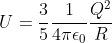
Where
U = Electric potential energy
Q = Charge on the sphere
R = Radius of the sphere
 =
Permittivity of free space = 8.85 x 10⁻¹² F/m
=
Permittivity of free space = 8.85 x 10⁻¹² F/m
Now, in the given question Q is equal for both the spheres
From the equation
U inversely proportional to R
As the larger sphere has greater radius so it will have lesser potential energy than the smaller sphere
So option C is correct
Add Answer to:
Consider two conducting spheres with one having a larger radius
than the other. Both spheres carry...
Two conducting spheres with radius r1 and r2 and charges q1 and q2, respectively, are connected...
 Two conducting spheres with radius r1 and r2 and charges q1 and q2, respectively, are connected with a conducting wire. The one with more charge will have a higher potential. Select one: True O False Check Two conducting spheres with radius r1 and r2 and charges q1 and q2, respectively. If they are connected with a conducting wire and at equilibrium, they have the same E field value on their surfaces, hence, q/r,2 2/2 Select one: False Check Two conducting...
Two conducting spheres, one of radius 0.030 m. and the other of radius 0.140 m., each...
Two conducting spheres, one of radius 0.030 m. and the other of radius 0.140 m., each have a charge 7.00E-08 C. and are very far apart. If the spheres are connected by a conducting wire, find the final potential (in volts) in each sphere.
4. Two conducting spheres are far apart. The smaller sphere has radius R and carries a...
 4. Two conducting spheres are far apart. The smaller sphere has radius R and carries a total charge of Q. The larger sphere has a radius 2R and is neutral. After the two spheres are connected by a conducting wire, find the potential of each sphere (5points) the new charges on each sphere. (10 points) (iii) the electric field on each sphere due to its new charge (10 points)
4. Two conducting spheres are far apart. The smaller sphere has radius R and carries a...
 4. Two conducting spheres are far apart. The smaller sphere has radius R and carries a total charge of Q. The larger sphere has a radius 2R and is neutral. After the two spheres are connected by a conducting wire, find (1) the potential of each sphere (5points) the new charges on each sphere. (10 points) the electric field on each sphere due to its new charge (10 points)
4. Two conducting spheres are far apart. The smaller sphere has radius R and carries a...
 4. Two conducting spheres are far apart. The smaller sphere has radius R and carries a total charge of Q. The larger sphere has a radius 2R and is neutral. After the two spheres are connected by a conducting wire, find (1) the potential of each sphere (Spoints) the new charges on each sphere. (10 points) (iii) the electric field on each sphere due to its new charge (10 points)
4. Two conducting spheres are far apart. The smaller sphere has radius R and carries a...
 4. Two conducting spheres are far apart. The smaller sphere has radius R and carries a total charge of Q. The larger sphere has a radius 2R and is neutral. After the two spheres are connected by a conducting wire, find (1) the potential of each sphere (Spoints) the new charges on each sphere. (10 points) (iii) the electric field on each sphere due to its new charge (10 points)
And most importantly, why? Two spherical conductors are far apart. Both have the same positive uniform...
 And most importantly, why?
Two spherical conductors are far apart. Both have the same positive uniform charge density on their surfaces. One sphere has a larger radius than the other. The larger sphere has (a) less total charge than the smaller sphere. (b) less electric potential than the smaller sphere. (c) less total potential energy than the smaller sphere. (d) None of the above.
And most importantly, why?
Two spherical conductors are far apart. Both have the same positive uniform charge density on their surfaces. One sphere has a larger radius than the other. The larger sphere has (a) less total charge than the smaller sphere. (b) less electric potential than the smaller sphere. (c) less total potential energy than the smaller sphere. (d) None of the above.
Two conductive spheres are identical in every way except that one is twice as big as...
 Two conductive spheres are identical in every way except that one is twice as big as the other. Both are equally negatively charged. The two spheres are brought together and allowed to touch. Which of the following statements is true? There will be no movement of charge at all The electrons will spread out as much as possible meaning that the larger sphere will have more electrons than the smaller. The negative charge will spread out equally between the spheres...
Consider two, conducting spheres, separated by a large distance. Sphere A has a radius of 0.85...
Consider two, conducting spheres, separated by a large distance. Sphere A has a radius of 0.85 m and sphere B has a radius of 1.25 m. Sphere A is charged to a potential of -25 V and sphere B is charged to a potential of +18 V. The spheres are then connected by a thin, conducting wire. Part A) What is the initial charge of Sphere A, in Coulombs? Part B) What is the initial charge of Sphere B, in...
Consider two widely separated conducting spheres, 1 and 2, the second having five times the diameter...
Consider two widely separated conducting spheres, 1 and 2, the second having five times the diameter of the first. The smaller sphere initially has a positive charge q = 8.00×10⁻⁶ C, and the larger one is initially uncharged. You now connect the spheres with a long thin wire. How are the final potentials V1 and V2 of the spheres related? Find the final charges q1 and q2. Please show work! Thanks
 Two conducting spheres with radius r1 and r2 and charges q1 and q2, respectively, are connected with a conducting wire. The one with more charge will have a higher potential. Select one: True O False Check Two conducting spheres with radius r1 and r2 and charges q1 and q2, respectively. If they are connected with a conducting wire and at equilibrium, they have the same E field value on their surfaces, hence, q/r,2 2/2 Select one: False Check Two conducting...
 4. Two conducting spheres are far apart. The smaller sphere has radius R and carries a total charge of Q. The larger sphere has a radius 2R and is neutral. After the two spheres are connected by a conducting wire, find the potential of each sphere (5points) the new charges on each sphere. (10 points) (iii) the electric field on each sphere due to its new charge (10 points)
 4. Two conducting spheres are far apart. The smaller sphere has radius R and carries a total charge of Q. The larger sphere has a radius 2R and is neutral. After the two spheres are connected by a conducting wire, find (1) the potential of each sphere (5points) the new charges on each sphere. (10 points) the electric field on each sphere due to its new charge (10 points)
 4. Two conducting spheres are far apart. The smaller sphere has radius R and carries a total charge of Q. The larger sphere has a radius 2R and is neutral. After the two spheres are connected by a conducting wire, find (1) the potential of each sphere (Spoints) the new charges on each sphere. (10 points) (iii) the electric field on each sphere due to its new charge (10 points)
 4. Two conducting spheres are far apart. The smaller sphere has radius R and carries a total charge of Q. The larger sphere has a radius 2R and is neutral. After the two spheres are connected by a conducting wire, find (1) the potential of each sphere (Spoints) the new charges on each sphere. (10 points) (iii) the electric field on each sphere due to its new charge (10 points)
 And most importantly, why?
Two spherical conductors are far apart. Both have the same positive uniform charge density on their surfaces. One sphere has a larger radius than the other. The larger sphere has (a) less total charge than the smaller sphere. (b) less electric potential than the smaller sphere. (c) less total potential energy than the smaller sphere. (d) None of the above.
And most importantly, why?
Two spherical conductors are far apart. Both have the same positive uniform charge density on their surfaces. One sphere has a larger radius than the other. The larger sphere has (a) less total charge than the smaller sphere. (b) less electric potential than the smaller sphere. (c) less total potential energy than the smaller sphere. (d) None of the above.
 Two conductive spheres are identical in every way except that one is twice as big as the other. Both are equally negatively charged. The two spheres are brought together and allowed to touch. Which of the following statements is true? There will be no movement of charge at all The electrons will spread out as much as possible meaning that the larger sphere will have more electrons than the smaller. The negative charge will spread out equally between the spheres...
Most questions answered within 3 hours.
-
Where is the error in this code sequence?
String s1 = "Hello";
String s2 = "ello";...
asked 10 months ago -
Financial data for Joel de Paris, Inc., for last year
follow:
Joel de Paris, Inc.
Balance...
asked 10 months ago -
Consider this reaction:
Al2(SO4)3 (aq)+ BaCl3
(aq) Al2Cl6 (aq)- +
3BaSO4(s) . What is the...
asked 10 months ago -
Suppose that Savneet is considering increasing her
recent random sample from 20 car rentals to 40...
asked 10 months ago -
Trucks arrive at an unloading terminal at an average rate of 120
per hour.
Trucks arrive...
asked 10 months ago -
Why are methanol and ethanol completely soluble in water while
octanol is not very little soluble....
asked 10 months ago -
A facilities manager at a university reads in a research report
that the mean amount of...
asked 10 months ago -
When the CuSO4 is rehydrated by adding water to the anhydrous
compound, is this an endothermic...
asked 10 months ago -
A ray of sunlight is passing from diamond into crown glass; the
angle of incidence is...
asked 10 months ago -
A block of mass 0.249 kg is placed on top of a light, vertical
spring of...
asked 10 months ago -
how do the kidneys compensate in the presences of acidosis
a) trigger hyperventilate
b) reserve acid...
asked 10 months ago -
Question 501 pts
The rental rate of capital to the firm increases. Which of the
following...
asked 10 months ago