A first-order all-pass filter impulse response is given by ℎ(??) = −??(??) + 2??−????(??) a) Find...
A first-order all-pass filter impulse response is given by ℎ(??) = −??(??) + 2??−????(??)
a) Find the response of this filter for the input ??????(−??),
b) Sketch the input and the corresponding output.
Homework Answers
Though the there was usage of double u and t's i was able to get the question. Thats why i have answered to this question.
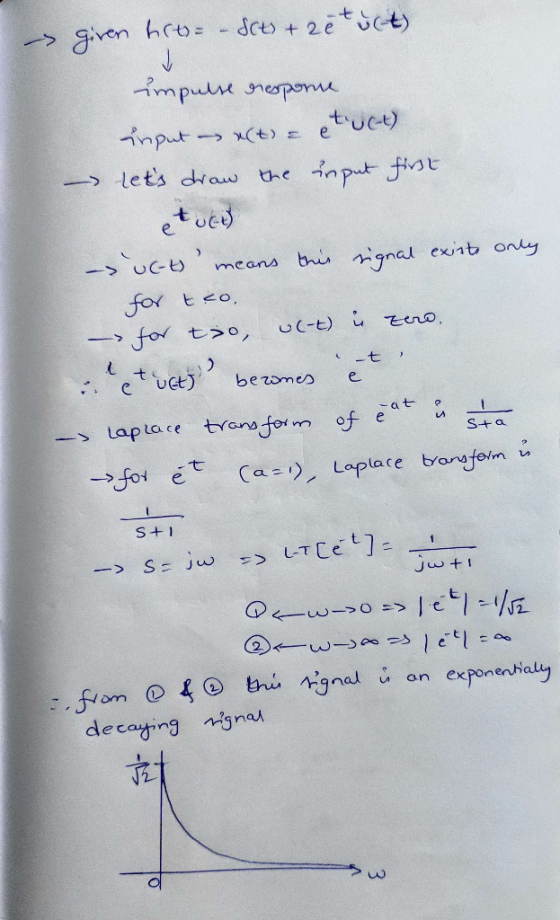
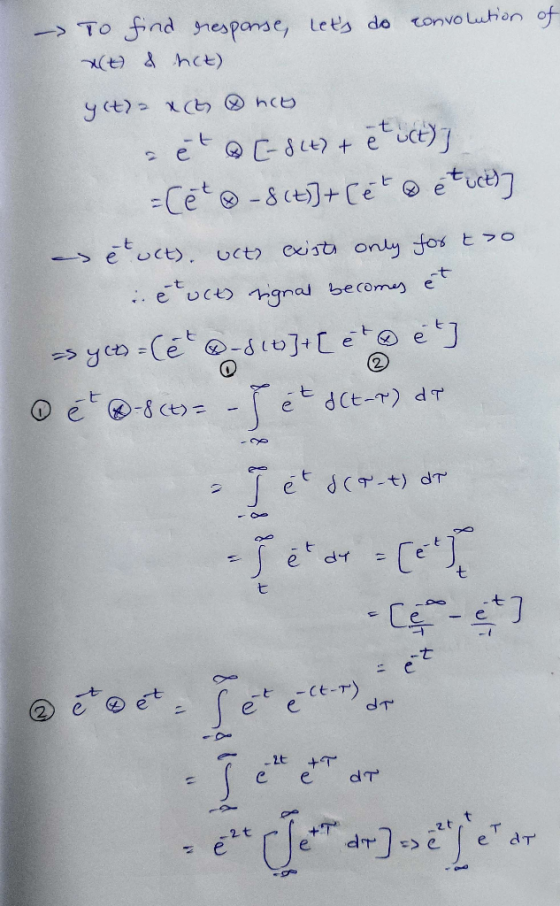
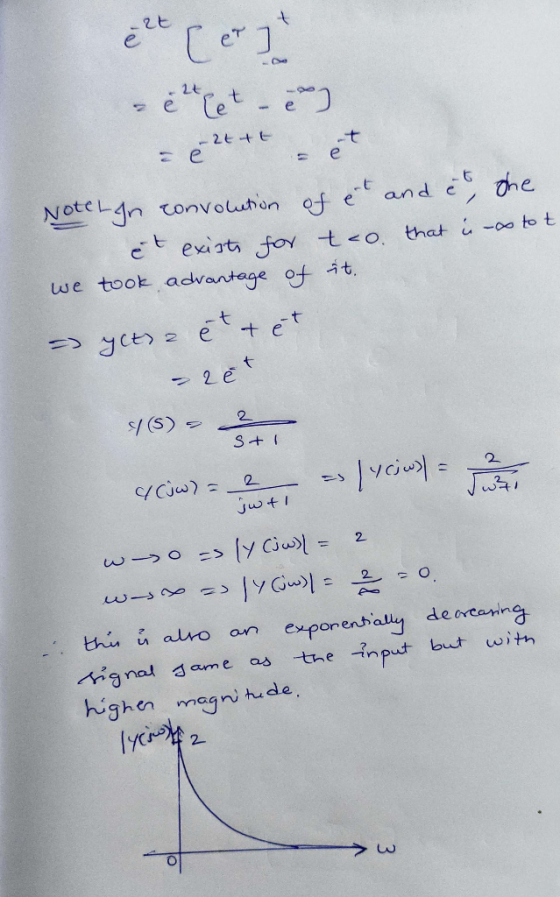
Hope this helps.
Do put a comment if you have any doubts regarding the answer.
Do give a like if you like the answer. It'll encourage me to write more quality answers.
Add Answer to:
A first-order all-pass filter impulse response is given by ℎ(??)
= −??(??) + 2??−????(??)
a) Find...
signals and systems show details and clear handwriting 4. A first-order filter impulse response is given...
 signals and systems show details and clear handwriting
4. A first-order filter impulse response is given by: h(t) = -48(t) +etult) • Find the zero-state response of this filter for the input e-2tu(t). • Sketch the input and the corresponding zero-state response. • Find the zero-state response of this filter for the input e-tu(t). • Sketch the input and the corresponding zero-state response.
signals and systems show details and clear handwriting
4. A first-order filter impulse response is given by: h(t) = -48(t) +etult) • Find the zero-state response of this filter for the input e-2tu(t). • Sketch the input and the corresponding zero-state response. • Find the zero-state response of this filter for the input e-tu(t). • Sketch the input and the corresponding zero-state response.
Using Convolution Integration not laplace transformation please A first-order allpass filter impulse response is given by:...
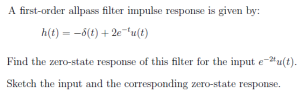 Using Convolution Integration not laplace
transformation please
A first-order allpass filter impulse response is given by: h(t)-(t) 2eu(t) ind the zero-state response O er for the input e u Sketch the input and the corresponding zero-state response.
Using Convolution Integration not laplace
transformation please
A first-order allpass filter impulse response is given by: h(t)-(t) 2eu(t) ind the zero-state response O er for the input e u Sketch the input and the corresponding zero-state response.
a) The transfer function of an ideal low-pass filter is and its impulse response is where...
 a) The transfer function of an ideal low-pass filter is and its impulse response is where oc is the cut-off frequency i) Is hLP[n] a finite impulse response (FIR) filter or an infinite impulse response filter (IIR)? Explain your answer ii Is hLP[n] a causal or a non-causal filter? Explain your answer iii) If ae-0. IT, plot the magnitude responses for the following impulse responses b) i) Let the five impulse response samples of a causal FIR filter be given...
(a) Find the impulse response ℎ(
 (a) Find the impulse response ℎ(
Question 5 (a) The impulse response of a discrete-time filter is given as, hin) 0.56n-1] +n-2)0.5...
 Question 5 (a) The impulse response of a discrete-time filter is given as, hin) 0.56n-1] +n-2)0.56 n -3]. i. Derive the filter's frequency response; 11. Roughly sketch the filter's magnitude response for 0 ii. Is it a low-pass or high-pass filter? Ω 2m; (b) A continuous-time signal se(t) is converted into a discrete-time signal as shown below. s(t) is a unit impulse train. s(t) x,) Conversion into x(1) __→ⓧ一ㄅㄧ-discrete-time sequence ー→ xu [n] The frequency spectrum of ap (t) is...
The impulse response of an ideal band pass filter is given by the equation: n 0 h(n)=-sin(nw.) wl...
 The impulse response of an ideal band pass filter is given by the equation: n 0 h(n)=-sin(nw.) wl sin(nw!) nヂ0 Using the above equation, write a Matlab program that implements an approximation for the band pass filter with cut-off frequencies ω1-0.2π rad/sample and c02-0.3t rad/sample. Set the order of the filter to 100 or 101. Use a Bartlett window here. Plot the frequency and phase responses of this digital filter.
The impulse response of an ideal band pass filter is...
The impulse response of an ideal band pass filter is given by the equation: n 0 h(n)=-sin(nw.) wl sin(nw!) nヂ0 Using the above equation, write a Matlab program that implements an approximation for the band pass filter with cut-off frequencies ω1-0.2π rad/sample and c02-0.3t rad/sample. Set the order of the filter to 100 or 101. Use a Bartlett window here. Plot the frequency and phase responses of this digital filter.
The impulse response of an ideal band pass filter is...
The transfer function of an ideal low-pass filter is given by: 4. a) i Prove that its impulse response is given by: a s...
 The transfer function of an ideal low-pass filter is given by: 4. a) i Prove that its impulse response is given by: a sin(na) π (na) where (Q is the cut-off frequency [-consoo] ii Is hIn] a FIR or an IIR filter? Is it causal or anti-causal filter? Explain 3 your answer. iii) If g. 0.1 π, plot the magnitude responses for the following impulse responses:
The transfer function of an ideal low-pass filter is given by: 4. a) i...
The transfer function of an ideal low-pass filter is given by: 4. a) i Prove that its impulse response is given by: a sin(na) π (na) where (Q is the cut-off frequency [-consoo] ii Is hIn] a FIR or an IIR filter? Is it causal or anti-causal filter? Explain 3 your answer. iii) If g. 0.1 π, plot the magnitude responses for the following impulse responses:
The transfer function of an ideal low-pass filter is given by: 4. a) i...
Question 2: (25 Marks) The Impulse response h(n) of a filter is non zero over the...
 Question 2: (25 Marks) The Impulse response h(n) of a filter is non zero over the index range of n be [5,8]. The input signal x(n) to this filter is non zero over the index range of n be [7,12]. Consider the direct and LTI forms of convolution y(n)-Σh(m) x(-m)- Σχm)h (n -m) m a. Determine the overall index range n for the output y(n). For each n, determine the corresponding summation range over m, for both the direct and...
Consider the convolutional encoder shown in Figure 2. (a) Find the impulse response of the encode...
 Consider the convolutional
encoder shown in Figure 2.
(a) Find the impulse response of the encoder
(b) Find the output codeword if the input sequence is all 1’s (1
1 1 1 1 1 . . .)
(c) Discuss the result of (b) (d) Find the polynomial
representation of the encoder
(e) Sketch the state diagram of the encoder
Consider the convolutional encoder shown in Figure 2 (a) Find the impulse response of the encoder (b) Find the output codeword...
Consider the convolutional
encoder shown in Figure 2.
(a) Find the impulse response of the encoder
(b) Find the output codeword if the input sequence is all 1’s (1
1 1 1 1 1 . . .)
(c) Discuss the result of (b) (d) Find the polynomial
representation of the encoder
(e) Sketch the state diagram of the encoder
Consider the convolutional encoder shown in Figure 2 (a) Find the impulse response of the encoder (b) Find the output codeword...
Consider the convolutional encoder shown in Figure 2 (a) Find the impulse response of the encoder...
 Consider the convolutional encoder shown in Figure 2 (a) Find the impulse response of the encoder (b) Find the output codeword if the input sequence is all 1's (111111...) (c) Discuss the result of (b) (d) Find the polynomial representation of the encoder (e) Sketch the state diagram of the encoder 2. Output input Figure 2
Consider the convolutional encoder shown in Figure 2 (a) Find the impulse response of the encoder (b) Find the output codeword if the input...
Consider the convolutional encoder shown in Figure 2 (a) Find the impulse response of the encoder (b) Find the output codeword if the input sequence is all 1's (111111...) (c) Discuss the result of (b) (d) Find the polynomial representation of the encoder (e) Sketch the state diagram of the encoder 2. Output input Figure 2
Consider the convolutional encoder shown in Figure 2 (a) Find the impulse response of the encoder (b) Find the output codeword if the input...
 signals and systems show details and clear handwriting
4. A first-order filter impulse response is given by: h(t) = -48(t) +etult) • Find the zero-state response of this filter for the input e-2tu(t). • Sketch the input and the corresponding zero-state response. • Find the zero-state response of this filter for the input e-tu(t). • Sketch the input and the corresponding zero-state response.
signals and systems show details and clear handwriting
4. A first-order filter impulse response is given by: h(t) = -48(t) +etult) • Find the zero-state response of this filter for the input e-2tu(t). • Sketch the input and the corresponding zero-state response. • Find the zero-state response of this filter for the input e-tu(t). • Sketch the input and the corresponding zero-state response.
 Using Convolution Integration not laplace
transformation please
A first-order allpass filter impulse response is given by: h(t)-(t) 2eu(t) ind the zero-state response O er for the input e u Sketch the input and the corresponding zero-state response.
Using Convolution Integration not laplace
transformation please
A first-order allpass filter impulse response is given by: h(t)-(t) 2eu(t) ind the zero-state response O er for the input e u Sketch the input and the corresponding zero-state response.
 a) The transfer function of an ideal low-pass filter is and its impulse response is where oc is the cut-off frequency i) Is hLP[n] a finite impulse response (FIR) filter or an infinite impulse response filter (IIR)? Explain your answer ii Is hLP[n] a causal or a non-causal filter? Explain your answer iii) If ae-0. IT, plot the magnitude responses for the following impulse responses b) i) Let the five impulse response samples of a causal FIR filter be given...
 (a) Find the impulse response ℎ(
 Question 5 (a) The impulse response of a discrete-time filter is given as, hin) 0.56n-1] +n-2)0.56 n -3]. i. Derive the filter's frequency response; 11. Roughly sketch the filter's magnitude response for 0 ii. Is it a low-pass or high-pass filter? Ω 2m; (b) A continuous-time signal se(t) is converted into a discrete-time signal as shown below. s(t) is a unit impulse train. s(t) x,) Conversion into x(1) __→ⓧ一ㄅㄧ-discrete-time sequence ー→ xu [n] The frequency spectrum of ap (t) is...
 The impulse response of an ideal band pass filter is given by the equation: n 0 h(n)=-sin(nw.) wl sin(nw!) nヂ0 Using the above equation, write a Matlab program that implements an approximation for the band pass filter with cut-off frequencies ω1-0.2π rad/sample and c02-0.3t rad/sample. Set the order of the filter to 100 or 101. Use a Bartlett window here. Plot the frequency and phase responses of this digital filter.
The impulse response of an ideal band pass filter is...
The impulse response of an ideal band pass filter is given by the equation: n 0 h(n)=-sin(nw.) wl sin(nw!) nヂ0 Using the above equation, write a Matlab program that implements an approximation for the band pass filter with cut-off frequencies ω1-0.2π rad/sample and c02-0.3t rad/sample. Set the order of the filter to 100 or 101. Use a Bartlett window here. Plot the frequency and phase responses of this digital filter.
The impulse response of an ideal band pass filter is...
 The transfer function of an ideal low-pass filter is given by: 4. a) i Prove that its impulse response is given by: a sin(na) π (na) where (Q is the cut-off frequency [-consoo] ii Is hIn] a FIR or an IIR filter? Is it causal or anti-causal filter? Explain 3 your answer. iii) If g. 0.1 π, plot the magnitude responses for the following impulse responses:
The transfer function of an ideal low-pass filter is given by: 4. a) i...
The transfer function of an ideal low-pass filter is given by: 4. a) i Prove that its impulse response is given by: a sin(na) π (na) where (Q is the cut-off frequency [-consoo] ii Is hIn] a FIR or an IIR filter? Is it causal or anti-causal filter? Explain 3 your answer. iii) If g. 0.1 π, plot the magnitude responses for the following impulse responses:
The transfer function of an ideal low-pass filter is given by: 4. a) i...
 Question 2: (25 Marks) The Impulse response h(n) of a filter is non zero over the index range of n be [5,8]. The input signal x(n) to this filter is non zero over the index range of n be [7,12]. Consider the direct and LTI forms of convolution y(n)-Σh(m) x(-m)- Σχm)h (n -m) m a. Determine the overall index range n for the output y(n). For each n, determine the corresponding summation range over m, for both the direct and...
 Consider the convolutional
encoder shown in Figure 2.
(a) Find the impulse response of the encoder
(b) Find the output codeword if the input sequence is all 1’s (1
1 1 1 1 1 . . .)
(c) Discuss the result of (b) (d) Find the polynomial
representation of the encoder
(e) Sketch the state diagram of the encoder
Consider the convolutional encoder shown in Figure 2 (a) Find the impulse response of the encoder (b) Find the output codeword...
Consider the convolutional
encoder shown in Figure 2.
(a) Find the impulse response of the encoder
(b) Find the output codeword if the input sequence is all 1’s (1
1 1 1 1 1 . . .)
(c) Discuss the result of (b) (d) Find the polynomial
representation of the encoder
(e) Sketch the state diagram of the encoder
Consider the convolutional encoder shown in Figure 2 (a) Find the impulse response of the encoder (b) Find the output codeword...
 Consider the convolutional encoder shown in Figure 2 (a) Find the impulse response of the encoder (b) Find the output codeword if the input sequence is all 1's (111111...) (c) Discuss the result of (b) (d) Find the polynomial representation of the encoder (e) Sketch the state diagram of the encoder 2. Output input Figure 2
Consider the convolutional encoder shown in Figure 2 (a) Find the impulse response of the encoder (b) Find the output codeword if the input...
Consider the convolutional encoder shown in Figure 2 (a) Find the impulse response of the encoder (b) Find the output codeword if the input sequence is all 1's (111111...) (c) Discuss the result of (b) (d) Find the polynomial representation of the encoder (e) Sketch the state diagram of the encoder 2. Output input Figure 2
Consider the convolutional encoder shown in Figure 2 (a) Find the impulse response of the encoder (b) Find the output codeword if the input...
Most questions answered within 3 hours.
-
Where is the error in this code sequence?
String s1 = "Hello";
String s2 = "ello";...
asked 11 months ago -
Financial data for Joel de Paris, Inc., for last year
follow:
Joel de Paris, Inc.
Balance...
asked 11 months ago -
Consider this reaction:
Al2(SO4)3 (aq)+ BaCl3
(aq) Al2Cl6 (aq)- +
3BaSO4(s) . What is the...
asked 11 months ago -
Suppose that Savneet is considering increasing her
recent random sample from 20 car rentals to 40...
asked 11 months ago -
Trucks arrive at an unloading terminal at an average rate of 120
per hour.
Trucks arrive...
asked 11 months ago -
Why are methanol and ethanol completely soluble in water while
octanol is not very little soluble....
asked 11 months ago -
A facilities manager at a university reads in a research report
that the mean amount of...
asked 11 months ago -
When the CuSO4 is rehydrated by adding water to the anhydrous
compound, is this an endothermic...
asked 11 months ago -
A ray of sunlight is passing from diamond into crown glass; the
angle of incidence is...
asked 11 months ago -
A block of mass 0.249 kg is placed on top of a light, vertical
spring of...
asked 11 months ago -
how do the kidneys compensate in the presences of acidosis
a) trigger hyperventilate
b) reserve acid...
asked 11 months ago -
Question 501 pts
The rental rate of capital to the firm increases. Which of the
following...
asked 11 months ago