Using Convolution Integration not laplace transformation please
Homework Answers

Add Answer to:
Using Convolution Integration not laplace
transformation please
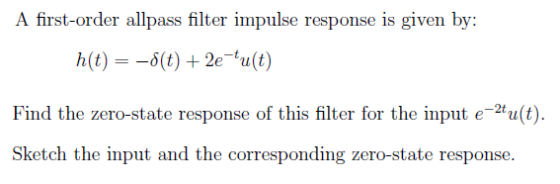
A first-order allpass filter impulse response is given by:...
signals and systems show details and clear handwriting 4. A first-order filter impulse response is given...
 signals and systems show details and clear handwriting
4. A first-order filter impulse response is given by: h(t) = -48(t) +etult) • Find the zero-state response of this filter for the input e-2tu(t). • Sketch the input and the corresponding zero-state response. • Find the zero-state response of this filter for the input e-tu(t). • Sketch the input and the corresponding zero-state response.
signals and systems show details and clear handwriting
4. A first-order filter impulse response is given by: h(t) = -48(t) +etult) • Find the zero-state response of this filter for the input e-2tu(t). • Sketch the input and the corresponding zero-state response. • Find the zero-state response of this filter for the input e-tu(t). • Sketch the input and the corresponding zero-state response.
A first-order all-pass filter impulse response is given by ℎ(??) = −??(??) + 2??−????(??) a) Find...
A first-order all-pass filter impulse response is given by ℎ(??) = −??(??) + 2??−????(??) a) Find the response of this filter for the input ??????(−??), b) Sketch the input and the corresponding output.
Consider a LTI system with unit impulse response, h(t) = e-3tu(t). Using direct integration technique for...
Consider a LTI system with unit impulse response, h(t) = e-3tu(t). Using direct integration technique for finding convolution, find its zero-state response due to an input, x(t) = u(t) (which is called unit step response of the system). Also, from your answer above, write down its response due to an input of the form, x(t) = 2δ(t) – 4u(t). [Hint: Use principle of superposition] !!Please show/explain step, WILL RATE!!
The impulse response of a filter is given by the function: Use convolution to calculate the...
 The impulse response of a filter is given by the function:
Use convolution to calculate the step-response/output of the filter.
- no x[n] was given in the task
h[n] = a[n]-20[n-1] + 0[n-2]
The impulse response of a filter is given by the function:
Use convolution to calculate the step-response/output of the filter.
- no x[n] was given in the task
h[n] = a[n]-20[n-1] + 0[n-2]
4. Convolution EX4. The input X(t) and impulse response h(t) for a system are given. Using...
 4. Convolution EX4. The input X(t) and impulse response h(t) for a system are given. Using convolution evaluating the system output y(t). X(t)=1 O<t1 h(t)=sin pi*t 0<<2 =0 else where =0 elsewhere Xit) ↑ hlt) E mer
Question 2: (25 Marks) The Impulse response h(n) of a filter is non zero over the...
 Question 2: (25 Marks) The Impulse response h(n) of a filter is non zero over the index range of n be [5,8]. The input signal x(n) to this filter is non zero over the index range of n be [7,12]. Consider the direct and LTI forms of convolution y(n)-Σh(m) x(-m)- Σχm)h (n -m) m a. Determine the overall index range n for the output y(n). For each n, determine the corresponding summation range over m, for both the direct and...
Question 5: (25marks) The Impulse response h(n) of a filter is non zero over the index range of n be [3,6]. The inp...
 Question 5: (25marks) The Impulse response h(n) of a filter is non zero over the index range of n be [3,6]. The input signal x(n) to this filter is non zero over the index range of n be [10,20]. Consider the direct and LTI forms of convolution yin)-Σh(m) x (n-m)- Σχm)h (n -m) Determine the overall index range n for the output y(n). For each n, determine the corresponding summation range over m, for both the direct and LTI forms....
Q1) Consider an LTI system with frequency response (u) given by (a) Find the impulse response h(0) for this system. [Hint: In case of polynomial over pohnomial frequency domain representation, we...
 Q1) Consider an LTI system with frequency response (u) given by (a) Find the impulse response h(0) for this system. [Hint: In case of polynomial over pohnomial frequency domain representation, we analyce the denominator and use partial fraction expansion to write H() in the form Then we notice that each of these fraction terms is the Fourier of an exponentiol multiplied by a unit step as per the Table J (b) What is the output y(t) from the system if...
A system has an input, x(t) and an impulse response, h(t). Using the convolution integral, find...
 A system has an input, x(t) and an impulse response, h(t). Using
the convolution integral,
find and plot the system output, y(t), for the combination given
below.
x(t) is P3.2(e) and h(t) is P3.2(f).
1/2 cycle of 2 cos at -2. (e)
A system has an input, x(t) and an impulse response, h(t). Using
the convolution integral,
find and plot the system output, y(t), for the combination given
below.
x(t) is P3.2(e) and h(t) is P3.2(f).
1/2 cycle of 2 cos at -2. (e)
4. A linear time invariant system has the following impulse response: h(t) =2e-at u(t) Use convolution...
 4. A linear time invariant system has the following impulse response: h(t) =2e-at u(t) Use convolution to find the response y(t) to the following input: x(t) = u(t)-u(t-4) Sketch y(t) for the case when a = 1
 signals and systems show details and clear handwriting
4. A first-order filter impulse response is given by: h(t) = -48(t) +etult) • Find the zero-state response of this filter for the input e-2tu(t). • Sketch the input and the corresponding zero-state response. • Find the zero-state response of this filter for the input e-tu(t). • Sketch the input and the corresponding zero-state response.
signals and systems show details and clear handwriting
4. A first-order filter impulse response is given by: h(t) = -48(t) +etult) • Find the zero-state response of this filter for the input e-2tu(t). • Sketch the input and the corresponding zero-state response. • Find the zero-state response of this filter for the input e-tu(t). • Sketch the input and the corresponding zero-state response.
 The impulse response of a filter is given by the function:
Use convolution to calculate the step-response/output of the filter.
- no x[n] was given in the task
h[n] = a[n]-20[n-1] + 0[n-2]
The impulse response of a filter is given by the function:
Use convolution to calculate the step-response/output of the filter.
- no x[n] was given in the task
h[n] = a[n]-20[n-1] + 0[n-2]
 4. Convolution EX4. The input X(t) and impulse response h(t) for a system are given. Using convolution evaluating the system output y(t). X(t)=1 O<t1 h(t)=sin pi*t 0<<2 =0 else where =0 elsewhere Xit) ↑ hlt) E mer
 Question 2: (25 Marks) The Impulse response h(n) of a filter is non zero over the index range of n be [5,8]. The input signal x(n) to this filter is non zero over the index range of n be [7,12]. Consider the direct and LTI forms of convolution y(n)-Σh(m) x(-m)- Σχm)h (n -m) m a. Determine the overall index range n for the output y(n). For each n, determine the corresponding summation range over m, for both the direct and...
 Question 5: (25marks) The Impulse response h(n) of a filter is non zero over the index range of n be [3,6]. The input signal x(n) to this filter is non zero over the index range of n be [10,20]. Consider the direct and LTI forms of convolution yin)-Σh(m) x (n-m)- Σχm)h (n -m) Determine the overall index range n for the output y(n). For each n, determine the corresponding summation range over m, for both the direct and LTI forms....
 Q1) Consider an LTI system with frequency response (u) given by (a) Find the impulse response h(0) for this system. [Hint: In case of polynomial over pohnomial frequency domain representation, we analyce the denominator and use partial fraction expansion to write H() in the form Then we notice that each of these fraction terms is the Fourier of an exponentiol multiplied by a unit step as per the Table J (b) What is the output y(t) from the system if...
 A system has an input, x(t) and an impulse response, h(t). Using
the convolution integral,
find and plot the system output, y(t), for the combination given
below.
x(t) is P3.2(e) and h(t) is P3.2(f).
1/2 cycle of 2 cos at -2. (e)
A system has an input, x(t) and an impulse response, h(t). Using
the convolution integral,
find and plot the system output, y(t), for the combination given
below.
x(t) is P3.2(e) and h(t) is P3.2(f).
1/2 cycle of 2 cos at -2. (e)
 4. A linear time invariant system has the following impulse response: h(t) =2e-at u(t) Use convolution to find the response y(t) to the following input: x(t) = u(t)-u(t-4) Sketch y(t) for the case when a = 1
Most questions answered within 3 hours.
-
Where is the error in this code sequence?
String s1 = "Hello";
String s2 = "ello";...
asked 11 months ago -
Financial data for Joel de Paris, Inc., for last year
follow:
Joel de Paris, Inc.
Balance...
asked 11 months ago -
Consider this reaction:
Al2(SO4)3 (aq)+ BaCl3
(aq) Al2Cl6 (aq)- +
3BaSO4(s) . What is the...
asked 11 months ago -
Suppose that Savneet is considering increasing her
recent random sample from 20 car rentals to 40...
asked 11 months ago -
Trucks arrive at an unloading terminal at an average rate of 120
per hour.
Trucks arrive...
asked 11 months ago -
Why are methanol and ethanol completely soluble in water while
octanol is not very little soluble....
asked 11 months ago -
A facilities manager at a university reads in a research report
that the mean amount of...
asked 11 months ago -
When the CuSO4 is rehydrated by adding water to the anhydrous
compound, is this an endothermic...
asked 11 months ago -
A ray of sunlight is passing from diamond into crown glass; the
angle of incidence is...
asked 11 months ago -
A block of mass 0.249 kg is placed on top of a light, vertical
spring of...
asked 11 months ago -
how do the kidneys compensate in the presences of acidosis
a) trigger hyperventilate
b) reserve acid...
asked 11 months ago -
Question 501 pts
The rental rate of capital to the firm increases. Which of the
following...
asked 11 months ago