Implement downHeap(Node *n) for a min heap implemented as an ordinary binary tree with an integer...
Implement downHeap(Node *n) for a min heap implemented as an ordinary binary tree with an integer member variable "value" and left and right child pointers. Any node might have only a left child, only a right child, both, or neither.
The starter code below defines a class called "Node" that has two child pointers ("left" , "right") and an integer "value" member variable. There is also a constructor Node(int val) that initializes the children to nullptr and the node's value to val.
Your job is to implement the procedure "downHeap(Node *n)" . The procedure should assume that n->left is the root of a min heap subtree (or nullptr) and the same for n->right. The value at Node *n (specifically n->value) might not be less than the values in its left subtree and in its right subtree, and so the tree with Node *n as its root might not be a min heap (even though its left subtree and right subtree are both min heaps). Your code should modify the tree rooted at Node *n so it is a min heap. You do not need to balance the tree or turn it into a complete tree. You only need to ensure that the tree satisfies the min heap property:
For a min heap, it is okay for a node's value to be equal to one or both of its children, but the node's value must not be greater than either of its children.
class Node {
public:
int value;
Node *left, *right;
Node(int val = 0) { value = val; left = right = nullptr; }
~Node() {
delete left;
left = nullptr;
delete right;
right = nullptr;
}
};
This function has also previously been defined for you:
void printTreeVertical(const Node* n);
You can use it to print a verbose, vertical diagram of
a tree rooted at n. In this vertical format, a left child
is shown above a right child in the same column. If no
child exists, [null] is displayed.
*/
void downHeap(Node *n)
{
}
// You can also use this compact printing function for
debugging.
void printTree(Node *n) {
if (!n) return;
std::cout << n->value << "(";
printTree(n->left);
std::cout << ")(";
printTree(n->right);
std::cout << ")";
}
int main() {
Node *n = new Node(100);
n->left = new Node(1);
n->right = new Node(2);
n->right->left = new Node(3);
n->right->right = new Node(4);
n->right->right->right = new Node(5);
downHeap(n);
std::cout << "Compact printout:" << std::endl;
printTree(n);
std::cout << std::endl << "Vertical printout:" <<
std::endl;
printTreeVertical(n);
delete n;
n = nullptr;
return 0;
}
Homework Answers
The updated C++ code is given below:
#include<bits/stdc++.h>
using namespace std;
class Node {
public:
int value;
Node *left, *right;
Node(int val = 0) {
value = val;
left = right = nullptr;
}
~Node() {
delete left;
left = nullptr;
delete right;
right = nullptr;
}
};
/*
This function has also previously been defined for you:
void printTreeVertical(const Node* n);
You can use it to print a verbose, vertical diagram of
a tree rooted at n. In this vertical format, a left child
is shown above a right child in the same column. If no
child exists, [null] is displayed.
*/
void heapify(Node *n)
{
if(!n) return;
/* Finding the minimum value among n , n->left and
n->right */
int mn = n->value;
char minChar = 'n'; // minchar = 'n' represents that
the min is at node n.
if(n->left && n->left->value < mn)
// if left child contains minm value
{
mn = n->left->value;
minChar = 'l';
}
if(n->right && n->right->value <
mn) // if right child contains minm value
{
mn = n->right->value;
minChar = 'r';
}
if(minChar == 'l')
{
swap(n->value,n->left->value); // swap and recur in left
subtree
heapify(n->left);
}
else if(minChar == 'r')
{
swap(n->value,n->right->value); // swap and recur in right
subtree
heapify(n->right);
}
} // otherwise everything is fine
void downHeap(Node *n)
{
if(!n) return;
downHeap(n->left); // recur for left subtree
downHeap(n->right); // recur for right
subtree
// after recurring left and right subtree the left and
right subtree becomes min heap.
heapify(n); // now place the n->value to its
correct location
}
// You can also use this compact printing function for
debugging.
void printTree(Node *n) {
if (!n) return;
std::cout << n->value << "(";
printTree(n->left);
std::cout << ")(";
printTree(n->right);
std::cout << ")";
}
int main() {
Node *n = new Node(100);
n->left = new Node(1);
n->right = new Node(2);
n->right->left = new Node(3);
n->right->right = new Node(4);
n->right->right->right = new Node(5);
std::cout << "Initial printout:" <<
std::endl;
printTree(n);
cout<<endl;
downHeap(n);
std::cout << "Compact printout:" <<
std::endl;
printTree(n);
// std::cout << std::endl << "Vertical
printout:" << std::endl;
// printTreeVertical(n);
delete n;
n = nullptr;
return 0;
}
Sample Output:
Initial printout:
100(1()())(2(3()())(4()(5()())))
Compact printout:
1(100()())(2(3()())(4()(5()())))
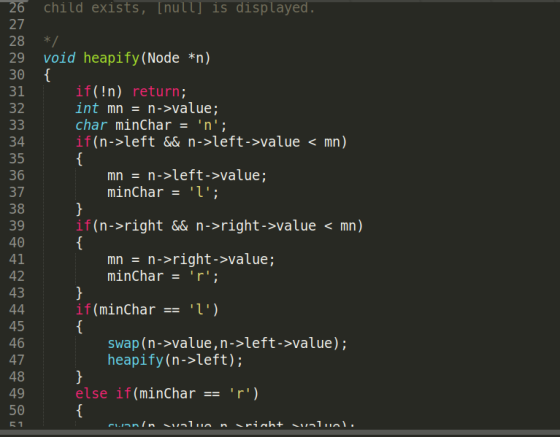
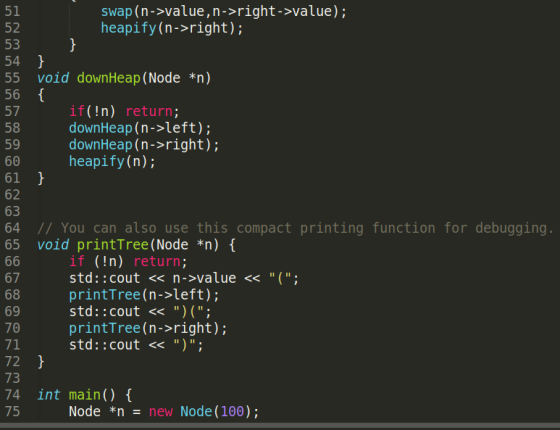
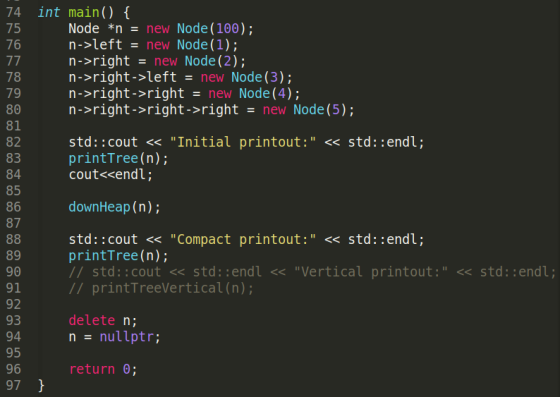
Screenshot of C++ code is given below:

If the answer helped please upvote, it means a lot and for any query please comment.
Add Answer to:
Implement downHeap(Node *n) for a min heap implemented as an
ordinary binary tree with an integer...
C++: PLEASE HELP~!!! ~~~~~~~~ Implement bool AVLTree::deleteNode(string ss) method. Function deleteNode() tries to delete the node...
C++: PLEASE HELP~!!! ~~~~~~~~ Implement bool AVLTree::deleteNode(string ss) method. Function deleteNode() tries to delete the node containing value ss. If there is no such node, it returns false. Otherwise, it deletes the node, check the balance of the tree, rebalance the tree if it is necessary. When you delete a node, consider three different scenarios: -The node is a leaf -The node has only ONE child subtree -The node has two child subtrees Important: When you implement this project, do...
In C++ I need the printRange function, and the main.cpp program. Thanks. (Binary search tree) Write...
In C++ I need the printRange function, and the main.cpp program. Thanks. (Binary search tree) Write a function printRange that takes as input a binary search tree t and two keys, k1 and k2, which are ordered so that k1 < k2, and print all elements x in the tree such that k1 <= x <= k2. You can add this function in BinarySearchTree.h (click the link) that we used in the lecture and lab 7. public: void printRange(int k1,...
C++, implement the bst.cpp file without adding any additional methods or functions to it ======================================================================== //...
C++, implement the bst.cpp file without adding any additional methods or functions to it ======================================================================== // bst.cpp #include <iostream> #include "bst.h" using namespace std; BinarySearchTree::BinarySearchTree() { root = nullptr; } void BinarySearchTree::insert(int key, string val) { Node* new_node = new Node; new_node->key = key; new_node->val = val; new_node->left = nullptr; new_node->right = nullptr; if (root == nullptr) { root = new_node; } else { insertHelper(root, new_node); } } void BinarySearchTree::insertHelper(Node* parent, Node* new_node) { if (new_node->key < parent->key) { if...
Hi there, I am working on a binary search tree code in c++. The program must...
Hi there, I am working on a binary search tree code in c++. The program must store and update students' academic records, each node includes the student name, credits attempted, credits earned and GPA. I have made some progress with the code and written most of the functions in the .cpp file (already did the .h file) but i am struggling with what to put in the main and how to put an update part in the insert function. I...
Write a method that determines the key of the successor of the root node in a...
Write a method that determines the key of the successor of the root node in a binary search tree. For any input binary search tree, find the key of successor of the root node.Note: Successor is the node with the next highest key, should work for any binary search tree - not just the given example input. #include <iostream> using namespace std; class Node { private: int key; string val; Node* left; Node* right; friend class BinarySearchTree; }; class BinarySearchTree {...
C++ (Using Binary Search Trees) other methods will result in downvote Implement the binary search tree...
C++ (Using Binary Search Trees) other methods will result in downvote Implement the binary search tree methods (bst.cpp) for the binary search tree provided in the header file. Test your implementation with the included test. bst.h bst_test.cpp Note: Your implementation must correspond to declarations in the header file, and pass the test. Do not modify these two. I will compile your code against these. If the compilation fails, you will get down vote. bst.h #ifndef BINARY_SEARCH_TREE_H #define BINARY_SEARCH_TREE_H #include <string>...
C++ comment code Comment the following code #include <iostream> using namespace std; class Node { public:...
C++ comment code Comment the following code #include <iostream> using namespace std; class Node { public: Node(int val); int value; Node* next; }; Node::Node(int val){ value = val; } class List { public: List(); // Uncomment the line below once you're ready List(List &other); void push_front(int value); bool pop_front(int &value); void push_back(int value); bool pop_back(int &value); int at(int index); void insert_at(int index, int value); void remove_at(int index); int size(); private: // other members you may have used Node* head; Node*...
#include <iostream> #include <cstddef> using std::cout; using std::endl; class Node { int value; public: Node* left;...
#include <iostream> #include <cstddef> using std::cout; using std::endl; class Node { int value; public: Node* left; // left child Node* right; // right child Node* p; // parent Node(int data) { value = data; left = NULL; right = NULL; p = NULL; } ~Node() { } int d() { return value; } void print() { std::cout << value << std::endl; } }; int main(int argc, const char * argv[]) { } function insert(Node *insert_node, Node *tree_root){ //Your code here...
In C++ and use functions that are asked for, thanks! Implement the BinarySearchTree ADT in a...
In C++ and use functions that are asked for, thanks! Implement the BinarySearchTree ADT in a file BinarySearchTree.h exactly as shown below. // BinarySearchTree.h // after Mark A. Weiss, Chapter 4, Dr. Kerstin Voigt #ifndef BINARY_SEARCH_TREE_H #define BINARY_SEARCH_TREE_H #include <cassert> #include <iostream> using namespace std; template <typename C> class BinarySearchTree { public: BinarySearchTree( ) : root{ nullptr } { } ~BinarySearchTree( ) { makeEmpty(); } const C & findMin( ) const { assert(!isEmpty()); return findMin( root )->element; } const C...
Write a function, swapSubtrees, that swaps all of the left and right subtrees of a binary...
Write a function, swapSubtrees, that swaps all of the left and right subtrees of a binary tree. Add this function to the class binaryTreeType and create a program to test this function. #include <iostream> using namespace std; //Definition of the Node template <class elemType> struct nodeType { elemType info; nodeType<elemType> *lLink; nodeType<elemType> *rLink; }; //Definition of the class template <class elemType> class binaryTreeType { public: //Overload the assignment operator. const binaryTreeType<elemType>& operator=(const binaryTreeType<elemType>&) { if (this != &otherTree) //avoid self-copy...
Most questions answered within 3 hours.
-
Where is the error in this code sequence?
String s1 = "Hello";
String s2 = "ello";...
asked 11 months ago -
Financial data for Joel de Paris, Inc., for last year
follow:
Joel de Paris, Inc.
Balance...
asked 11 months ago -
Consider this reaction:
Al2(SO4)3 (aq)+ BaCl3
(aq) Al2Cl6 (aq)- +
3BaSO4(s) . What is the...
asked 11 months ago -
Suppose that Savneet is considering increasing her
recent random sample from 20 car rentals to 40...
asked 11 months ago -
Trucks arrive at an unloading terminal at an average rate of 120
per hour.
Trucks arrive...
asked 11 months ago -
Why are methanol and ethanol completely soluble in water while
octanol is not very little soluble....
asked 11 months ago -
A facilities manager at a university reads in a research report
that the mean amount of...
asked 11 months ago -
When the CuSO4 is rehydrated by adding water to the anhydrous
compound, is this an endothermic...
asked 11 months ago -
A ray of sunlight is passing from diamond into crown glass; the
angle of incidence is...
asked 11 months ago -
A block of mass 0.249 kg is placed on top of a light, vertical
spring of...
asked 11 months ago -
how do the kidneys compensate in the presences of acidosis
a) trigger hyperventilate
b) reserve acid...
asked 11 months ago -
Question 501 pts
The rental rate of capital to the firm increases. Which of the
following...
asked 11 months ago