peroxide is broken down into what two less harmful molecules in lab2? a)oxygen and water b)carbon...
peroxide is broken down into what two less harmful
molecules in lab2?
a)oxygen and water
b)carbon dioxide and vinegar
c)water and syrup
d)oxygen and carbon dioxide
Homework Answers
Option a is correct. Peroxide is broken down into oxygen and water. This reaction occurs in the presence of catalase enzyme.
Add Answer to:
peroxide is broken down into what two less harmful
molecules in lab2?
a)oxygen and water
b)carbon...
As pyruvate is completely broken down in the TCA (Krebs) cycle, some of its energy is...
As pyruvate is completely broken down in the TCA (Krebs) cycle, some of its energy is A) conserved in the water molecules resulting from reduction of oxygen. B) conserved in the carbon dioxide molecules released by the processes. C) conserved in FAD and NAD+. D) conserved in NADH + H+ and FADH2. E) found in the oxygen used in the electron transport chain.
Here are visual representations (ball-and-stick and space-filling models) of four molecules: carbon dioxide, oxygen, water, and...
 Here are visual representations (ball-and-stick and space-filling models) of four molecules: carbon dioxide, oxygen, water, and ozone. Part 1Which of these molecules contain polar bonds, and which contain nonpolar bonds? Sort the images accordingly.Part 2Which of these four molecules is nonpolar despite the fact that it contains polar bonds?Choose one:A. carbon dioxideB. oxygenC. waterD. ozonePart 3Which of these four molecules is polar and contains polar bonds?Choose one:A. carbon dioxideB. oxygenC. WaterD. ozonePart 4Which of these four molecules is polar despite the...
Carbon dioxide and oxygen are molecules that can move freely across a plasma membrane. What determines...
Carbon dioxide and oxygen are molecules that can move freely across a plasma membrane. What determines the direction that carbon dioxide and oxygen molecules move? A. orientation of cholesterol in the plasma membrane B. concentration gradient across the plasma membrane C. confi guration of phospholipids in the plasma membrane D. location of receptors on the surface of the plasma membrane
The organic molecules of living organisms have a measurably lower ratio of carbon-13/carbon-12, two stable isotopes...
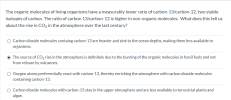 The organic molecules of living organisms have a measurably lower ratio of carbon-13/carbon-12, two stable isotopes of carbon. The ratio of carbon 13/carbon-12 is higher in non-organic molecules. What does this tell us about the rise in CO2 in the atmosphere over the last century? O Carbon dioxide molecules containg carbon-13 are heavier and sink to the ocean depths, making them less available to organisms. O The source of CO2 rise in the atmosphere is definitely due to the burning...
What is the role of Coenzyme A? A) It gets broken down to make ATP B)...
What is the role of Coenzyme A? A) It gets broken down to make ATP B) It gets attached to a two carbon molecule C) It is an enzyme that breaks down pyruvate D) It is an enzyme that will break down acetyl E) None of the above
Which of the following molecules would require a transport protein to cross the membrane? A. Carbon...
 Which of the following molecules would require a transport protein to cross the membrane? A. Carbon Dioxide B. Oxygen C. Glucose D. A&B E. All of the above What is energy coupling? A. An enzyme reducing activation energy B. The hydrolysis of ATP to ADP and inorganic phosphate C. The use of energy released from an exergonic reaction to power an endergonic reaction D. All of the above are examples of energy coupling Peroxisomes A.Contains enzyme to produce hydrogen peroxide...
Problem 6. (6 points) Regarding a covalent bond between carbon and oxygen atoms in a carbon...
 Problem 6. (6 points) Regarding a covalent bond between carbon and oxygen atoms in a carbon monoxide, CO, molecule, determine in each of the following statements if they are either true or false. Justify your answer.? (a) Valence electrons are transferred from carbon to oxygen atoms. (b)Bonding electrons are distributed over the entire CO molecule. (c) The bond length is less than the sum of the two atomic radii. (d) Energy is released when a covalent bond is broken. Problem...
Liquid heptane, C7H16, burns in oxygen gas to yield carbon dioxide and water. What is the...
Liquid heptane, C7H16, burns in oxygen gas to yield carbon dioxide and water. What is the minimum mass of oxygen required for the complete reaction of 25.5 mL of heptane? (density of heptane = 0.6838 g/mL) a)5.57 g b)8.14 g c)30.6 g d)61.3 g e)89.6 g
Why do we need hemoglobin to transport oxygen in the bloodstream, but no protein is required...
Why do we need hemoglobin to transport oxygen in the bloodstream, but no protein is required to transport carbon dioxide in the blood from the tissues to the lungs? A. carbon dioxide is hydrophilic, and can interact with water molecules in the blood, but oxygen cannot B. the bonds in carbon dioxide are nonpolar covalent bonds, but the bonds in oxygen are polar bonds C. carbon dioxide is surrounded by a shell of sodium ions in the bloodstream, but oxygen...
Liquid octane reacts with gaseous oxygen gas to produce gaseous carbon dioxide and gaseous water . What is the theoretic...
 Liquid octane reacts with
gaseous oxygen gas to produce gaseous carbon dioxide and gaseous
water . What is the theoretical yield of carbon dioxide formed from
the reaction of of octane and of oxygen gas? Be sure your answer
has the correct number of significant digits in it.
Liquid octane reacts with gaseous oxygen gas (02) to produce gaseous carbon dioxide (CO2) and gaseous water (H2O). What is the theoretical yield of carbon dioxide formed from the reaction of 36.6...
Liquid octane reacts with
gaseous oxygen gas to produce gaseous carbon dioxide and gaseous
water . What is the theoretical yield of carbon dioxide formed from
the reaction of of octane and of oxygen gas? Be sure your answer
has the correct number of significant digits in it.
Liquid octane reacts with gaseous oxygen gas (02) to produce gaseous carbon dioxide (CO2) and gaseous water (H2O). What is the theoretical yield of carbon dioxide formed from the reaction of 36.6...
 Here are visual representations (ball-and-stick and space-filling models) of four molecules: carbon dioxide, oxygen, water, and ozone. Part 1Which of these molecules contain polar bonds, and which contain nonpolar bonds? Sort the images accordingly.Part 2Which of these four molecules is nonpolar despite the fact that it contains polar bonds?Choose one:A. carbon dioxideB. oxygenC. waterD. ozonePart 3Which of these four molecules is polar and contains polar bonds?Choose one:A. carbon dioxideB. oxygenC. WaterD. ozonePart 4Which of these four molecules is polar despite the...
 The organic molecules of living organisms have a measurably lower ratio of carbon-13/carbon-12, two stable isotopes of carbon. The ratio of carbon 13/carbon-12 is higher in non-organic molecules. What does this tell us about the rise in CO2 in the atmosphere over the last century? O Carbon dioxide molecules containg carbon-13 are heavier and sink to the ocean depths, making them less available to organisms. O The source of CO2 rise in the atmosphere is definitely due to the burning...
 Which of the following molecules would require a transport protein to cross the membrane? A. Carbon Dioxide B. Oxygen C. Glucose D. A&B E. All of the above What is energy coupling? A. An enzyme reducing activation energy B. The hydrolysis of ATP to ADP and inorganic phosphate C. The use of energy released from an exergonic reaction to power an endergonic reaction D. All of the above are examples of energy coupling Peroxisomes A.Contains enzyme to produce hydrogen peroxide...
 Problem 6. (6 points) Regarding a covalent bond between carbon and oxygen atoms in a carbon monoxide, CO, molecule, determine in each of the following statements if they are either true or false. Justify your answer.? (a) Valence electrons are transferred from carbon to oxygen atoms. (b)Bonding electrons are distributed over the entire CO molecule. (c) The bond length is less than the sum of the two atomic radii. (d) Energy is released when a covalent bond is broken. Problem...
 Liquid octane reacts with
gaseous oxygen gas to produce gaseous carbon dioxide and gaseous
water . What is the theoretical yield of carbon dioxide formed from
the reaction of of octane and of oxygen gas? Be sure your answer
has the correct number of significant digits in it.
Liquid octane reacts with gaseous oxygen gas (02) to produce gaseous carbon dioxide (CO2) and gaseous water (H2O). What is the theoretical yield of carbon dioxide formed from the reaction of 36.6...
Liquid octane reacts with
gaseous oxygen gas to produce gaseous carbon dioxide and gaseous
water . What is the theoretical yield of carbon dioxide formed from
the reaction of of octane and of oxygen gas? Be sure your answer
has the correct number of significant digits in it.
Liquid octane reacts with gaseous oxygen gas (02) to produce gaseous carbon dioxide (CO2) and gaseous water (H2O). What is the theoretical yield of carbon dioxide formed from the reaction of 36.6...
Most questions answered within 3 hours.
-
Where is the error in this code sequence?
String s1 = "Hello";
String s2 = "ello";...
asked 10 months ago -
Financial data for Joel de Paris, Inc., for last year
follow:
Joel de Paris, Inc.
Balance...
asked 10 months ago -
Consider this reaction:
Al2(SO4)3 (aq)+ BaCl3
(aq) Al2Cl6 (aq)- +
3BaSO4(s) . What is the...
asked 10 months ago -
Suppose that Savneet is considering increasing her
recent random sample from 20 car rentals to 40...
asked 10 months ago -
Trucks arrive at an unloading terminal at an average rate of 120
per hour.
Trucks arrive...
asked 10 months ago -
Why are methanol and ethanol completely soluble in water while
octanol is not very little soluble....
asked 10 months ago -
A facilities manager at a university reads in a research report
that the mean amount of...
asked 10 months ago -
When the CuSO4 is rehydrated by adding water to the anhydrous
compound, is this an endothermic...
asked 10 months ago -
A ray of sunlight is passing from diamond into crown glass; the
angle of incidence is...
asked 10 months ago -
A block of mass 0.249 kg is placed on top of a light, vertical
spring of...
asked 10 months ago -
how do the kidneys compensate in the presences of acidosis
a) trigger hyperventilate
b) reserve acid...
asked 10 months ago -
Question 501 pts
The rental rate of capital to the firm increases. Which of the
following...
asked 10 months ago