If an electron with a charge of 1.6x10^-19C is displaced across a potential difference of 6...
Homework Answers

Add Answer to:
If
an electron with a charge of 1.6x10^-19C is displaced across a
potential difference of 6...
A particular electric dipole consists of a proton of charge of 1.6x10⁻¹⁹ Coulomb and an electron...
A particular electric dipole consists of a proton of charge of 1.6x10⁻¹⁹ Coulomb and an electron of charge of -1.6x10⁻¹⁹ Coulomb, separated by 2x10⁻¹⁰[m] = 0.2[nm]. 1a. What’s the electrostatic force between the charges (magnitude and direction), and why? 1b. What’s the electric field magnitude and direction at a point halfway between the two charges, and why? 1c. How much energy (in electron Volts OR in Joules) is needed to separate these two charges? 1d. If these two charges “fell...
The charge of an electron is -1.6 x 10^-19C. The formula for current is : Current...
The charge of an electron is -1.6 x 10^-19C. The formula for current is : Current = Charge/time or I = Q/t 1. If 8000 C of charge pass through a section of wire in 2 minutes, what would the current be? 2. A current of 55 Amperes through a wire over 5 seconds will have how much charge pass through it? how many electrons made up that charge?
13. If a charge of 3.0 coulombs is transferred through a potential is: difference of 6.0...
 13. If a charge of 3.0 coulombs is transferred through a potential is: difference of 6.0 volts, the amount of work done zero. b. 0.50 c. 2.0 d. 18 J none of these One volt is equal to: a. one (N/C)(m) b. one (kg my (s C) c. one ev (1.6x 10- C) d. all of these e. e. -14. none of these 15. A charge is moved through the potential difference from A to B. In which case is...
Question 23 6V switch open Figure 6 What is the potential difference in volts across RD...
 Question 23 6V switch open Figure 6 What is the potential difference in volts across RD in Fig. 6?
1. Calculate the charge on capacitor C1. 2. Calculate the potential difference across capacitor C1. 3....
 1. Calculate the charge on capacitor C1.
2. Calculate the potential difference across capacitor C1.
3. Calculate the charge on capacitor C2
4. Calculate the potential difference across capacitor C2.
5. Calculate the charge on capacitor C3.
6. Calculate the potential difference across capacitor C3.
7. Calculate the charge on capacitor C4.
8. Calculate the potential difference across capacitor C4.
9. Calculate the potential difference between points a and
d.
In the figure (Figure 1), each capacitor has 5.00 uF...
1. Calculate the charge on capacitor C1.
2. Calculate the potential difference across capacitor C1.
3. Calculate the charge on capacitor C2
4. Calculate the potential difference across capacitor C2.
5. Calculate the charge on capacitor C3.
6. Calculate the potential difference across capacitor C3.
7. Calculate the charge on capacitor C4.
8. Calculate the potential difference across capacitor C4.
9. Calculate the potential difference between points a and
d.
In the figure (Figure 1), each capacitor has 5.00 uF...
An electron is “boiled” from a filament. This means that the electron, with charge e and...
An electron is “boiled” from a filament. This means that the electron, with charge e and mass m, starts from rest near the filament. It is then accelerated by a potential difference of ∆V volts. What is the speed v of the electron? Solve symbolically and put your work here:
Find the potential difference across and the charge on each of the capacitors, A - F,...
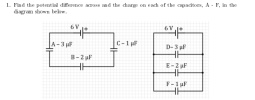 Find the potential difference across and the charge on each of the capacitors, A - F, in the diagram shown below.
A magnesium ion, Mg2+, with a charge of 3.2×10⁻¹⁹C and an oxide ion, O2−, with a...
A magnesium ion, Mg2+, with a charge of 3.2×10⁻¹⁹C and an oxide ion, O2−, with a charge of −3.2×10⁻¹⁹C, are separated by a distance of 0.40 nm. How much work would be required to increase the separation of the two ions to an infinite distance?
Potential Difference - Three charged plates - Will rate lifesaver for at least half correct
 Please show me some work? i just need help getting started, Will rate lifesaver for at least half correctThree charged metal disks are arranged as shown (cutaway view). The disks are held apart by insulating supports not shown in the diagram. Each disk has an area of2.2 m2 (this is the area of one flat surface of the disk). Use the value 8.85e-12 C2/(N·m2) for ε0.The charge Q1 = 3e-8 coulombs, and the charge Q2 = 3e-7coulombs.What is the magnitude...
6 Calculate the energy gained by an electron when it is accelerated through a potential difference...
 6 Calculate the energy gained by an electron when it is accelerated through a potential difference of 50kV. (Charge on the electron=1.6x 10⁻¹°C.)
 13. If a charge of 3.0 coulombs is transferred through a potential is: difference of 6.0 volts, the amount of work done zero. b. 0.50 c. 2.0 d. 18 J none of these One volt is equal to: a. one (N/C)(m) b. one (kg my (s C) c. one ev (1.6x 10- C) d. all of these e. e. -14. none of these 15. A charge is moved through the potential difference from A to B. In which case is...
 Question 23 6V switch open Figure 6 What is the potential difference in volts across RD in Fig. 6?
 1. Calculate the charge on capacitor C1.
2. Calculate the potential difference across capacitor C1.
3. Calculate the charge on capacitor C2
4. Calculate the potential difference across capacitor C2.
5. Calculate the charge on capacitor C3.
6. Calculate the potential difference across capacitor C3.
7. Calculate the charge on capacitor C4.
8. Calculate the potential difference across capacitor C4.
9. Calculate the potential difference between points a and
d.
In the figure (Figure 1), each capacitor has 5.00 uF...
1. Calculate the charge on capacitor C1.
2. Calculate the potential difference across capacitor C1.
3. Calculate the charge on capacitor C2
4. Calculate the potential difference across capacitor C2.
5. Calculate the charge on capacitor C3.
6. Calculate the potential difference across capacitor C3.
7. Calculate the charge on capacitor C4.
8. Calculate the potential difference across capacitor C4.
9. Calculate the potential difference between points a and
d.
In the figure (Figure 1), each capacitor has 5.00 uF...
 Find the potential difference across and the charge on each of the capacitors, A - F, in the diagram shown below.
 Please show me some work? i just need help getting started, Will rate lifesaver for at least half correctThree charged metal disks are arranged as shown (cutaway view). The disks are held apart by insulating supports not shown in the diagram. Each disk has an area of2.2 m2 (this is the area of one flat surface of the disk). Use the value 8.85e-12 C2/(N·m2) for ε0.The charge Q1 = 3e-8 coulombs, and the charge Q2 = 3e-7coulombs.What is the magnitude...
 6 Calculate the energy gained by an electron when it is accelerated through a potential difference of 50kV. (Charge on the electron=1.6x 10⁻¹°C.)
Most questions answered within 3 hours.
-
Where is the error in this code sequence?
String s1 = "Hello";
String s2 = "ello";...
asked 11 months ago -
Financial data for Joel de Paris, Inc., for last year
follow:
Joel de Paris, Inc.
Balance...
asked 11 months ago -
Consider this reaction:
Al2(SO4)3 (aq)+ BaCl3
(aq) Al2Cl6 (aq)- +
3BaSO4(s) . What is the...
asked 11 months ago -
Suppose that Savneet is considering increasing her
recent random sample from 20 car rentals to 40...
asked 11 months ago -
Trucks arrive at an unloading terminal at an average rate of 120
per hour.
Trucks arrive...
asked 11 months ago -
Why are methanol and ethanol completely soluble in water while
octanol is not very little soluble....
asked 11 months ago -
A facilities manager at a university reads in a research report
that the mean amount of...
asked 11 months ago -
When the CuSO4 is rehydrated by adding water to the anhydrous
compound, is this an endothermic...
asked 11 months ago -
A ray of sunlight is passing from diamond into crown glass; the
angle of incidence is...
asked 11 months ago -
A block of mass 0.249 kg is placed on top of a light, vertical
spring of...
asked 11 months ago -
how do the kidneys compensate in the presences of acidosis
a) trigger hyperventilate
b) reserve acid...
asked 11 months ago -
Question 501 pts
The rental rate of capital to the firm increases. Which of the
following...
asked 11 months ago