Write an SN1 and SN2 reaction with he same final product? Explain
Write an SN1 and SN2 reaction with he same final product? Explain
Homework Answers
SN1 reaction takes place with wek nucleophile and in polar protic solvent. In SN1 first step is the formation of carbocation and then nucleophile combines
whereas SN2 takes place with strong nucleophile and in polar aprotic solvent. here Nucleophile attacks directly while the leaving group departs
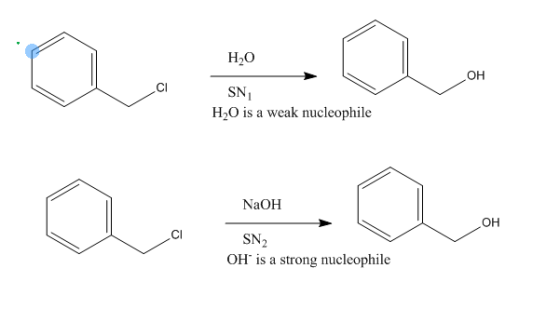
Show an example where a SN1 reaction and SN2 reaction have the same final product
Show an example where a SN1 reaction and SN2 reaction have the same final product
SN1 reaction and SN2 reaction with the SAME product. Show ALL steps.
SN1 reaction and SN2 reaction with the SAME product. Show ALL steps.
Write the potential sn2 and sn1 reaction as well as the potential the sn2 and sn1...
 Write
the potential sn2 and sn1 reaction as well as the potential the sn2
and sn1 mechanism. Then state which reaction(s) will occur if any,
and why?
with naI/acetone and with AgNO3/ethanol
F) chlorobenzene G) 1-bromobutane H) 2-bromobutane
Write
the potential sn2 and sn1 reaction as well as the potential the sn2
and sn1 mechanism. Then state which reaction(s) will occur if any,
and why?
with naI/acetone and with AgNO3/ethanol
F) chlorobenzene G) 1-bromobutane H) 2-bromobutane
Write the potential sn2 and sn1 reaction as well as the potential the sn2 and sn1...
 Write
the potential sn2 and sn1 reaction as well as the potential the sn2
and sn1 mechanism. Then state which reaction(s) will occur if any,
and why?
with NaI/acetone and AgNO3/ethanol
1) t-butyl bromide J) benzyl bromide K) bromobenzene
Write
the potential sn2 and sn1 reaction as well as the potential the sn2
and sn1 mechanism. Then state which reaction(s) will occur if any,
and why?
with NaI/acetone and AgNO3/ethanol
1) t-butyl bromide J) benzyl bromide K) bromobenzene
Write the potential sn2 and sn1 reaction as well as the potential the sn2 and sn1...
 Write the potential sn2 and sn1 reaction as well as the potential
the sn2 and sn1 mechanism. Then state which reaction(s) will occur
if any, and why?
with NaI/acetone and AgNO3 and ethanol
C) 2-iodobutane D) t-butyl chloride E) benzyl chloride
Write the potential sn2 and sn1 reaction as well as the potential
the sn2 and sn1 mechanism. Then state which reaction(s) will occur
if any, and why?
with NaI/acetone and AgNO3 and ethanol
C) 2-iodobutane D) t-butyl chloride E) benzyl chloride
what is the major product and it is SN1 or SN2 reaction ? what is the...
 what is the major product and it is SN1 or SN2 reaction
?
what is the major This reaction is undergo SN, OV. SN z ? Product) 2 NaI Aceton
what is the major product and it is SN1 or SN2 reaction
?
what is the major This reaction is undergo SN, OV. SN z ? Product) 2 NaI Aceton
Please write clearly and explain. 1. Draw the Sn1, SN2, E1, and Ez reaction mechanisms of...
 Please write clearly and explain.
1. Draw the Sn1, SN2, E1, and Ez reaction mechanisms of (just do all four reactions): A. (2S,3R)-3-bromo-2-methoxy-3-methylpentane with NaF
Please write clearly and explain.
1. Draw the Sn1, SN2, E1, and Ez reaction mechanisms of (just do all four reactions): A. (2S,3R)-3-bromo-2-methoxy-3-methylpentane with NaF
Determine if the reaction is SN1, SN2, E1 or E2. Write the complete mechanism and answer...
 Determine if the reaction is SN1, SN2, E1 or E2. Write
the complete mechanism and answer any questions
*Please don't leave any steps out*
но oplommor + NH3- a. Is the most stable alkene formed? Explain b. Is Zaitsev's rule followed? c. If the concentration of substrate is increased will the rate increase, decrease or remain the same? Explain
Determine if the reaction is SN1, SN2, E1 or E2. Write
the complete mechanism and answer any questions
*Please don't leave any steps out*
но oplommor + NH3- a. Is the most stable alkene formed? Explain b. Is Zaitsev's rule followed? c. If the concentration of substrate is increased will the rate increase, decrease or remain the same? Explain
21. Propose a mechanism to explain this reaction (SN1, SN2, E1 or E2). What is the...
 21. Propose a mechanism to explain this reaction (SN1, SN2, E1 or E2). What is the structure of the product? H 22. How can we get this product? CI CI ?
please explain in detail. Thank you in advance . 1. Circle the mechanism (SN2, SN1, E2,...
 please explain in detail. Thank you in advance .
1. Circle the mechanism (SN2, SN1, E2, or E1) responsible for the formation of each product in this reaction. If the product cannot be formed in the reaction, circle "not a product". (2 pts) CI CHE CH3 CHE CH3 осна SN2 SN1 E2 E1 S2 SN1 E2 E1 SN2 Sn1 E2 E1 SN2 SN1 E2 E1 not a product not a product not a product not a product 2. These reactions...
please explain in detail. Thank you in advance .
1. Circle the mechanism (SN2, SN1, E2, or E1) responsible for the formation of each product in this reaction. If the product cannot be formed in the reaction, circle "not a product". (2 pts) CI CHE CH3 CHE CH3 осна SN2 SN1 E2 E1 S2 SN1 E2 E1 SN2 Sn1 E2 E1 SN2 SN1 E2 E1 not a product not a product not a product not a product 2. These reactions...
 Write
the potential sn2 and sn1 reaction as well as the potential the sn2
and sn1 mechanism. Then state which reaction(s) will occur if any,
and why?
with naI/acetone and with AgNO3/ethanol
F) chlorobenzene G) 1-bromobutane H) 2-bromobutane
Write
the potential sn2 and sn1 reaction as well as the potential the sn2
and sn1 mechanism. Then state which reaction(s) will occur if any,
and why?
with naI/acetone and with AgNO3/ethanol
F) chlorobenzene G) 1-bromobutane H) 2-bromobutane
 Write
the potential sn2 and sn1 reaction as well as the potential the sn2
and sn1 mechanism. Then state which reaction(s) will occur if any,
and why?
with NaI/acetone and AgNO3/ethanol
1) t-butyl bromide J) benzyl bromide K) bromobenzene
Write
the potential sn2 and sn1 reaction as well as the potential the sn2
and sn1 mechanism. Then state which reaction(s) will occur if any,
and why?
with NaI/acetone and AgNO3/ethanol
1) t-butyl bromide J) benzyl bromide K) bromobenzene
 Write the potential sn2 and sn1 reaction as well as the potential
the sn2 and sn1 mechanism. Then state which reaction(s) will occur
if any, and why?
with NaI/acetone and AgNO3 and ethanol
C) 2-iodobutane D) t-butyl chloride E) benzyl chloride
Write the potential sn2 and sn1 reaction as well as the potential
the sn2 and sn1 mechanism. Then state which reaction(s) will occur
if any, and why?
with NaI/acetone and AgNO3 and ethanol
C) 2-iodobutane D) t-butyl chloride E) benzyl chloride
 what is the major product and it is SN1 or SN2 reaction
?
what is the major This reaction is undergo SN, OV. SN z ? Product) 2 NaI Aceton
what is the major product and it is SN1 or SN2 reaction
?
what is the major This reaction is undergo SN, OV. SN z ? Product) 2 NaI Aceton
 Please write clearly and explain.
1. Draw the Sn1, SN2, E1, and Ez reaction mechanisms of (just do all four reactions): A. (2S,3R)-3-bromo-2-methoxy-3-methylpentane with NaF
Please write clearly and explain.
1. Draw the Sn1, SN2, E1, and Ez reaction mechanisms of (just do all four reactions): A. (2S,3R)-3-bromo-2-methoxy-3-methylpentane with NaF
 Determine if the reaction is SN1, SN2, E1 or E2. Write
the complete mechanism and answer any questions
*Please don't leave any steps out*
но oplommor + NH3- a. Is the most stable alkene formed? Explain b. Is Zaitsev's rule followed? c. If the concentration of substrate is increased will the rate increase, decrease or remain the same? Explain
Determine if the reaction is SN1, SN2, E1 or E2. Write
the complete mechanism and answer any questions
*Please don't leave any steps out*
но oplommor + NH3- a. Is the most stable alkene formed? Explain b. Is Zaitsev's rule followed? c. If the concentration of substrate is increased will the rate increase, decrease or remain the same? Explain
 21. Propose a mechanism to explain this reaction (SN1, SN2, E1 or E2). What is the structure of the product? H 22. How can we get this product? CI CI ?
 please explain in detail. Thank you in advance .
1. Circle the mechanism (SN2, SN1, E2, or E1) responsible for the formation of each product in this reaction. If the product cannot be formed in the reaction, circle "not a product". (2 pts) CI CHE CH3 CHE CH3 осна SN2 SN1 E2 E1 S2 SN1 E2 E1 SN2 Sn1 E2 E1 SN2 SN1 E2 E1 not a product not a product not a product not a product 2. These reactions...
please explain in detail. Thank you in advance .
1. Circle the mechanism (SN2, SN1, E2, or E1) responsible for the formation of each product in this reaction. If the product cannot be formed in the reaction, circle "not a product". (2 pts) CI CHE CH3 CHE CH3 осна SN2 SN1 E2 E1 S2 SN1 E2 E1 SN2 Sn1 E2 E1 SN2 SN1 E2 E1 not a product not a product not a product not a product 2. These reactions...
Most questions answered within 3 hours.
-
Where is the error in this code sequence?
String s1 = "Hello";
String s2 = "ello";...
asked 10 months ago -
Financial data for Joel de Paris, Inc., for last year
follow:
Joel de Paris, Inc.
Balance...
asked 10 months ago -
Consider this reaction:
Al2(SO4)3 (aq)+ BaCl3
(aq) Al2Cl6 (aq)- +
3BaSO4(s) . What is the...
asked 10 months ago -
Suppose that Savneet is considering increasing her
recent random sample from 20 car rentals to 40...
asked 10 months ago -
Trucks arrive at an unloading terminal at an average rate of 120
per hour.
Trucks arrive...
asked 10 months ago -
Why are methanol and ethanol completely soluble in water while
octanol is not very little soluble....
asked 10 months ago -
A facilities manager at a university reads in a research report
that the mean amount of...
asked 10 months ago -
When the CuSO4 is rehydrated by adding water to the anhydrous
compound, is this an endothermic...
asked 10 months ago -
A ray of sunlight is passing from diamond into crown glass; the
angle of incidence is...
asked 10 months ago -
A block of mass 0.249 kg is placed on top of a light, vertical
spring of...
asked 10 months ago -
how do the kidneys compensate in the presences of acidosis
a) trigger hyperventilate
b) reserve acid...
asked 10 months ago -
Question 501 pts
The rental rate of capital to the firm increases. Which of the
following...
asked 10 months ago