1.) a. Why does entry into markets decrease firm profits? b. Describe some of the ways...
1.)
a. Why does entry into markets decrease firm profits?
b. Describe some of the ways firms differentiate their products.
c. Graph and explain how a firm in a monopolistic competition chooses the profit maximizing output to produce and the price to charge.
Homework Answers
1.Entry into the market increases supply and reduces price.A reduction in price reduces profits of individual firms.
2.Firms differentiate their products mainly though advertisement and discounts.The products in a monopolistic market is similar in nature so advertisement helps in highlighting the different aspects of each product.Also,a firm gives discounts to lure the consumers into buying their products.
3.A monopolistic competitive firm maximizes their profits at the point where marginal revenue and marginal cost are equal.
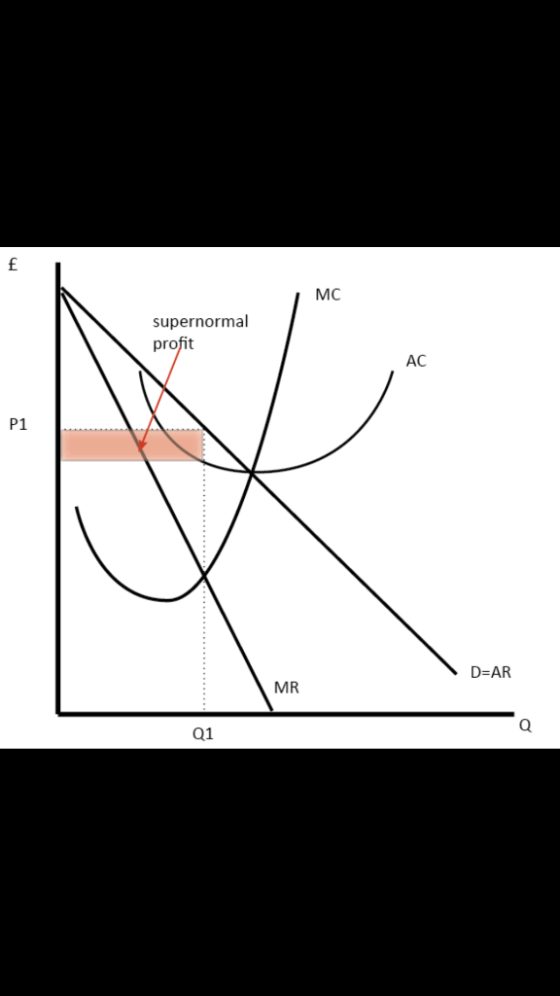
Add Answer to:
1.)
a. Why does entry into markets decrease firm profits?
b. Describe some of the ways...
2. In a perfectly competitive market, there are initially economic profits. Firm entry causes the...
 2. In a perfectly competitive market, there are initially economic profits. Firm entry causes the market supply curve to shift rightwards, but the market does not reach its long run state. a. Draw two corresponding graphs, side-by-side, that allustrate this shift. One is the market supply and demand graph, and the other is the profit-maximizing production choice of a typical firm. Using your graph, explain b. How do price and marginal revenue change as firms enter c. How do MC...
QUESTION 5 A monopolistically competitive firm will: maximize profits by producing where MR = MC. not...
QUESTION 5 A monopolistically competitive firm will: maximize profits by producing where MR = MC. not likely earn an economic profit in the long run. shut down in the short run if price is less than average variable cost. all of the above. QUESTION 6 A monopolistic competitive firm is inefficient because the firm: earns positive economic profit in the long run. is producing at an output corresponding to the condition that marginal cost equals price. is not maximizing its...
a) Why is a monopolistically competitive firm less efficient than a perfectly competitive firm? It produces...
a) Why is a monopolistically competitive firm less efficient than a perfectly competitive firm? It produces at an output that is lower than its minimum efficient scale (MES) It earns positive economic profits in the long run It deters entry of new firms by putting up entry barriers All of the answers are correct b) Suppose a monopolistically competitive firm has MC=4Q+5. Its demand is P=145-3Q and marginal revenue is MR=145-6Q. What is its profit-maximizing output level? 17 14 16...
QUESTION 14 Outline the main assumptions of monopolistic competition. Explain, with the graphs, the short run and long...
 QUESTION 14 Outline the main assumptions of monopolistic competition. Explain, with the graphs, the short run and long run equilibrium conditions of a monopolistic competitive firm (10 marks) QUESTION 15 At what price and output will a monopolist firm maximise profits and how much profit will it make? Explain with graph (10 marks) (10 marks) QUESTION 16 What conditions must hold for price discrimination to be possible? In each of the cases below, why and how does a firm choose...
1. How does the product in a monopolistic competition compare with the product in a competitive...
1. How does the product in a monopolistic competition compare with the product in a competitive market? 2. How does the seller’s demand curve in a monopolistic competition compare with the seller’s demand curve in competition? 3. Why will an monopolistic competitive firm only lose some of its customers, but not all when it raises its price? 4. What feature is the “hallmark” in monopolistic competition? 5. What short-run profit maximizing rule do monopolistic competitive firms follow? 6. If economic...
36) When a monopolist sells the same product at different prices and the prices are not related to cost differences, we have B) price differentiation. D) monopoly pricing A) price discrimination...
 36) When a monopolist sells the same product at different prices and the prices are not related to cost differences, we have B) price differentiation. D) monopoly pricing A) price discrimination C) marginal cost pricing. 37) 37) Monopolies misallocate resources because A) price does not equal marginal cost B) profits are usually positive. C) marginal cost does not equal average total cost. D) price does not equal average total cost. 38) 38) Which of the following assumptions is true about...
QUESTION 7 Monopolistic competitive firms in the long run earn: positive economic profits. zero pure economic...
QUESTION 7 Monopolistic competitive firms in the long run earn: positive economic profits. zero pure economic profits. negative economic profits. Positive, zero, or negative economic profits. QUESTION 8 Which of the following statements best describes firms under monopolistic competition? Profits will be positive in the long run. Price always equals average variable cost. In the long run, positive economic profit will be eliminated. Marginal revenue equals minimum average total cost in the short run. QUESTION 9 Which of the following...
1.Consider an industry with only two firms that produce identical products. Each of the firms only...
1.Consider an industry with only two firms that produce identical products. Each of the firms only incurs a fixed cost of $1000 to produce and marginal cost is 20. The market demand function is as follows: Q=q1+q2=400-P a. Assuming that the firms form a cartel, calculate the profit-maximizing quantity of output, price and profits b. If the firms choose to behave as in the Cournot model, what would be the profit- maximizing quantities of output, price and profits? c. if...
The major difference between monopolistic competition and monopoly is O A. only a firm in monopolistic...
The major difference between monopolistic competition and monopoly is A. only a firm in monopolistic competition can earn an economic profit in the short run. B. only firms in monopolistic competition are protected by barriers to entryC. only a monopoly can earn an economic profit in the long run. D. how the quantity of output is determined. E. monopoly is a price setter and a firm in monopolistic competition is a price taker.In the long run, firms in monopolistic competition earn zero economic profit...
1. How do fims differentiate there products from closely related substitutes? 2. Under Monopolistic Competition: ex...
 1. How do fims differentiate there products from closely related substitutes? 2. Under Monopolistic Competition: explain the firm's strategy in advertising to lower the elasticity of demand for its product. Illustrate below, the shape of the fim's demand curve before and after lowering the elasticity of demand. 3. Unlike a perfectly competitive fim, the monopolistic competitive firm is able to (a little) control price. Discuss, why, the position of the firm in the long run, is similar to that of...
 2. In a perfectly competitive market, there are initially economic profits. Firm entry causes the market supply curve to shift rightwards, but the market does not reach its long run state. a. Draw two corresponding graphs, side-by-side, that allustrate this shift. One is the market supply and demand graph, and the other is the profit-maximizing production choice of a typical firm. Using your graph, explain b. How do price and marginal revenue change as firms enter c. How do MC...
 QUESTION 14 Outline the main assumptions of monopolistic competition. Explain, with the graphs, the short run and long run equilibrium conditions of a monopolistic competitive firm (10 marks) QUESTION 15 At what price and output will a monopolist firm maximise profits and how much profit will it make? Explain with graph (10 marks) (10 marks) QUESTION 16 What conditions must hold for price discrimination to be possible? In each of the cases below, why and how does a firm choose...
 36) When a monopolist sells the same product at different prices and the prices are not related to cost differences, we have B) price differentiation. D) monopoly pricing A) price discrimination C) marginal cost pricing. 37) 37) Monopolies misallocate resources because A) price does not equal marginal cost B) profits are usually positive. C) marginal cost does not equal average total cost. D) price does not equal average total cost. 38) 38) Which of the following assumptions is true about...
 1. How do fims differentiate there products from closely related substitutes? 2. Under Monopolistic Competition: explain the firm's strategy in advertising to lower the elasticity of demand for its product. Illustrate below, the shape of the fim's demand curve before and after lowering the elasticity of demand. 3. Unlike a perfectly competitive fim, the monopolistic competitive firm is able to (a little) control price. Discuss, why, the position of the firm in the long run, is similar to that of...
Most questions answered within 3 hours.
-
Where is the error in this code sequence?
String s1 = "Hello";
String s2 = "ello";...
asked 10 months ago -
Financial data for Joel de Paris, Inc., for last year
follow:
Joel de Paris, Inc.
Balance...
asked 10 months ago -
Consider this reaction:
Al2(SO4)3 (aq)+ BaCl3
(aq) Al2Cl6 (aq)- +
3BaSO4(s) . What is the...
asked 10 months ago -
Suppose that Savneet is considering increasing her
recent random sample from 20 car rentals to 40...
asked 10 months ago -
Trucks arrive at an unloading terminal at an average rate of 120
per hour.
Trucks arrive...
asked 10 months ago -
Why are methanol and ethanol completely soluble in water while
octanol is not very little soluble....
asked 10 months ago -
A facilities manager at a university reads in a research report
that the mean amount of...
asked 10 months ago -
When the CuSO4 is rehydrated by adding water to the anhydrous
compound, is this an endothermic...
asked 10 months ago -
A ray of sunlight is passing from diamond into crown glass; the
angle of incidence is...
asked 10 months ago -
A block of mass 0.249 kg is placed on top of a light, vertical
spring of...
asked 10 months ago -
how do the kidneys compensate in the presences of acidosis
a) trigger hyperventilate
b) reserve acid...
asked 10 months ago -
Question 501 pts
The rental rate of capital to the firm increases. Which of the
following...
asked 10 months ago