james isolated E. coli from a urine sample. how may the microscope have helped james to...
Homework Answers
Following microscopic analysis, it might have been possible to detect the presence of bacteria in the urine sample.
Furthermore, E. coli are rod shaped bacteria, that are Gram-negative; whereas, S. aureus are Gram-positive round shaped bacteria. Under the microscope, the shapes of these two bacteria can easily be distinguished (especially because of the fact that S. aureus have the tendency to form chains). Also, performing a Gram staining can also be helpful in distinguishing between the two, as under the microscope, as following the counterstain, the E. coli will appear in the color of the counterstain under the microscope, while S. aureus will appear violet.
Add Answer to:
james isolated E. coli from a urine sample. how may the microscope
have helped james to...
While working in a research lab, your summer student may have contaminated your E. coli sample...
While working in a research lab, your summer student may have contaminated your E. coli sample with a Gram positive organism. Using the BD Media Manual (BD Difco and BBL culture media manual 2nd Ed), 1) List the media you would use to isolate your E. coli, and 2) state the expected colony characteristics on that media since E. coli can ferment lactose. Remember that E. coli is a Gram negative, lactose fermenting bacteria.
You have isolated an E. coli mutant which is not able to complete DNA replication. Instead,...
You have isolated an E. coli mutant which is not able to complete DNA replication. Instead, only short fragments of DNA are made. Which enzyme would you suspect is mutated? A. Ligase B. Primase C. Helicase
Scenario 1: A bacterium isolated from a wound sample gave the following results: MacConkey agar =...
 Scenario 1: A bacterium isolated from a wound sample gave the following results: MacConkey agar = no growth Mannitol salt agar - good growth, color of medium unchanged Based on these results, which of the following statements is/are true? (Choose ALL true statements.) A. The organism is most likely Gram positive. B. The organism is most likely Gram negative. C. The organism is most likely a bacillus. D. The organism is most likely a coccus. Which of the following most...
As a student project, you have isolated six new mutant strains of E. coli with altered...
 As a student project, you have isolated six new mutant strains
of E. coli with altered behavior of the lactose operon. The strains
are listed in the table below, together with their phenotypes (with
regard to significant ?-galactosidase synthesis) in three specific
situations.
Columns 1 and 2 present the phenotypes of each mutant haploid
strain. In column 1, the mutant is in an otherwise wild-type
genome. In column 2, the genome also carries a nonsense-suppressor
mutation (that is not present...
As a student project, you have isolated six new mutant strains
of E. coli with altered behavior of the lactose operon. The strains
are listed in the table below, together with their phenotypes (with
regard to significant ?-galactosidase synthesis) in three specific
situations.
Columns 1 and 2 present the phenotypes of each mutant haploid
strain. In column 1, the mutant is in an otherwise wild-type
genome. In column 2, the genome also carries a nonsense-suppressor
mutation (that is not present...
One strand of a section of DNA isolated from E. coli reads: 5’GTAGCCTACCCATAGG-3’
One strand of a section of DNA isolated from E. coli reads: 5’GTAGCCTACCCATAGG-3’ (a) Suppose that an mRNA is transcribed from this DNA using the complementary strand as a template. What will the sequence of the mRNA in this region be? (b) What is the amino acid sequence of the proteins. (c) Would the same proteins be made if the other strand of DNA served as template for transcription? Why or why not. (d) If the T underlined in the above sequence was to...
One strand of a section of DNA isolated from E. coli reads: Suppose that an mRNA...
 One strand of a section of DNA isolated from E. coli reads: Suppose that an mRNA is transcribed from this DNA using the complementary strand as a template. What will the sequence of the mRNA in this region be? What is the amino acid sequence of the proteins? Would the same proteins be made if the other strand of DNA served as template for transcription? Why or why not? If the T underlined in the above sequence was to go...
6. You isolated a E. coli strain from a gastro enteric infection, the physician ask you...
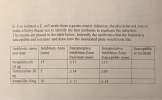 6. You isolated a E. coli strain from a gastro enteric infection, the physician ask you to make a Kirby Bauer test to identify the best antibiotic to eradicate the infection. The results are placed in the table below, Indentify the antibiotics that the bacteria is susceptible and resistant and draw how the inoculated plate would look like Antibiotic name Inhibitory Area and dose (mm) Interpretative Inhibition Zone Resistant (mm) Susceptible or resistant Interpretative Inhibition Zone Susceptible (mm) 215 311...
4. Given the following information: One strand of a section of DNA isolated from E. coli...
4. Given the following information: One strand of a section of DNA isolated from E. coli reads 5’-GTAGCCTACCCATAGG-3’ 3’ CATCGGATGGGTACC’5 Suppose that an mRNA is transcribed from this DNA using the complementary strand as a template. What will the sequence of the mRNA in this region be (please include orientation)? How many different polypeptides chains could potentially be made from this sequence of RNA? Would the same polypeptide chains be made if the other strand of the DNA...
14. You inoculated a 1 mL tube of sterile LB broth with E. coli, and let...
 14. You inoculated a 1 mL tube of sterile LB broth with E. coli, and let it grow @37C overnight. The next day you extracted a total of 2.15 ug of DNA from this culture. Calculate how many cells were in that 1 mL of culture? (Hint: Use the value derived above to do this calculation). 5 points 15. If you assume that your 2.15 ug of DNA isolated from E. coli had an average length of 10,000 bp, approximately...
Kirby-Bauer Test time-lapse with E. coli and S. aureus Elapsed Time: 24 hours coll Il 0...
 Kirby-Bauer Test time-lapse with E. coli and S. aureus Elapsed Time: 24 hours coll Il 0 :18/1:11 Ampicillin Gentamicin Neomycin Vancomycin Tetracycline Bacitracin Trimethoprim/ Sulfamethoxazole Optochin Penicillin Erythromycin Streptomycin Amoxicillin/ Clavulanic Acid E. coli HD Q : II 0 - 0:33/1:11 3. Which of your organisms appears more susceptible to penicillin? 4. Which of your organisms appears difficult to treat with the selected antibiotics? 5. What is the difference between G+ and G-in reference to the selected antibiotics? 6. Which...
 Scenario 1: A bacterium isolated from a wound sample gave the following results: MacConkey agar = no growth Mannitol salt agar - good growth, color of medium unchanged Based on these results, which of the following statements is/are true? (Choose ALL true statements.) A. The organism is most likely Gram positive. B. The organism is most likely Gram negative. C. The organism is most likely a bacillus. D. The organism is most likely a coccus. Which of the following most...
 As a student project, you have isolated six new mutant strains
of E. coli with altered behavior of the lactose operon. The strains
are listed in the table below, together with their phenotypes (with
regard to significant ?-galactosidase synthesis) in three specific
situations.
Columns 1 and 2 present the phenotypes of each mutant haploid
strain. In column 1, the mutant is in an otherwise wild-type
genome. In column 2, the genome also carries a nonsense-suppressor
mutation (that is not present...
As a student project, you have isolated six new mutant strains
of E. coli with altered behavior of the lactose operon. The strains
are listed in the table below, together with their phenotypes (with
regard to significant ?-galactosidase synthesis) in three specific
situations.
Columns 1 and 2 present the phenotypes of each mutant haploid
strain. In column 1, the mutant is in an otherwise wild-type
genome. In column 2, the genome also carries a nonsense-suppressor
mutation (that is not present...
 One strand of a section of DNA isolated from E. coli reads: Suppose that an mRNA is transcribed from this DNA using the complementary strand as a template. What will the sequence of the mRNA in this region be? What is the amino acid sequence of the proteins? Would the same proteins be made if the other strand of DNA served as template for transcription? Why or why not? If the T underlined in the above sequence was to go...
 6. You isolated a E. coli strain from a gastro enteric infection, the physician ask you to make a Kirby Bauer test to identify the best antibiotic to eradicate the infection. The results are placed in the table below, Indentify the antibiotics that the bacteria is susceptible and resistant and draw how the inoculated plate would look like Antibiotic name Inhibitory Area and dose (mm) Interpretative Inhibition Zone Resistant (mm) Susceptible or resistant Interpretative Inhibition Zone Susceptible (mm) 215 311...
 14. You inoculated a 1 mL tube of sterile LB broth with E. coli, and let it grow @37C overnight. The next day you extracted a total of 2.15 ug of DNA from this culture. Calculate how many cells were in that 1 mL of culture? (Hint: Use the value derived above to do this calculation). 5 points 15. If you assume that your 2.15 ug of DNA isolated from E. coli had an average length of 10,000 bp, approximately...
 Kirby-Bauer Test time-lapse with E. coli and S. aureus Elapsed Time: 24 hours coll Il 0 :18/1:11 Ampicillin Gentamicin Neomycin Vancomycin Tetracycline Bacitracin Trimethoprim/ Sulfamethoxazole Optochin Penicillin Erythromycin Streptomycin Amoxicillin/ Clavulanic Acid E. coli HD Q : II 0 - 0:33/1:11 3. Which of your organisms appears more susceptible to penicillin? 4. Which of your organisms appears difficult to treat with the selected antibiotics? 5. What is the difference between G+ and G-in reference to the selected antibiotics? 6. Which...
Most questions answered within 3 hours.
-
Where is the error in this code sequence?
String s1 = "Hello";
String s2 = "ello";...
asked 10 months ago -
Financial data for Joel de Paris, Inc., for last year
follow:
Joel de Paris, Inc.
Balance...
asked 10 months ago -
Consider this reaction:
Al2(SO4)3 (aq)+ BaCl3
(aq) Al2Cl6 (aq)- +
3BaSO4(s) . What is the...
asked 10 months ago -
Suppose that Savneet is considering increasing her
recent random sample from 20 car rentals to 40...
asked 10 months ago -
Trucks arrive at an unloading terminal at an average rate of 120
per hour.
Trucks arrive...
asked 10 months ago -
Why are methanol and ethanol completely soluble in water while
octanol is not very little soluble....
asked 10 months ago -
A facilities manager at a university reads in a research report
that the mean amount of...
asked 10 months ago -
When the CuSO4 is rehydrated by adding water to the anhydrous
compound, is this an endothermic...
asked 10 months ago -
A ray of sunlight is passing from diamond into crown glass; the
angle of incidence is...
asked 10 months ago -
A block of mass 0.249 kg is placed on top of a light, vertical
spring of...
asked 10 months ago -
how do the kidneys compensate in the presences of acidosis
a) trigger hyperventilate
b) reserve acid...
asked 10 months ago -
Question 501 pts
The rental rate of capital to the firm increases. Which of the
following...
asked 10 months ago