could you write a python code program using version 3 and jupyter notebook to implement DBSCAN...
could you write a python code program using version 3 and jupyter notebook to implement DBSCAN algorithm?
Homework Answers
code:
import matplotlib.pyplot as plt
import numpy as np
from sklearn.cluster import DBSCAN
from sklearn import metrics
from sklearn.datasets.samples_generator import make_blobs
# generating sampl data
centers = [[5, 5], [0, 0], [1, 5],[5, -1]]
X, labels_true =make_blobs(n_samples=500, n_features=5,
centers=centers, cluster_std=0.9, center_box=(1, 10.0),
shuffle=True, random_state=0)
# Compute DBSCAN
db = DBSCAN(eps=0.5, min_samples=10).fit(X)
#zeros_like :Return an array of zeros with the same shape and
type as a given array., dtype will overrides the data type of the
result.
core_samples_mask = np.zeros_like(db.labels_, dtype=bool)
#core_sample_indices_ : Attributes and it is index of core
samples (array, shape = [n_core_samples])
core_samples_mask[db.core_sample_indices_] = True
labels = db.labels_
# Number of clusters in labels, ignoring noise if present.
n_clusters_ = len(set(labels)) - (1 if -1 in labels else 0)
#print results
print('Estimated number of clusters: %d' % n_clusters_)
print("Homogeneity: %0.3f" % metrics.homogeneity_score(labels_true,
labels))
print("Completeness: %0.3f" %
metrics.completeness_score(labels_true, labels))
print("V-measure: %0.3f" % metrics.v_measure_score(labels_true,
labels))
print("Adjusted Rand Index: %0.3f"%
metrics.adjusted_rand_score(labels_true, labels))
print("Adjusted Mutual Information: %0.3f"%
metrics.adjusted_mutual_info_score(labels_true, labels))
print("Silhouette Coefficient: %0.3f"% metrics.silhouette_score(X,
labels))
# Drawing chart
# Black removed and is used for noise instead.
unique_labels = set(labels)
colors = plt.cm.Spectral(np.linspace(0, 1,
len(unique_labels)))
for k, col in zip(unique_labels, colors):
if k == -1:
# Black used for noise.
col = 'k'
class_member_mask = (labels == k)
xy = X[class_member_mask & core_samples_mask]
plt.plot(xy[:, 0], xy[:, 1], 'o', markerfacecolor=col,
markeredgecolor='k', markersize=14)
xy = X[class_member_mask & ~core_samples_mask]
plt.plot(xy[:, 0], xy[:, 1], 'o', markerfacecolor=col,
markeredgecolor='k', markersize=6)
plt.title('Estimated number of clusters: %d' %
n_clusters_)
plt.show()
output:

Add Answer to:
could you write a python code program using version 3 and
jupyter notebook to implement DBSCAN...
Write a short python program in the Jupyter notebook using the TIPS dataset. Take a screenshot...
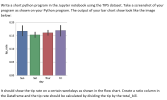 Write a short python program in the Jupyter notebook using the TIPS dataset. Take a screenshot of your program as shown on your Python program. The output of your bar chart show look like the image below: 0.20 0.15 tip_rate 0.10 0.05 0.00 Sun Sat Thur Fri day It should show the tip rate on a certain weekdays as shown in the flow chart. Create a ratio column in the Dataframe and the tip rate should be calculated by dividing...
Write a Python program in this Jupyter Notebook. This program will allow a user to choose...
Write a Python program in this Jupyter Notebook. This program will allow a user to choose from a menu to print various text shapes includeing rectangle, triangle, and diamond as well as a set of numbers in a pattern. This program will allow the user to select the type, the size and/or the fill character for a shape. Your program will verify user inputs such as size for certain range specifications, depending on the shapes.
write a function in jupyter notebook in python that calculate the # exact derivative value of...
write a function in jupyter notebook in python that calculate the # exact derivative value of f(x) = sin^3(x) at x = 1/5
Write a python programme in a Jupyter notebook which asks the user to input the number...
Write a python programme in a Jupyter notebook which asks the user to input the number of radioactive nuclei in a sample, the number at a later time, and the elapsed time. The programme should calculate and display the decay constant and the half-life. The decay is described by the equations: ? = ? ?−?? ?0 ?1/2 = ln (2)/? PLEASE INCLUDE COMMENTS ON CODE. THANKS
Write a program in jupyter notebook to sum the following series: 1/3 + 3/5 + 5/7...
Write a program in jupyter notebook to sum the following series: 1/3 + 3/5 + 5/7 + 7/9 + 11/9 + ....+ 95/97 + 97/ 99
write a python program Implement a “bouncing” bubble sort algorithm. In this version if bubble sort,...
write a python program Implement a “bouncing” bubble sort algorithm. In this version if bubble sort, instead of making passes through a list that starts at the beginning andirons through to the end, you should reverse the direction each pass.That is , if the first pass starts at the beginning of the list and runs through to the end, the second pass out run from the end of the list back to the beginning and then the third pass would...
Install Python, PyTorch, and Jupyter Lab on your computer. Download source code from Deep Learning with...
Install Python, PyTorch, and Jupyter Lab on your computer. Download source code from Deep Learning with PyTorch's Web site. Run jupyter notebook on code in pich3 and submit the screen shots (both jupyter server and the browser display). Can I have step in step on how to do this I’m very confused and finished picture would be fine
In python, Write short programs (notebook cells) showing how to create & use the following data...
In python, Write short programs (notebook cells) showing how to create & use the following data types: Tuples Ints Floats Dictionaries Sets Numpy array The programming details are provided in a separate Jupyter notebook file
1) Write a Python program that prompts the user to enter the current month name and...
1) Write a Python program that prompts the user to enter the current month name and prints the season for that month. Hint: If the user enters March, the output should be "Spring"; if the user enters June, the output should be "Summer". 2 )Write a Python program using the recursive/loop structure to print out an equilateral triangle below (double spacing and one space between any two adjacent asterisks in the same row). * * * * *...
Jupyter code (PYTHON) True error Write a function called trueError that takes the following inputs: •...
 Jupyter code (PYTHON)
True error Write a function called trueError that takes the following inputs: • X, the new value • Xtrue, the previous value And returns the following output: • error, the calculated relative error The formula for the relative error is shown below: errue = 11100% In (): def trueError(x,xtrue): # YOUR CODE HERE raise Not ImplementedError() In (): # You can call and test your function here # YOUR CODE HERE raise Not ImplementedError()
Jupyter code (PYTHON)
True error Write a function called trueError that takes the following inputs: • X, the new value • Xtrue, the previous value And returns the following output: • error, the calculated relative error The formula for the relative error is shown below: errue = 11100% In (): def trueError(x,xtrue): # YOUR CODE HERE raise Not ImplementedError() In (): # You can call and test your function here # YOUR CODE HERE raise Not ImplementedError()
 Write a short python program in the Jupyter notebook using the TIPS dataset. Take a screenshot of your program as shown on your Python program. The output of your bar chart show look like the image below: 0.20 0.15 tip_rate 0.10 0.05 0.00 Sun Sat Thur Fri day It should show the tip rate on a certain weekdays as shown in the flow chart. Create a ratio column in the Dataframe and the tip rate should be calculated by dividing...
 Jupyter code (PYTHON)
True error Write a function called trueError that takes the following inputs: • X, the new value • Xtrue, the previous value And returns the following output: • error, the calculated relative error The formula for the relative error is shown below: errue = 11100% In (): def trueError(x,xtrue): # YOUR CODE HERE raise Not ImplementedError() In (): # You can call and test your function here # YOUR CODE HERE raise Not ImplementedError()
Jupyter code (PYTHON)
True error Write a function called trueError that takes the following inputs: • X, the new value • Xtrue, the previous value And returns the following output: • error, the calculated relative error The formula for the relative error is shown below: errue = 11100% In (): def trueError(x,xtrue): # YOUR CODE HERE raise Not ImplementedError() In (): # You can call and test your function here # YOUR CODE HERE raise Not ImplementedError()
Most questions answered within 3 hours.
-
Where is the error in this code sequence?
String s1 = "Hello";
String s2 = "ello";...
asked 11 months ago -
Financial data for Joel de Paris, Inc., for last year
follow:
Joel de Paris, Inc.
Balance...
asked 11 months ago -
Consider this reaction:
Al2(SO4)3 (aq)+ BaCl3
(aq) Al2Cl6 (aq)- +
3BaSO4(s) . What is the...
asked 11 months ago -
Suppose that Savneet is considering increasing her
recent random sample from 20 car rentals to 40...
asked 11 months ago -
Trucks arrive at an unloading terminal at an average rate of 120
per hour.
Trucks arrive...
asked 11 months ago -
Why are methanol and ethanol completely soluble in water while
octanol is not very little soluble....
asked 11 months ago -
A facilities manager at a university reads in a research report
that the mean amount of...
asked 11 months ago -
When the CuSO4 is rehydrated by adding water to the anhydrous
compound, is this an endothermic...
asked 11 months ago -
A ray of sunlight is passing from diamond into crown glass; the
angle of incidence is...
asked 11 months ago -
A block of mass 0.249 kg is placed on top of a light, vertical
spring of...
asked 11 months ago -
how do the kidneys compensate in the presences of acidosis
a) trigger hyperventilate
b) reserve acid...
asked 11 months ago -
Question 501 pts
The rental rate of capital to the firm increases. Which of the
following...
asked 11 months ago