Fe(s)+O2(g)+H2O(l)=Fe(OH)3(s) A) Balance the equation. B) A 27.9-gram iron nail falls into a stream and remains...
Fe(s)+O2(g)+H2O(l)=Fe(OH)3(s)
A) Balance the equation.
B) A 27.9-gram iron nail falls into a stream and remains at the bottom rusting for many years. Eventually all the iron reacts to form rust. How many grams of rust form?
Homework Answers
4Fe + 3O2 + 6H2O = 4Fe(OH)3
Moles of Fe = mass / molar mass
= 27.9 / 55.8
= 0.5 moles
Now , moles of Fe = moles of Fe(OH)3
= 0.5 mole
Mass of Fe = mole * molar mass
= 0.5 * 106.87
= 53.435 grams
If you have any query please comment
If you satisfied with the solution please like it thankxx
Add Answer to:
Fe(s)+O2(g)+H2O(l)=Fe(OH)3(s)
A) Balance the equation.
B) A 27.9-gram iron nail falls into a stream and remains...
Thefollowingequationdescribestherustingofiron.Note:rustisFe2O3(s) Fe(s) + O2(g) Fe2O3(s) a. Balance the above equa...
Thefollowingequationdescribestherustingofiron.Note:rustisFe2O3(s) Fe(s) + O2(g) Fe2O3(s) a. Balance the above equation. b. If you start with 100.0 grams of iron, how many moles of iron do you have? c. If you start with 100.0 grams of rust, how many moles of rust do you have? d How many moles of rust could be formed from 5.00 moles of iron? e. How many moles of rust could be formed from 5.00 moles of oxygen? f. If 50. moles of rust formed, how...
Iron reacts with oxygen to produce iron(III) oxide. 4 Fe(s) + 3 O2(g) → 2 Fe2O3(s)...
Iron reacts with oxygen to produce iron(III) oxide. 4 Fe(s) + 3 O2(g) → 2 Fe2O3(s) If 4.03 moles of Fe react with excess O2, how many moles of Fe2O3 can be formed?
37. Balance the following equations: a. PbO2(s) —>PbO(s) + O2(g) b. Fe(OH)3(s) —>Fe2O3(s) +H2O(s) C. (NH4)2CO3(s)...
 37. Balance the following equations: a. PbO2(s) —>PbO(s) + O2(g) b. Fe(OH)3(s) —>Fe2O3(s) +H2O(s) C. (NH4)2CO3(s) —>NH3(g)+H20(g) + CO2(g) d. CaCl2(aq) + H2SO4(aq) — CaSO4(s) + HCl(aq) 761
When the reaction below is balanced, how many electrons are transferred? O2(g) + H2O(l) + Fe(s)...
 When the reaction below is balanced, how many electrons are transferred? O2(g) + H2O(l) + Fe(s) --> Fe(OH)3(s) Oo 04 • 12 8
4Fe(OH)^+ (aq) +4(OH)^-(aq) + O2 (g) +2H2O(l)---> 4Fe(OH)3 How many grams of O2 are consumed to...
4Fe(OH)^+ (aq) +4(OH)^-(aq) + O2 (g) +2H2O(l)---> 4Fe(OH)3 How many grams of O2 are consumed to precipitate all of the iron in 80.0 mL of 0.0450 M Fe(II)? I dont understand how to even go about answering this question, so please simplify it as much as possible.
4. Balance the following equations: Al(NO)(aq) + NH.OH(aq) Al(OH),(s) + (NH) (NO) (aq) classify Fe(OH)3(s) +...
 4. Balance the following equations: Al(NO)(aq) + NH.OH(aq) Al(OH),(s) + (NH) (NO) (aq) classify Fe(OH)3(s) + __H,SO.(aq) → ___ Fer(SO.)s(aq) + _ H2O(1) classify CH,CI(I) + O2(g) → - CO2(g) + H2O(g) +- HCI(9) classify Ca(s) + __P_Os() → _ Cao(s) + - P.(I) classify LI.CO() - - HCl(aq) + LICH(aq) H2O(l) + - CO2(g) classify NO2(g) → N2(g) + H2O(1) classify + N2H400) + - 5. P.(s) + O2(g) → - P.Os(s) balance, then classify Calculate the following, with...
Consider the unbalanced equation for the following reaction: O2(g) + C6H5COOH(aq) → CO2(g) + H2O(l) If...
Consider the unbalanced equation for the following reaction: O2(g) + C6H5COOH(aq) → CO2(g) + H2O(l) If 54.0 grams of C6H5COOH(aq) reacts with an excess of O2(g) and 103. grams of CO2(g) is formed, determine the percent yield of CO2(g). (the answer is 76.0%, I want to know the process)
Balance the following equation by the half-reaction method. The reaction takes place in basic solution. Fe(s) + H2O(1)...
 Balance the following equation by the half-reaction method. The reaction takes place in basic solution. Fe(s) + H2O(1) + O2(g) → Fe(OH)3(s) Express your answer as a chemical equation including phases.
The reaction of Fe304(s) with hydrogen(g) to form iron(s) and water(g) proceeds as follows: >3 Fe(s)...
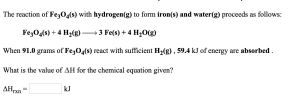 The reaction of Fe304(s) with hydrogen(g) to form iron(s) and water(g) proceeds as follows: >3 Fe(s) + 4 H2O(g) Fe304(s) 4 H2(g) When 91.0 grams of Fe304(s) react with sufficient H2(g), 59.4 kJ of energy are absorbed What is the value of AH for the chemical equation given? kJ AHxn
1) 0.0675 moles of sodium reacts with hydrochloric acid. The skeleton equation is: Na (s) Chem...
 1) 0.0675 moles of sodium reacts with hydrochloric acid. The skeleton equation is: Na (s) Chem 120 Worksheet: Gas Stoichiometry HCl(aq) → NaCl(aq). a) Balance the equation b) Determine the volume of hydrogen gas that will be produced at STP. H, (B) 2) 0.425 moles of ethane undergoes combustion. The skeleton equation is: CaHs (8) + Oz (6) ► co, el a) Balance the equation. b) Determine the volume of carbon dioxide that will be produced at STP. H2O(g) 3)...
 37. Balance the following equations: a. PbO2(s) —>PbO(s) + O2(g) b. Fe(OH)3(s) —>Fe2O3(s) +H2O(s) C. (NH4)2CO3(s) —>NH3(g)+H20(g) + CO2(g) d. CaCl2(aq) + H2SO4(aq) — CaSO4(s) + HCl(aq) 761
 When the reaction below is balanced, how many electrons are transferred? O2(g) + H2O(l) + Fe(s) --> Fe(OH)3(s) Oo 04 • 12 8
 4. Balance the following equations: Al(NO)(aq) + NH.OH(aq) Al(OH),(s) + (NH) (NO) (aq) classify Fe(OH)3(s) + __H,SO.(aq) → ___ Fer(SO.)s(aq) + _ H2O(1) classify CH,CI(I) + O2(g) → - CO2(g) + H2O(g) +- HCI(9) classify Ca(s) + __P_Os() → _ Cao(s) + - P.(I) classify LI.CO() - - HCl(aq) + LICH(aq) H2O(l) + - CO2(g) classify NO2(g) → N2(g) + H2O(1) classify + N2H400) + - 5. P.(s) + O2(g) → - P.Os(s) balance, then classify Calculate the following, with...
 Balance the following equation by the half-reaction method. The reaction takes place in basic solution. Fe(s) + H2O(1) + O2(g) → Fe(OH)3(s) Express your answer as a chemical equation including phases.
 The reaction of Fe304(s) with hydrogen(g) to form iron(s) and water(g) proceeds as follows: >3 Fe(s) + 4 H2O(g) Fe304(s) 4 H2(g) When 91.0 grams of Fe304(s) react with sufficient H2(g), 59.4 kJ of energy are absorbed What is the value of AH for the chemical equation given? kJ AHxn
 1) 0.0675 moles of sodium reacts with hydrochloric acid. The skeleton equation is: Na (s) Chem 120 Worksheet: Gas Stoichiometry HCl(aq) → NaCl(aq). a) Balance the equation b) Determine the volume of hydrogen gas that will be produced at STP. H, (B) 2) 0.425 moles of ethane undergoes combustion. The skeleton equation is: CaHs (8) + Oz (6) ► co, el a) Balance the equation. b) Determine the volume of carbon dioxide that will be produced at STP. H2O(g) 3)...
Most questions answered within 3 hours.
-
Where is the error in this code sequence?
String s1 = "Hello";
String s2 = "ello";...
asked 10 months ago -
Financial data for Joel de Paris, Inc., for last year
follow:
Joel de Paris, Inc.
Balance...
asked 10 months ago -
Consider this reaction:
Al2(SO4)3 (aq)+ BaCl3
(aq) Al2Cl6 (aq)- +
3BaSO4(s) . What is the...
asked 10 months ago -
Suppose that Savneet is considering increasing her
recent random sample from 20 car rentals to 40...
asked 10 months ago -
Trucks arrive at an unloading terminal at an average rate of 120
per hour.
Trucks arrive...
asked 10 months ago -
Why are methanol and ethanol completely soluble in water while
octanol is not very little soluble....
asked 10 months ago -
A facilities manager at a university reads in a research report
that the mean amount of...
asked 10 months ago -
When the CuSO4 is rehydrated by adding water to the anhydrous
compound, is this an endothermic...
asked 10 months ago -
A ray of sunlight is passing from diamond into crown glass; the
angle of incidence is...
asked 10 months ago -
A block of mass 0.249 kg is placed on top of a light, vertical
spring of...
asked 10 months ago -
how do the kidneys compensate in the presences of acidosis
a) trigger hyperventilate
b) reserve acid...
asked 10 months ago -
Question 501 pts
The rental rate of capital to the firm increases. Which of the
following...
asked 10 months ago