Match each statement below with the letters of one or more of the following processes. Letters...
Match each statement below with the letters of one or more of the following processes. Letters may be used more than once, or not at all.
A) Natural Selection
B) Genetic Drift
C) Migration
D) Polyploidy
E) Nucleotide substitution
F) Sexual Selection
1. Creates new genetic variation ________________________________________
2. Changes allele frequencies ____________________________________________
3. Deterministic (directional) process ___________________________________
4. Random process ____________________________________________________
Homework Answers
1)nucleotide substitution causes new genetic variation. Polyploidy also can creates.
2)natural selection, genetic drift and migration can cause change in allelic frequency.
3)sexual selection is directional process.
4)natural selection is random process
Add Answer to:
Match each statement below with the letters of one or more of
the following processes. Letters...
For the four evolutionary processes below, indicate: how they affect allele and genotype frequencies within a...
 For the four evolutionary processes below, indicate: how they affect allele and genotype frequencies within a population, whether or not these effects are random, and how they affect differentiation between populations. Number your answers as indicated in the table below to indicate which part of this question you are answering: Process Within-population allele & genotype frequencies Random?Y/N Genetic differences between populations #1 #9 Natural Selection Genetic Drift Mutation #6 #10 . #11 Migration between populations #4 #12
It is exceedingly rare for all the Hardy-Weinberg assumptions to be met in nature.
It is exceedingly rare for all the Hardy-Weinberg assumptions to be met in nature. Evolution is a change in allele frequencies in a population over time, so a population in Hardy-Weinberg equilibrium is not evolving. Match the following terms with the most correct statement. Each of these relates to evolutionary forces or conditions that violate the Hardy- Weinberg assumptions. (Each term only matches to one statement). Genetic drift - Migration - Inbreeding - 4 Mutation - Natural selection - Nonrandom mating a. Does...
Match the evolutionary forces to their corresponding position on the table. Forces can be placed more...
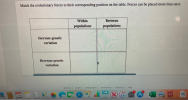 Match the evolutionary forces to their corresponding position on the table. Forces can be placed more than once. Within populations Between populations Increase genetic variation Decrease genetic variation care pracy tenos contact us he IR 29 variation Decrease genetic variation Answer Bank genetic drift mutation some types of natyal selection migration about us Careers privacy policy terms of use contact us help
6. Which of these conditions will lead to evolution by natural selection? a. Heavy metal pollution...
 6. Which of these conditions will lead to evolution by natural selection? a. Heavy metal pollution reduces reproductive success of all phenotypes of green algae in the pond. b. Variation among individuals is not genetic; instead it results from learned behavior or physiological environmental responses. c. Introduction of an exotic predator species results in one native prey phenotype evading predation while other phenotypes get eaten. d. Individuals of the population are clones (genetically identical). 7. Which one is used as...
Draw a model or concept map linking at least these evolutionary concepts. You are free to...
Draw a model or concept map linking at least these evolutionary concepts. You are free to add more. When you make a link between two ideas you must write what links the concepts above the arrow. Just drawing arrows does not help build your understanding. Words required to appear in your map: allele frequencies evolution non-random mating migration natural selection genetic drift Hardy-Weinberg equilibrium population individual speciation sexual selection fossil record macroevolution phenotypic plasticity kin selection coevolution population size species...
Can you complete this concept map that reviews some key ideas about evolution? Part A Drag...
 Can you complete this concept map that reviews some key ideas about evolution? Part A Drag the labels from the left to their correct locations in the concept map on the right. Reset Help Populations allele frequencies include individuals with differences due to 6 are units that undergo may be in genetic drift genetic variation sources are if change in if no change in maintained only if mutation Hardy-Weinberg equilibrium large population size, no gene flow, no mutation, random mating,...
Match one of the following terms to each part: Natural selection, speciation, disruptive selection, allele frequencies,...
 Match one of the following terms to each part: Natural selection, speciation, disruptive selection, allele frequencies, directional selection a)Through time organisms change morphology making them different species is called? b) When an organism is fit and withstands change in their environment they can adapt and are selected to live longer and breed more is called? c)When traits change in populations the genotypes change which leads to this in the population?
For the four evolutionary processes below, indicate: how they affect allele and genotype frequencies within a...
 For the four evolutionary processes below, indicate: how they affect allele and genotype frequencies within a population, whether or not these effects are random, and how they affect differentiation between populations. Number your answers as indicated in the table below to indicate which part of this question you are answering: Process Within-population allele & genotype frequencies Random? Y/N Genetic differences between populations #1 Natural Selection Genetic Drift Mutation #2 #5 #6 #7 #9 #10 #11 #3 Migration between populations #4...
heterozygote disadvantage Natural selection is the process by which organisms with the best adapted phenotype are...
 heterozygote disadvantage Natural selection is the process by which organisms with the best adapted phenotype are selected for by environmental conditions. anthropogenic events such as the use of DDT heterozygote advantage Allelic frequencies can change due to selection or they may change due to genetic drift. environmental conditions The process of natural selection relies on the presence of of a gene within a population. genetic drift Deleterious alleles may persist in the population particularly if they confer a single allele...
13. Which of the following is the only evolutionary process that consistently produces adaptation? a. Genetic...
 13. Which of the following is the only evolutionary process that consistently produces adaptation? a. Genetic drift b. Natural selection c. Gene flow d. Mutations 14. Which of the following is NOT a possible result when isolated populations come into contact? a. Dispersal b. Stability c. Reinforcement d. Fusion e. New Species 15. What is greater than mutations in producing variation in diploids? a, transformation b. sexual recombination c. natural selection d. punctuated equilibrium e. conjugation 16. Which type of...
 For the four evolutionary processes below, indicate: how they affect allele and genotype frequencies within a population, whether or not these effects are random, and how they affect differentiation between populations. Number your answers as indicated in the table below to indicate which part of this question you are answering: Process Within-population allele & genotype frequencies Random?Y/N Genetic differences between populations #1 #9 Natural Selection Genetic Drift Mutation #6 #10 . #11 Migration between populations #4 #12
 Match the evolutionary forces to their corresponding position on the table. Forces can be placed more than once. Within populations Between populations Increase genetic variation Decrease genetic variation care pracy tenos contact us he IR 29 variation Decrease genetic variation Answer Bank genetic drift mutation some types of natyal selection migration about us Careers privacy policy terms of use contact us help
 6. Which of these conditions will lead to evolution by natural selection? a. Heavy metal pollution reduces reproductive success of all phenotypes of green algae in the pond. b. Variation among individuals is not genetic; instead it results from learned behavior or physiological environmental responses. c. Introduction of an exotic predator species results in one native prey phenotype evading predation while other phenotypes get eaten. d. Individuals of the population are clones (genetically identical). 7. Which one is used as...
 Can you complete this concept map that reviews some key ideas about evolution? Part A Drag the labels from the left to their correct locations in the concept map on the right. Reset Help Populations allele frequencies include individuals with differences due to 6 are units that undergo may be in genetic drift genetic variation sources are if change in if no change in maintained only if mutation Hardy-Weinberg equilibrium large population size, no gene flow, no mutation, random mating,...
 Match one of the following terms to each part: Natural selection, speciation, disruptive selection, allele frequencies, directional selection a)Through time organisms change morphology making them different species is called? b) When an organism is fit and withstands change in their environment they can adapt and are selected to live longer and breed more is called? c)When traits change in populations the genotypes change which leads to this in the population?
 For the four evolutionary processes below, indicate: how they affect allele and genotype frequencies within a population, whether or not these effects are random, and how they affect differentiation between populations. Number your answers as indicated in the table below to indicate which part of this question you are answering: Process Within-population allele & genotype frequencies Random? Y/N Genetic differences between populations #1 Natural Selection Genetic Drift Mutation #2 #5 #6 #7 #9 #10 #11 #3 Migration between populations #4...
 heterozygote disadvantage Natural selection is the process by which organisms with the best adapted phenotype are selected for by environmental conditions. anthropogenic events such as the use of DDT heterozygote advantage Allelic frequencies can change due to selection or they may change due to genetic drift. environmental conditions The process of natural selection relies on the presence of of a gene within a population. genetic drift Deleterious alleles may persist in the population particularly if they confer a single allele...
 13. Which of the following is the only evolutionary process that consistently produces adaptation? a. Genetic drift b. Natural selection c. Gene flow d. Mutations 14. Which of the following is NOT a possible result when isolated populations come into contact? a. Dispersal b. Stability c. Reinforcement d. Fusion e. New Species 15. What is greater than mutations in producing variation in diploids? a, transformation b. sexual recombination c. natural selection d. punctuated equilibrium e. conjugation 16. Which type of...
Most questions answered within 3 hours.
-
Where is the error in this code sequence?
String s1 = "Hello";
String s2 = "ello";...
asked 10 months ago -
Financial data for Joel de Paris, Inc., for last year
follow:
Joel de Paris, Inc.
Balance...
asked 10 months ago -
Consider this reaction:
Al2(SO4)3 (aq)+ BaCl3
(aq) Al2Cl6 (aq)- +
3BaSO4(s) . What is the...
asked 10 months ago -
Suppose that Savneet is considering increasing her
recent random sample from 20 car rentals to 40...
asked 10 months ago -
Trucks arrive at an unloading terminal at an average rate of 120
per hour.
Trucks arrive...
asked 10 months ago -
Why are methanol and ethanol completely soluble in water while
octanol is not very little soluble....
asked 10 months ago -
A facilities manager at a university reads in a research report
that the mean amount of...
asked 10 months ago -
When the CuSO4 is rehydrated by adding water to the anhydrous
compound, is this an endothermic...
asked 10 months ago -
A ray of sunlight is passing from diamond into crown glass; the
angle of incidence is...
asked 10 months ago -
A block of mass 0.249 kg is placed on top of a light, vertical
spring of...
asked 10 months ago -
how do the kidneys compensate in the presences of acidosis
a) trigger hyperventilate
b) reserve acid...
asked 10 months ago -
Question 501 pts
The rental rate of capital to the firm increases. Which of the
following...
asked 10 months ago