A negative feedback closed-loop amplifier employs an internal open-loop basic amplifier with input and output resistances...
-
A negative feedback closed-loop amplifier employs an internal open-loop basic amplifier with input and output resistances each of 1k and gain A=1000V/V. The closed-loop amplifier has a feedback factor of =0.1V/V. Sketch the closed-loop feedback amplifier block diagram. For the closed-loop amplifier, find the gain, Af, the input resistance, Rif, and the output resistance, Rof.
Homework Answers

Add Answer to:
A negative feedback closed-loop amplifier employs an internal
open-loop basic amplifier with input and output resistances...
Requires 100% correct answer along with pspice 10.24 A transconductance amplifier with negative feedback is shown...
 Requires 100% correct answer along with pspice
10.24 A transconductance amplifier with negative feedback is shown in Fig. P10.24. The amplifier has an open-loop P transconductance of A 50 x 103 A/V, an input resistance of R 25 k!2, and an output resistance of Ro-50 k2. The feedback circuit has RF 2.5 kS2. The source resistance is Rs 1 k, and the load resistance is RL-500 Ω. Determine (a) the input resistance Ri,-vs/is, (b) the output resistance Rof, and (c)...
Requires 100% correct answer along with pspice
10.24 A transconductance amplifier with negative feedback is shown in Fig. P10.24. The amplifier has an open-loop P transconductance of A 50 x 103 A/V, an input resistance of R 25 k!2, and an output resistance of Ro-50 k2. The feedback circuit has RF 2.5 kS2. The source resistance is Rs 1 k, and the load resistance is RL-500 Ω. Determine (a) the input resistance Ri,-vs/is, (b) the output resistance Rof, and (c)...
Q 9. The open-loop gain of an amplifier is A = 65 , and the feedback...
 Q 9. The open-loop gain of an amplifier is A = 65 , and the feedback factor is B = 0.5 . If the open-loop gain A changes by -18% and the feedback factor B changes by +17%, determine the closed-loop gain Af (25 points)
7. For a particular voltage amplifier connected in a feedback loop, measurement of the output resistance...
 7. For a particular voltage amplifier connected in a feedback loop, measurement of the output resistance before and after the loop is connected shows a change by a factor of 100. (a) (5 pts) Is the output resistance with feedback higher or lower? (b) (5 pts) What is the value of the loop gain ? (c) (5 pts) If Rof is 100 Ω, what is Ro without feedback?
EEET255 Electronics Page 4 of6 QUESTION 3: [25 marks] Figure 3 shows a feedback amplifier circuit...
 EEET255 Electronics Page 4 of6 QUESTION 3: [25 marks] Figure 3 shows a feedback amplifier circuit R, is the source resistor, R is the feedback resistor and R, is the load resistor. The op-amp has an internal input resistance of R, an intemal output resistance R, and an internal gain of A Apply the "Systematic Analysis" method in this question. Figure 3 3.a State the feedback topology used in the amplifier circuit and which type of feedback amplifier is shown...
2. For the amplifier with feedback shown: Output Input OL Give expressions for the open-loop and...
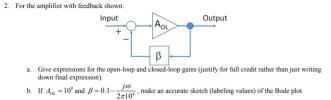 2. For the amplifier with feedback shown: Output Input OL Give expressions for the open-loop and closed-loop gains (justify for full credit rather than just writing down final expression). a. If AOL = 10 and β-01-2-04, make an accurate sketch (labeling values) of the Bode plot. b. 2T104
Q3(a) Explain TWO (2) differences between system with positive feedback and system with negative feedback. (b)...
 Q3(a) Explain TWO (2) differences between system with positive feedback and system with negative feedback. (b) With the aid of a block diagram, derive the closed-loop gain, Af of a negative feedback system. (c) An amplifier with a negative feedback has a midband gain of 47.96 dB and low cutoff frequency of 75 Hz. The feedback network of the system has a feedback factor (B) of 0.0022. (1) Determine the midband gain and the low cutoff frequency if the amplifier...
2. A designer is considering two possible designs of a feedback amplifier. The goal is to get a c...
 2. A designer is considering two possible designs of a feedback amplifier. The goal is to get a closed- loop gain of A, 20 V/V. One design employs an amplifier for which A- 500 V/V; the other uses an amplifier with the open-loop gain A 250 V/N Find B and the desensitivity factor in both cases. If the A-500 V/V amplifier unit has a gain uncertainty of ±10%, what is the gain uncertainty for the closed-loop amplifiers utilizing this amplifier?...
Question 4: Figure 4 In the series-shunt feedback amplifier shown in Figure 4, the transistors are...
 Question 4: Figure 4 In the series-shunt feedback amplifier shown in Figure 4, the transistors are biased with ideal current-sources 1, 0.1mA, 12 1mA, the devices operate with VE0.7V and t = 100. The input signal V, has a zero DC component. Resistances are (a) If the open loop gain is large, what do you expect the closed-loop gain A, -V/V, to be? Give both an expression and its approximate value (b) Find the DC emitter current in each of...
A positive-feedback closed-loop system is subjected to an input voltage of 1V dc. Assuming the forward...
A positive-feedback closed-loop system is subjected to an input voltage of 1V dc. Assuming the forward path gain of 1 and a feedback path gain of 0.5 Sketch the block diagram of the system. Deduce the signal flow diagram of the system Determine the output voltage
A negative feedback amplifier has an open loop voltage gain as follows: (1+s/opl)( 1+s/op2) If th...
 A negative feedback amplifier has an open loop voltage gain as follows: (1+s/opl)( 1+s/op2) If the feedback factor is β (a) show that the gain with feedback is given by (b) Show the pole locations on the complex plane
A negative feedback amplifier has an open loop voltage gain as follows: (1+s/opl)( 1+s/op2) If the feedback factor is β (a) show that the gain with feedback is given by (b) Show the pole locations on the complex plane
A negative feedback amplifier has an open loop voltage gain as follows: (1+s/opl)( 1+s/op2) If the feedback factor is β (a) show that the gain with feedback is given by (b) Show the pole locations on the complex plane
 Requires 100% correct answer along with pspice
10.24 A transconductance amplifier with negative feedback is shown in Fig. P10.24. The amplifier has an open-loop P transconductance of A 50 x 103 A/V, an input resistance of R 25 k!2, and an output resistance of Ro-50 k2. The feedback circuit has RF 2.5 kS2. The source resistance is Rs 1 k, and the load resistance is RL-500 Ω. Determine (a) the input resistance Ri,-vs/is, (b) the output resistance Rof, and (c)...
Requires 100% correct answer along with pspice
10.24 A transconductance amplifier with negative feedback is shown in Fig. P10.24. The amplifier has an open-loop P transconductance of A 50 x 103 A/V, an input resistance of R 25 k!2, and an output resistance of Ro-50 k2. The feedback circuit has RF 2.5 kS2. The source resistance is Rs 1 k, and the load resistance is RL-500 Ω. Determine (a) the input resistance Ri,-vs/is, (b) the output resistance Rof, and (c)...
 Q 9. The open-loop gain of an amplifier is A = 65 , and the feedback factor is B = 0.5 . If the open-loop gain A changes by -18% and the feedback factor B changes by +17%, determine the closed-loop gain Af (25 points)
 7. For a particular voltage amplifier connected in a feedback loop, measurement of the output resistance before and after the loop is connected shows a change by a factor of 100. (a) (5 pts) Is the output resistance with feedback higher or lower? (b) (5 pts) What is the value of the loop gain ? (c) (5 pts) If Rof is 100 Ω, what is Ro without feedback?
 EEET255 Electronics Page 4 of6 QUESTION 3: [25 marks] Figure 3 shows a feedback amplifier circuit R, is the source resistor, R is the feedback resistor and R, is the load resistor. The op-amp has an internal input resistance of R, an intemal output resistance R, and an internal gain of A Apply the "Systematic Analysis" method in this question. Figure 3 3.a State the feedback topology used in the amplifier circuit and which type of feedback amplifier is shown...
 2. For the amplifier with feedback shown: Output Input OL Give expressions for the open-loop and closed-loop gains (justify for full credit rather than just writing down final expression). a. If AOL = 10 and β-01-2-04, make an accurate sketch (labeling values) of the Bode plot. b. 2T104
 Q3(a) Explain TWO (2) differences between system with positive feedback and system with negative feedback. (b) With the aid of a block diagram, derive the closed-loop gain, Af of a negative feedback system. (c) An amplifier with a negative feedback has a midband gain of 47.96 dB and low cutoff frequency of 75 Hz. The feedback network of the system has a feedback factor (B) of 0.0022. (1) Determine the midband gain and the low cutoff frequency if the amplifier...
 2. A designer is considering two possible designs of a feedback amplifier. The goal is to get a closed- loop gain of A, 20 V/V. One design employs an amplifier for which A- 500 V/V; the other uses an amplifier with the open-loop gain A 250 V/N Find B and the desensitivity factor in both cases. If the A-500 V/V amplifier unit has a gain uncertainty of ±10%, what is the gain uncertainty for the closed-loop amplifiers utilizing this amplifier?...
 Question 4: Figure 4 In the series-shunt feedback amplifier shown in Figure 4, the transistors are biased with ideal current-sources 1, 0.1mA, 12 1mA, the devices operate with VE0.7V and t = 100. The input signal V, has a zero DC component. Resistances are (a) If the open loop gain is large, what do you expect the closed-loop gain A, -V/V, to be? Give both an expression and its approximate value (b) Find the DC emitter current in each of...
 A negative feedback amplifier has an open loop voltage gain as follows: (1+s/opl)( 1+s/op2) If the feedback factor is β (a) show that the gain with feedback is given by (b) Show the pole locations on the complex plane
A negative feedback amplifier has an open loop voltage gain as follows: (1+s/opl)( 1+s/op2) If the feedback factor is β (a) show that the gain with feedback is given by (b) Show the pole locations on the complex plane
A negative feedback amplifier has an open loop voltage gain as follows: (1+s/opl)( 1+s/op2) If the feedback factor is β (a) show that the gain with feedback is given by (b) Show the pole locations on the complex plane
Most questions answered within 3 hours.
-
Where is the error in this code sequence?
String s1 = "Hello";
String s2 = "ello";...
asked 11 months ago -
Financial data for Joel de Paris, Inc., for last year
follow:
Joel de Paris, Inc.
Balance...
asked 11 months ago -
Consider this reaction:
Al2(SO4)3 (aq)+ BaCl3
(aq) Al2Cl6 (aq)- +
3BaSO4(s) . What is the...
asked 11 months ago -
Suppose that Savneet is considering increasing her
recent random sample from 20 car rentals to 40...
asked 11 months ago -
Trucks arrive at an unloading terminal at an average rate of 120
per hour.
Trucks arrive...
asked 11 months ago -
Why are methanol and ethanol completely soluble in water while
octanol is not very little soluble....
asked 11 months ago -
A facilities manager at a university reads in a research report
that the mean amount of...
asked 11 months ago -
When the CuSO4 is rehydrated by adding water to the anhydrous
compound, is this an endothermic...
asked 11 months ago -
A ray of sunlight is passing from diamond into crown glass; the
angle of incidence is...
asked 11 months ago -
A block of mass 0.249 kg is placed on top of a light, vertical
spring of...
asked 11 months ago -
how do the kidneys compensate in the presences of acidosis
a) trigger hyperventilate
b) reserve acid...
asked 11 months ago -
Question 501 pts
The rental rate of capital to the firm increases. Which of the
following...
asked 11 months ago