Given a four element linear array with element spacing d, derive the array factor and how...
- Given a four element linear array with element spacing d, derive the array factor and how does this differ from the total antenna pattern?
Homework Answers
solution:
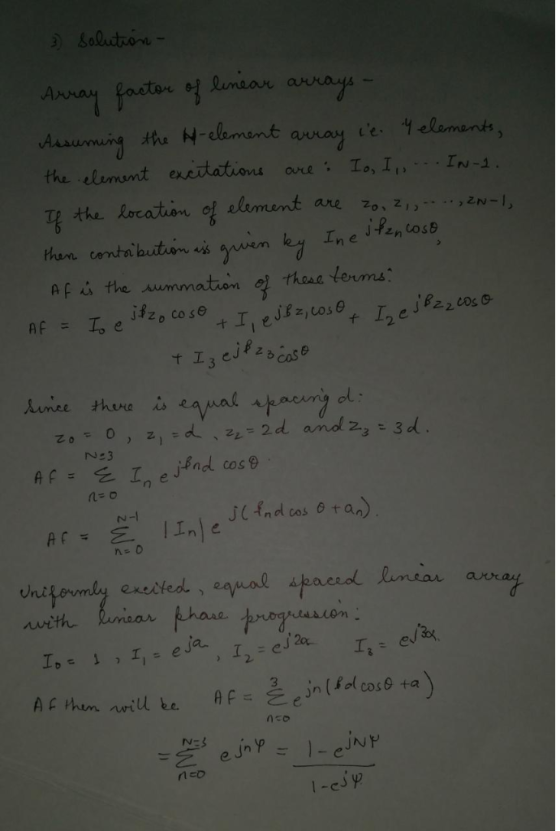
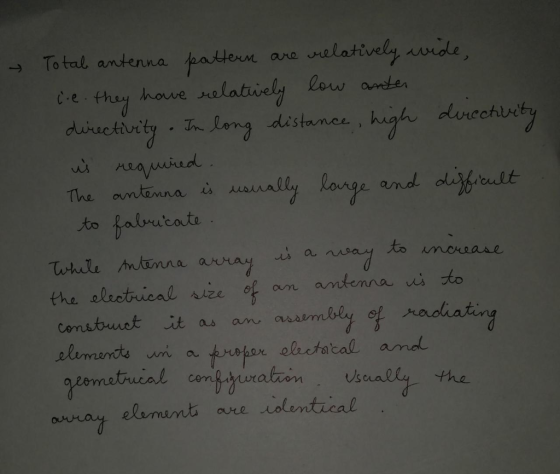
please give me up-vote ..its help me to write more questions,,thank you..
Add Answer to:
Given a four element linear array with element spacing
d, derive the array factor and how...
Q4: (0) Define array factor for an N element unifom linear array antenna with the help of a suita...
 Q4: (0) Define array factor for an N element unifom linear array antenna with the help of a suitable igure and equations. Assume have progressive phase shift of B. How total antenna nattern is related to the array factor? (iü) Compute array factor in simplified form for 10 elements array placed along Z-axis where element to element spacing (d) is 0.72), progressive phase is 45°, frequency of operation is 24 GHz when the main beam is pointed at θ 60°....
Problem 2 (20 pts). Given a 5-element array with equal spacing, uniform amplitude and phase with d Write the normalized array factor for both the endfire and broadside radiation patterns. Pr...
 Problem 2 (20 pts). Given a 5-element array with equal spacing, uniform amplitude and phase with d Write the normalized array factor for both the endfire and broadside radiation patterns.
Problem 2 (20 pts). Given a 5-element array with equal spacing, uniform amplitude and phase with d Write the normalized array factor for both the endfire and broadside radiation patterns.
Problem 2 (20 pts). Given a 5-element array with equal spacing, uniform amplitude and phase with d Write the normalized array factor for both the endfire and broadside radiation patterns.
Design a 19-element uniform linear scanning array with a spacing of A/4 between the ele- ments....
 Design a 19-element uniform linear scanning array with a spacing of A/4 between the ele- ments. (a) What is the progressive phase excitation between the elements so that the maximum of the array factor is 30° from the line where the elements are placed? (b) What is the half-power beamwidth (in degrees) of the array factor of part a? (c) What is the value (in dB) of the maximum of the first minor lobe? Verify using the computer program Arrays...
0 Problem 2 (20 pts). Given a S-element array with equal spacing, uniform amplitude and phase with dWrite the normalized array factor for both the endfie and broadside radiation patterns 0 P...
 0 Problem 2 (20 pts). Given a S-element array with equal spacing, uniform amplitude and phase with dWrite the normalized array factor for both the endfie and broadside radiation patterns
0 Problem 2 (20 pts). Given a S-element array with equal spacing, uniform amplitude and phase with dWrite the normalized array factor for both the endfie and broadside radiation patterns
0 Problem 2 (20 pts). Given a S-element array with equal spacing, uniform amplitude and phase with dWrite the normalized array factor for both the endfie and broadside radiation patterns
8.3-8 Design and plot the array factor for an ordinary endfire, five-element, uniformly excited linear array with spacings d 0.35λ. Use θ°-180° and find a. 8.3-8 Design and plot the array factor...
 8.3-8 Design and plot the array factor for an ordinary endfire, five-element, uniformly excited linear array with spacings d 0.35λ. Use θ°-180° and find a.
8.3-8 Design and plot the array factor for an ordinary endfire, five-element, uniformly excited linear array with spacings d 0.35λ. Use θ°-180° and find a.
8.3-8 Design and plot the array factor for an ordinary endfire, five-element, uniformly excited linear array with spacings d 0.35λ. Use θ°-180° and find a.
Consider the special case of an interferometer, which can be described as a 2-element phased array...
Consider the special case of an interferometer, which can be described as a 2-element phased array antenna, consisting of two isotropic, in-phase, radiating elements separated by a distance d. Assume d is much greater than λ, the wavelength of the transmitted EM wave. Show that the first null off boresight in the far-field antenna pattern occurs at angle θ≈λ /2d radians.(See “The Double Slit” or “Young’s Experiment” for ideas).
Name: Problem 2. (Option # 1 ) Five half wavelength dipole antennas are used as sources to form a linear phased arr...
 Name: Problem 2. (Option # 1 ) Five half wavelength dipole antennas are used as sources to form a linear phased array antenna, as shown below. These elements are all excited by sinusoidal current source of equal amplitude and phase followed by phase shifters. (9 pts.) a) If d 2, write the expression for array factor of the linear array. (9 pts.) b) Find total field at observation point P: (r, 0, 6) at far-field (i.e., kr>1). (8 pts.) c)...
8.2-4 Usually, the interelement spacing of an array is about one-half wavelength. Spacings much greater than this produce major lobes in undesired directions. To illustrate this point, use the techni...
 8.2-4 Usually, the interelement spacing of an array is about one-half wavelength. Spacings much greater than this produce major lobes in undesired directions. To illustrate this point, use the techniques of Fig. 8-6 to sketch the array factor for a two-element array with equal amplitude, in-phase elements in polar form for the following spacings: (a) d31/4 and (b) d- 22. Examples 3-2 and 8-1 and this problem show the effects of spacing on an array of fixed excitation. 2π -Visible...
It is desired to design a broadside uniform linear array with the elements placed along the...
 It is desired to design a broadside uniform linear array with the elements placed along the x-axis. The design requires a total length (edge-to-edge) of the array is 42 and the spacing between the elements must be A/2. Determine the: (a) Number of elements of the array (b) Half-power beamwidth (in degrees) for the uniform broadside array. (c) Maximum directivity (dimensionless and in dB) for the uniform broadside array. (d) Side lobe level (in dB) of the uniform broadside array....
Name three types of data structures. How is an element in an array different from an...
Name three types of data structures. How is an element in an array different from an element in a record? How is an element in an array different from an element in a linked list? Why should we use indexes rather than subscripts to identify array elements? How are the elements of an array stored in memory?
 Q4: (0) Define array factor for an N element unifom linear array antenna with the help of a suitable igure and equations. Assume have progressive phase shift of B. How total antenna nattern is related to the array factor? (iü) Compute array factor in simplified form for 10 elements array placed along Z-axis where element to element spacing (d) is 0.72), progressive phase is 45°, frequency of operation is 24 GHz when the main beam is pointed at θ 60°....
 Problem 2 (20 pts). Given a 5-element array with equal spacing, uniform amplitude and phase with d Write the normalized array factor for both the endfire and broadside radiation patterns.
Problem 2 (20 pts). Given a 5-element array with equal spacing, uniform amplitude and phase with d Write the normalized array factor for both the endfire and broadside radiation patterns.
Problem 2 (20 pts). Given a 5-element array with equal spacing, uniform amplitude and phase with d Write the normalized array factor for both the endfire and broadside radiation patterns.
 Design a 19-element uniform linear scanning array with a spacing of A/4 between the ele- ments. (a) What is the progressive phase excitation between the elements so that the maximum of the array factor is 30° from the line where the elements are placed? (b) What is the half-power beamwidth (in degrees) of the array factor of part a? (c) What is the value (in dB) of the maximum of the first minor lobe? Verify using the computer program Arrays...
 0 Problem 2 (20 pts). Given a S-element array with equal spacing, uniform amplitude and phase with dWrite the normalized array factor for both the endfie and broadside radiation patterns
0 Problem 2 (20 pts). Given a S-element array with equal spacing, uniform amplitude and phase with dWrite the normalized array factor for both the endfie and broadside radiation patterns
0 Problem 2 (20 pts). Given a S-element array with equal spacing, uniform amplitude and phase with dWrite the normalized array factor for both the endfie and broadside radiation patterns
 8.3-8 Design and plot the array factor for an ordinary endfire, five-element, uniformly excited linear array with spacings d 0.35λ. Use θ°-180° and find a.
8.3-8 Design and plot the array factor for an ordinary endfire, five-element, uniformly excited linear array with spacings d 0.35λ. Use θ°-180° and find a.
8.3-8 Design and plot the array factor for an ordinary endfire, five-element, uniformly excited linear array with spacings d 0.35λ. Use θ°-180° and find a.
 Name: Problem 2. (Option # 1 ) Five half wavelength dipole antennas are used as sources to form a linear phased array antenna, as shown below. These elements are all excited by sinusoidal current source of equal amplitude and phase followed by phase shifters. (9 pts.) a) If d 2, write the expression for array factor of the linear array. (9 pts.) b) Find total field at observation point P: (r, 0, 6) at far-field (i.e., kr>1). (8 pts.) c)...
 8.2-4 Usually, the interelement spacing of an array is about one-half wavelength. Spacings much greater than this produce major lobes in undesired directions. To illustrate this point, use the techniques of Fig. 8-6 to sketch the array factor for a two-element array with equal amplitude, in-phase elements in polar form for the following spacings: (a) d31/4 and (b) d- 22. Examples 3-2 and 8-1 and this problem show the effects of spacing on an array of fixed excitation. 2π -Visible...
 It is desired to design a broadside uniform linear array with the elements placed along the x-axis. The design requires a total length (edge-to-edge) of the array is 42 and the spacing between the elements must be A/2. Determine the: (a) Number of elements of the array (b) Half-power beamwidth (in degrees) for the uniform broadside array. (c) Maximum directivity (dimensionless and in dB) for the uniform broadside array. (d) Side lobe level (in dB) of the uniform broadside array....
Most questions answered within 3 hours.
-
Where is the error in this code sequence?
String s1 = "Hello";
String s2 = "ello";...
asked 11 months ago -
Financial data for Joel de Paris, Inc., for last year
follow:
Joel de Paris, Inc.
Balance...
asked 11 months ago -
Consider this reaction:
Al2(SO4)3 (aq)+ BaCl3
(aq) Al2Cl6 (aq)- +
3BaSO4(s) . What is the...
asked 11 months ago -
Suppose that Savneet is considering increasing her
recent random sample from 20 car rentals to 40...
asked 11 months ago -
Trucks arrive at an unloading terminal at an average rate of 120
per hour.
Trucks arrive...
asked 11 months ago -
Why are methanol and ethanol completely soluble in water while
octanol is not very little soluble....
asked 11 months ago -
A facilities manager at a university reads in a research report
that the mean amount of...
asked 11 months ago -
When the CuSO4 is rehydrated by adding water to the anhydrous
compound, is this an endothermic...
asked 11 months ago -
A ray of sunlight is passing from diamond into crown glass; the
angle of incidence is...
asked 11 months ago -
A block of mass 0.249 kg is placed on top of a light, vertical
spring of...
asked 11 months ago -
how do the kidneys compensate in the presences of acidosis
a) trigger hyperventilate
b) reserve acid...
asked 11 months ago -
Question 501 pts
The rental rate of capital to the firm increases. Which of the
following...
asked 11 months ago