As a particle in a box is heated from 25ºC to 50ºC, by what factor will...
As a particle in a box is heated from 25ºC to 50ºC, by what factor will its partition function increase or decrease?
Homework Answers
Request Answer!
We need at least 10 more requests to produce the answer.
0 / 10 have requested this problem solution
The more requests, the faster the answer.
Add Answer to:
As a particle in a box is heated from 25ºC to 50ºC, by what
factor will...
probabilities. A box containing a particle is divided into a right and left compartment by a...
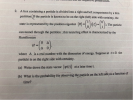 probabilities. A box containing a particle is divided into a right and left compartment by a thin 2. partition If the particle is known to be on the right (left) side with certainty, the state is represented by the position eigenket |R)=|, ||2)=|, .T The particle can tunnel through the partition; this tunneling effect is characterized by the Hamiltonian -) 0 A Н%D where A is a real number with the dimension of energy. Suppose at t 0 the particlé...
A particle is in the ground state of a box of length L (from -L/2 to...
 A particle is in the ground state of a box of length L (from -L/2 to L/2). Suddenly the box expands symmetrically to twice its size (from -L to L), leaving the wave function undisturbed. Show that the probability of finding the particle in the ground state of the new box is (8/3pi)^2.
The wavefunctions for a particle in a box are given by: ψn(x) = (2/L)^1/2 sin(nπx/L), with...
The wavefunctions for a particle in a box are given by: ψn(x) = (2/L)^1/2 sin(nπx/L), with n=1,2,3,4. . . . Let’s assume an electron is trapped in a box of length L = 0.5 nm. (a) Light of what wavelength is needed to excite the electron from the ground to the first excited state? (b) Will that wavelength increase or decrease, if you exchange the electron with a proton? Why?
6. For a particle in a one-dimensional box, the ground state wave function is sin What...
 6. For a particle in a one-dimensional box, the ground state wave function is sin What is the probability that the particle is in the right-hand half of the box? Ans: V/, or 50% а. b What is the probability that the partic le is in the middle third of the box? Ans: 0.609 or 60.9%
for a particle in a square box of side L, at what position is the probability...
for a particle in a square box of side L, at what position is the probability density a maximum if the wave function has n1=1, n2=3? also describe the position of any node or nodes in the wave function.
For the particle-in-a-box of length a, assume that instead of a sine function, the ground state wavefunction is an upside-down parabola at the center of the box, b/2. What is the total energy of...
 For the particle-in-a-box of length a, assume that instead of a sine function, the ground state wavefunction is an upside-down parabola at the center of the box, b/2. What is the total energy of the trial system and what is the wavefunction of the system. Now compare your result to the particle-in-a-box where the potential energy inside the box is zero, what is the difference of percentage of both systems?
For the particle-in-a-box of length a, assume that instead of...
For the particle-in-a-box of length a, assume that instead of a sine function, the ground state wavefunction is an upside-down parabola at the center of the box, b/2. What is the total energy of the trial system and what is the wavefunction of the system. Now compare your result to the particle-in-a-box where the potential energy inside the box is zero, what is the difference of percentage of both systems?
For the particle-in-a-box of length a, assume that instead of...
When we discussed the particle in a box model, we defined our box to be from...
When we discussed the particle in a box model, we defined our box to be from x=0 to x=a. Re- examine this problem, defining the box to be from -a to +a. Recall that the general solution for a particle in a region of V=0 is ψ = A sin kx + B cos kx. Apply the appropriate boundary conditions, figure out what k is (in terms of a), and normalize your solution (i.e. evaluate A and B). .
By what factor is the kinetic energy for a relatvisitic particle greater than a classical particle...
By what factor is the kinetic energy for a relatvisitic particle greater than a classical particle if the particle is moving at .3c, .9c, .99c?
Particle in a box Figure 1 is an illustration of the concept of a particle in...
 Particle in a box Figure 1 is an illustration of the concept of a particle in a box. V=00 V=00 V=0 Figure 1. A representation of a particle in a box, where the potential energy, V, is zero between x = 0 and x = L and rises abruptly to infinity at the walls. The Schrödinger equation for a particle in a box reads t² d²u Y +V(x)y = Ey 2m dx2 + (1) where ħ=h/21 , y represents the...
II.6. The wave function of a particle in a 1D rigid box (infinite potential well) of...
 II.6. The wave function of a particle in a 1D rigid box (infinite potential well) of length L is: v, 8, 1) = sin(x)e-En/5). n = 1,2,3... What is the probability density of finding the particle in its 2nd excited state?
 probabilities. A box containing a particle is divided into a right and left compartment by a thin 2. partition If the particle is known to be on the right (left) side with certainty, the state is represented by the position eigenket |R)=|, ||2)=|, .T The particle can tunnel through the partition; this tunneling effect is characterized by the Hamiltonian -) 0 A Н%D where A is a real number with the dimension of energy. Suppose at t 0 the particlé...
 A particle is in the ground state of a box of length L (from -L/2 to L/2). Suddenly the box expands symmetrically to twice its size (from -L to L), leaving the wave function undisturbed. Show that the probability of finding the particle in the ground state of the new box is (8/3pi)^2.
 6. For a particle in a one-dimensional box, the ground state wave function is sin What is the probability that the particle is in the right-hand half of the box? Ans: V/, or 50% а. b What is the probability that the partic le is in the middle third of the box? Ans: 0.609 or 60.9%
 For the particle-in-a-box of length a, assume that instead of a sine function, the ground state wavefunction is an upside-down parabola at the center of the box, b/2. What is the total energy of the trial system and what is the wavefunction of the system. Now compare your result to the particle-in-a-box where the potential energy inside the box is zero, what is the difference of percentage of both systems?
For the particle-in-a-box of length a, assume that instead of...
For the particle-in-a-box of length a, assume that instead of a sine function, the ground state wavefunction is an upside-down parabola at the center of the box, b/2. What is the total energy of the trial system and what is the wavefunction of the system. Now compare your result to the particle-in-a-box where the potential energy inside the box is zero, what is the difference of percentage of both systems?
For the particle-in-a-box of length a, assume that instead of...
 Particle in a box Figure 1 is an illustration of the concept of a particle in a box. V=00 V=00 V=0 Figure 1. A representation of a particle in a box, where the potential energy, V, is zero between x = 0 and x = L and rises abruptly to infinity at the walls. The Schrödinger equation for a particle in a box reads t² d²u Y +V(x)y = Ey 2m dx2 + (1) where ħ=h/21 , y represents the...
 II.6. The wave function of a particle in a 1D rigid box (infinite potential well) of length L is: v, 8, 1) = sin(x)e-En/5). n = 1,2,3... What is the probability density of finding the particle in its 2nd excited state?
Most questions answered within 3 hours.
-
Where is the error in this code sequence?
String s1 = "Hello";
String s2 = "ello";...
asked 11 months ago -
Financial data for Joel de Paris, Inc., for last year
follow:
Joel de Paris, Inc.
Balance...
asked 11 months ago -
Consider this reaction:
Al2(SO4)3 (aq)+ BaCl3
(aq) Al2Cl6 (aq)- +
3BaSO4(s) . What is the...
asked 11 months ago -
Suppose that Savneet is considering increasing her
recent random sample from 20 car rentals to 40...
asked 11 months ago -
Trucks arrive at an unloading terminal at an average rate of 120
per hour.
Trucks arrive...
asked 11 months ago -
Why are methanol and ethanol completely soluble in water while
octanol is not very little soluble....
asked 11 months ago -
A facilities manager at a university reads in a research report
that the mean amount of...
asked 11 months ago -
When the CuSO4 is rehydrated by adding water to the anhydrous
compound, is this an endothermic...
asked 11 months ago -
A ray of sunlight is passing from diamond into crown glass; the
angle of incidence is...
asked 11 months ago -
A block of mass 0.249 kg is placed on top of a light, vertical
spring of...
asked 11 months ago -
how do the kidneys compensate in the presences of acidosis
a) trigger hyperventilate
b) reserve acid...
asked 11 months ago -
Question 501 pts
The rental rate of capital to the firm increases. Which of the
following...
asked 11 months ago