Can someone explain how this P-value is found step-by step? Suppose that the sample mean is...
Can someone explain how this P-value is found step-by step?
Suppose that the sample
mean is x = 51.3, with n = 16 and st. dev = 2.5. Then we want
to
find the smallest significance level so that 51.3 is outside
the
acceptance region. In other words, since the symmetric
acceptance region is centered at the hypothesized the population
mean (u) = 50, we
want the probability that the sample mean x is greater than
51.3 or less than 48.7, if the true population mean is = 50.
So we find P-value = 1 - P(48:7 < X < 51:3) = 0:038.
I am not sure how to evaluate the probability given the only info given was that the sample mean is 51.3
Homework Answers
P value = 1 - P(48.7<X<51.3)
= . 
= 1 - P(-1.04<Z<0)
= 1 - [ P(Z<0) - P(Z<-1.04) ]
From Z table
= 1 - [ 0.5 - 0.1492 ]
= 0.6492
P value = 0.6492
Add Answer to:
Can someone explain how this P-value is found step-by step?
Suppose that the sample
mean is...
#1-4 Exit Suppose that car wash times are normally distributed with a mean of 25 minutes...
 #1-4
Exit Suppose that car wash times are normally distributed with a mean of 25 minutes and a standard deviation of 3 minutes. You will be considering a group of 9 randomly selected car wash times. Answer the following questions. D 1. Given the information above, what can we say about the sampling distribution of x-bar. It is also normally distributed, because the original poplation was normally distributed. It is normally distributed because n is bigger than 30. We do...
#1-4
Exit Suppose that car wash times are normally distributed with a mean of 25 minutes and a standard deviation of 3 minutes. You will be considering a group of 9 randomly selected car wash times. Answer the following questions. D 1. Given the information above, what can we say about the sampling distribution of x-bar. It is also normally distributed, because the original poplation was normally distributed. It is normally distributed because n is bigger than 30. We do...
6. We want to determine the sample size for estimating the population proportion p that would...
 6. We want to determine the sample size for estimating the population proportion p that would vote for candidate A with a 95% confidence interval and a margin of error of no greater than 2 %. What is the sample size given that we have no fore knowledge so that p should be a value of 0.5 or 50%?
Suppose a random sample of 100 observations from a binomial population gives a value of p...
 Suppose a random sample of 100 observations from a binomial population gives a value of p = 0.45 and you wish to test the null hypothesis that the population parameter p is equal to 0.40 against the alternative hypothesis that p is greater than 0.40. Complete parts a through c. a. Noting that p = 0.45, what does your intuition tell you? Does the value of p appear to contradict the null hypothesis? O A. Yes, because p satisfies Hg:p>0.40...
Explain how you found the test statistic and p-value? Assume that a simple random sample has...
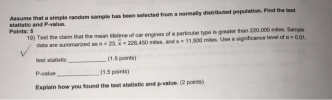 Explain how you found the test statistic and p-value?
Assume that a simple random sample has been solocted from a normally distributed population. Find the test statistic and P-value. Points: 5 19) Test the claim that the mean lifetime of car engines of a particular type is greater than 220,000 miles. Sample data are summarized as n = 23, X = 226,450 miles, and s = 11,500 miles. Use a significance level of a = 0.01. test statistic (1.5 points)...
Explain how you found the test statistic and p-value?
Assume that a simple random sample has been solocted from a normally distributed population. Find the test statistic and P-value. Points: 5 19) Test the claim that the mean lifetime of car engines of a particular type is greater than 220,000 miles. Sample data are summarized as n = 23, X = 226,450 miles, and s = 11,500 miles. Use a significance level of a = 0.01. test statistic (1.5 points)...
5. Suppose X follows a normal distribution with mean u = 200 and standard deviation o...
 5. Suppose X follows a normal distribution with mean u = 200 and standard deviation o = 40. Find each of the following probabilities. (8 points) a. P(160 < x < 232) b. P(X > 160) C. P(X < 100) d. P(230 < x < 284) 6. Sup Suppose we know that SAT scores have a population average u = 1080 and a standard deviation o = 200. A university wants to give merit scholarships to all students with an...
9. P( mean wait is between 11.6 and 13.6)= Explain how to found your answer. 10....
 9. P( mean wait is between 11.6 and 13.6)=
Explain how to found your answer.
10. A class has 8 students who are assigned seating by lot.
What is the probability that the students will be arranged in order
from shortest to tallest? (Assume that no two students are the same
height.)
11. Minimum sample size ___
Show your work
12. Probability ___
Explain how you found the answer
Solve the problem. Points: 5 9) The weights of the fish...
9. P( mean wait is between 11.6 and 13.6)=
Explain how to found your answer.
10. A class has 8 students who are assigned seating by lot.
What is the probability that the students will be arranged in order
from shortest to tallest? (Assume that no two students are the same
height.)
11. Minimum sample size ___
Show your work
12. Probability ___
Explain how you found the answer
Solve the problem. Points: 5 9) The weights of the fish...
1. You want to test whether you can reject the null hypothesis that a population mean...
1. You want to test whether you can reject the null hypothesis that a population mean is greater than or equal to 10. To do this, you collect a random sample of size 500 from the population, and you calculate that the sample mean and sample standard deviation are 8.6 and s, respectively. Which of the following is true? a. If s is any value between 11 and 13, you can reject the null hypothesis at the 5% significance level....
1a. A random sample of 29 BSN nurses at a large Michigan hospital have the average (mean) hourly wage of $37.55 with the...
1a. A random sample of 29 BSN nurses at a large Michigan hospital have the average (mean) hourly wage of $37.55 with the standard deviation of $4.66. If we want a 99% confidence interval to have a margin of error of no more than $3, what is the minimum required sample size we should take? (Hint: use t*=2.7633) 1b. A test of the hypotheses H0: mu=17 vs. Ha: mu >17 is conducted. Sample data of n=30 cases provides x-bar=14 with...
Can someone show step by step how to get P0e^rt from equation (1.4)? Consider a population...
 Can someone show step by step how to get P0e^rt from equation
(1.4)?
Consider a population P(t) that is varying with time. A mathematician will say that the rate at which the population is changing with respect to time is given by the derivative dP dt On the other hand, a population biologist will say that the rate of change is roughly proportional to the population. This means that there is a constant r, called the reproductive rate, such that...
Can someone show step by step how to get P0e^rt from equation
(1.4)?
Consider a population P(t) that is varying with time. A mathematician will say that the rate at which the population is changing with respect to time is given by the derivative dP dt On the other hand, a population biologist will say that the rate of change is roughly proportional to the population. This means that there is a constant r, called the reproductive rate, such that...
A one-sample z-test for a population mean is performed. Suppose that the P-value for the test...
 A one-sample z-test for a population mean is performed. Suppose that the P-value for the test is 0.04. For what significance levels (values of a) can the null hypothesis be rejected? For a = 0.04 For all values of a greater than or equal to 0.04 For a = 0.05, 0.10 For all values of a smaller than 0.04
 #1-4
Exit Suppose that car wash times are normally distributed with a mean of 25 minutes and a standard deviation of 3 minutes. You will be considering a group of 9 randomly selected car wash times. Answer the following questions. D 1. Given the information above, what can we say about the sampling distribution of x-bar. It is also normally distributed, because the original poplation was normally distributed. It is normally distributed because n is bigger than 30. We do...
#1-4
Exit Suppose that car wash times are normally distributed with a mean of 25 minutes and a standard deviation of 3 minutes. You will be considering a group of 9 randomly selected car wash times. Answer the following questions. D 1. Given the information above, what can we say about the sampling distribution of x-bar. It is also normally distributed, because the original poplation was normally distributed. It is normally distributed because n is bigger than 30. We do...
 6. We want to determine the sample size for estimating the population proportion p that would vote for candidate A with a 95% confidence interval and a margin of error of no greater than 2 %. What is the sample size given that we have no fore knowledge so that p should be a value of 0.5 or 50%?
 Suppose a random sample of 100 observations from a binomial population gives a value of p = 0.45 and you wish to test the null hypothesis that the population parameter p is equal to 0.40 against the alternative hypothesis that p is greater than 0.40. Complete parts a through c. a. Noting that p = 0.45, what does your intuition tell you? Does the value of p appear to contradict the null hypothesis? O A. Yes, because p satisfies Hg:p>0.40...
 Explain how you found the test statistic and p-value?
Assume that a simple random sample has been solocted from a normally distributed population. Find the test statistic and P-value. Points: 5 19) Test the claim that the mean lifetime of car engines of a particular type is greater than 220,000 miles. Sample data are summarized as n = 23, X = 226,450 miles, and s = 11,500 miles. Use a significance level of a = 0.01. test statistic (1.5 points)...
Explain how you found the test statistic and p-value?
Assume that a simple random sample has been solocted from a normally distributed population. Find the test statistic and P-value. Points: 5 19) Test the claim that the mean lifetime of car engines of a particular type is greater than 220,000 miles. Sample data are summarized as n = 23, X = 226,450 miles, and s = 11,500 miles. Use a significance level of a = 0.01. test statistic (1.5 points)...
 5. Suppose X follows a normal distribution with mean u = 200 and standard deviation o = 40. Find each of the following probabilities. (8 points) a. P(160 < x < 232) b. P(X > 160) C. P(X < 100) d. P(230 < x < 284) 6. Sup Suppose we know that SAT scores have a population average u = 1080 and a standard deviation o = 200. A university wants to give merit scholarships to all students with an...
 9. P( mean wait is between 11.6 and 13.6)=
Explain how to found your answer.
10. A class has 8 students who are assigned seating by lot.
What is the probability that the students will be arranged in order
from shortest to tallest? (Assume that no two students are the same
height.)
11. Minimum sample size ___
Show your work
12. Probability ___
Explain how you found the answer
Solve the problem. Points: 5 9) The weights of the fish...
9. P( mean wait is between 11.6 and 13.6)=
Explain how to found your answer.
10. A class has 8 students who are assigned seating by lot.
What is the probability that the students will be arranged in order
from shortest to tallest? (Assume that no two students are the same
height.)
11. Minimum sample size ___
Show your work
12. Probability ___
Explain how you found the answer
Solve the problem. Points: 5 9) The weights of the fish...
 Can someone show step by step how to get P0e^rt from equation
(1.4)?
Consider a population P(t) that is varying with time. A mathematician will say that the rate at which the population is changing with respect to time is given by the derivative dP dt On the other hand, a population biologist will say that the rate of change is roughly proportional to the population. This means that there is a constant r, called the reproductive rate, such that...
Can someone show step by step how to get P0e^rt from equation
(1.4)?
Consider a population P(t) that is varying with time. A mathematician will say that the rate at which the population is changing with respect to time is given by the derivative dP dt On the other hand, a population biologist will say that the rate of change is roughly proportional to the population. This means that there is a constant r, called the reproductive rate, such that...
 A one-sample z-test for a population mean is performed. Suppose that the P-value for the test is 0.04. For what significance levels (values of a) can the null hypothesis be rejected? For a = 0.04 For all values of a greater than or equal to 0.04 For a = 0.05, 0.10 For all values of a smaller than 0.04
Most questions answered within 3 hours.
-
Where is the error in this code sequence?
String s1 = "Hello";
String s2 = "ello";...
asked 10 months ago -
Financial data for Joel de Paris, Inc., for last year
follow:
Joel de Paris, Inc.
Balance...
asked 10 months ago -
Consider this reaction:
Al2(SO4)3 (aq)+ BaCl3
(aq) Al2Cl6 (aq)- +
3BaSO4(s) . What is the...
asked 10 months ago -
Suppose that Savneet is considering increasing her
recent random sample from 20 car rentals to 40...
asked 10 months ago -
Trucks arrive at an unloading terminal at an average rate of 120
per hour.
Trucks arrive...
asked 10 months ago -
Why are methanol and ethanol completely soluble in water while
octanol is not very little soluble....
asked 10 months ago -
A facilities manager at a university reads in a research report
that the mean amount of...
asked 10 months ago -
When the CuSO4 is rehydrated by adding water to the anhydrous
compound, is this an endothermic...
asked 10 months ago -
A ray of sunlight is passing from diamond into crown glass; the
angle of incidence is...
asked 10 months ago -
A block of mass 0.249 kg is placed on top of a light, vertical
spring of...
asked 10 months ago -
how do the kidneys compensate in the presences of acidosis
a) trigger hyperventilate
b) reserve acid...
asked 10 months ago -
Question 501 pts
The rental rate of capital to the firm increases. Which of the
following...
asked 10 months ago