Write a script called “faracha” that plots a vs. b as defined in the following equations:...
Write a script called “faracha” that plots a vs. b as defined in the following equations:
a = sin(t)[ecos(t) – 2cos(4t) – (sin(t/12)5)]
b = cos(t)[ ecos(t) – 2cos(4t) – (sin(t/12)5)]
Where t = [-10;10]. Use 0.01 interval for t. Use 0.01 intervals for t.
Homework Answers
import math
import numpy as np
time = np.arange(-10, 10, 0.01) #this creates a numpy array time
having elements between -10 to 10 in the interval of 0.1
# like -10, -9.99, -9.98,.......,0,.......9.98, 9.99, 10
a = []
b = []
for t in time:
a.append(math.sin(t) * (math.exp(1)*math.cos(t) - 2*math.cos(4*t) -
(math.sin(5*t/12)))) #it creates a list of x elements
b.append(math.cos(t) * (math.exp(1)*math.cos(t) - 2*math.cos(4*t) -
(math.sin(5*t/12)))) #it creates a list of y elements
import matplotlib.pyplot as plt #module for plotting graph
x = a
y = b
print(plt.plot(x,y)) #plots the graph
#####
output:
[<matplotlib.lines.Line2D object at 0x0000013401D9C2B0>]
the above functions creates flower like structures
Add Answer to:
Write a script called “faracha” that plots a vs. b as defined in
the following equations:...
(USING MATLAB) Given two differential equations X= sin(t)(exp(cos(t))-2cos(4t)+sin(t/12)^5) And Y = cos(t)(exp(cos(t))-2cos(4t)+sin(t/12)^5) where 0<t<20pi is a...
(USING MATLAB) Given two differential equations X= sin(t)(exp(cos(t))-2cos(4t)+sin(t/12)^5) And Y = cos(t)(exp(cos(t))-2cos(4t)+sin(t/12)^5) where 0<t<20pi is a vector of 5000 points created by using (linspace) command : Write script to plot X and Y with red color ?
4. Given (x)=x-5x + 5x5x2 - 6x , write a symbolic MATLAB script that: (a) plots...
 4. Given (x)=x-5x + 5x5x2 - 6x , write a symbolic MATLAB script that: (a) plots g(x) in the interval -2 <x< 4, (b) finds and display all of its maxima and minima, (c) evaluates g(x) at the following values of x: -21, 21, 0, 1, 2st and displays the five results. tidad
1) Write a script that plots sin(x), cos(x), tan(x) for x between 0 and 360◦ (or...
1) Write a script that plots sin(x), cos(x), tan(x) for x between 0 and 360◦ (or 2π radians) on one graph, adjusts the y axis to range between −10 and +10, and includes a legend identifying each line. 2)Write a Matlab function that sums up a specified number of odd-power terms from the Maclaurin series of sin(x) For example, if you use the function you wrote to sum the first 10 terms for x = 1, you should get 1...
MATLAB, please provide code script Objective: Create a function file that animates projectile motion defined by...
 MATLAB,
please provide code script
Objective: Create a function file that animates projectile motion defined by the following equations in a subplot. Your function should accept user inputs of launch speed and launch angle. The output of your function will be a top subplot that displays height (y) as a function of x. The bottom subplot should display the vertical velocity while the projectile is in motion. A video of what your animation should look like is posted with this...
MATLAB,
please provide code script
Objective: Create a function file that animates projectile motion defined by the following equations in a subplot. Your function should accept user inputs of launch speed and launch angle. The output of your function will be a top subplot that displays height (y) as a function of x. The bottom subplot should display the vertical velocity while the projectile is in motion. A video of what your animation should look like is posted with this...
Use your bes judgement on where to place the tile 1. Submit plots of the following...
 Use your bes judgement on where to place the tile 1. Submit plots of the following functions. Lahel all axes and include a title (and a legend when appropriate). The first two plots are for discrete- time signals. a. 5 cos(π n /6-π/2). Plot this function in a figure by itself. b. I0 sin(π n/6). Plot this function in afigure by itself. c. 5 cos(3 t 6). Plot this function in a figure by itself. d. 10 sin (4 t...
45. *Write a code that plots each of the reaction forces for the beam below: A0 a. Write equations in terms of the beam length, L, applied force, P, and angle of the applied force, B, for each of the...
 45. *Write a code that plots each of the reaction forces for the beam below: A0 a. Write equations in terms of the beam length, L, applied force, P, and angle of the applied force, B, for each of the reaction forces. b. Write a script in MATLAB that plots the difference forces for angles ranging from 0 to 90°. Assume the beam length remains constant at 10 feet and the applied force always has a magnitude of 15 kips....
Determine the DTFS of (B) only. 1. Determine the DTFS of the following signals. Write a...
 Determine the DTFS of (B) only.
1. Determine the DTFS of the following signals. Write a MATLAB program to calculate the coefficients Ck for each of the signals. Plot a) t[n] vs n, and b) Ck vs 2k. (a) 5 points: t[n] = cos(0.3an) (b) 5 points: t[n] = 1 + cos(0.24an) + 3 sin(0.56n)
Determine the DTFS of (B) only.
1. Determine the DTFS of the following signals. Write a MATLAB program to calculate the coefficients Ck for each of the signals. Plot a) t[n] vs n, and b) Ck vs 2k. (a) 5 points: t[n] = cos(0.3an) (b) 5 points: t[n] = 1 + cos(0.24an) + 3 sin(0.56n)
Convert the following 3 equations to a system using the example below. The initial value problems...
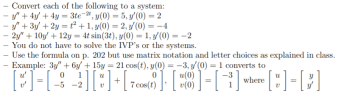 Convert the following 3 equations to a system using the example
below. The initial value problems and systems do not need to be
solved. The formula from pg 202 is in the form of the example
below.
Convert each of the following to a system: 2/, + 10y' + 12y-4t sin(3t), y(0)-1,y'(0)--2 - You do not have to solve the IVP's or the systems. Use the formula on p. 202 but use matrix notation and letter choices as explained in...
Convert the following 3 equations to a system using the example
below. The initial value problems and systems do not need to be
solved. The formula from pg 202 is in the form of the example
below.
Convert each of the following to a system: 2/, + 10y' + 12y-4t sin(3t), y(0)-1,y'(0)--2 - You do not have to solve the IVP's or the systems. Use the formula on p. 202 but use matrix notation and letter choices as explained in...
3. (40 Pts.) Write a script which takes the frequency, amplitude and type (sinusoidal, square or...
 3. (40 Pts.) Write a script which takes the frequency, amplitude and type (sinusoidal, square or triangular) of a function as input from user and plots the function y(t) at output. Hint: In MATLAB, you can generate a sinusoidal function by using "sin", a square function by using "square" and a triangular function by using "sawtooth" functions. User-inputs Select any frequency within the interval FE lkHz, 100 kHz , select the amplitude of the signal "VM" and define the time...
Write a MATLAB function with the following specifications: Input parameter 1: A Input parameter 2: B...
 Write a MATLAB function with the following specifications: Input parameter 1: A Input parameter 2: B Input parameter 3: C Input parameter 4: D Output parameter: Sum of the input parameters Time interval: -2T lessthanorequalto t lessthanorequalto 2T Waveform 1 to plot: y(t) = A sin(B(t - c))+D Waveform 2 to plot: y(t) = A cos(B(t - c)) + D Display two plots in vertical fashion on one figure Include all labeling on both plots. Add a grid to both...
 4. Given (x)=x-5x + 5x5x2 - 6x , write a symbolic MATLAB script that: (a) plots g(x) in the interval -2 <x< 4, (b) finds and display all of its maxima and minima, (c) evaluates g(x) at the following values of x: -21, 21, 0, 1, 2st and displays the five results. tidad
 MATLAB,
please provide code script
Objective: Create a function file that animates projectile motion defined by the following equations in a subplot. Your function should accept user inputs of launch speed and launch angle. The output of your function will be a top subplot that displays height (y) as a function of x. The bottom subplot should display the vertical velocity while the projectile is in motion. A video of what your animation should look like is posted with this...
MATLAB,
please provide code script
Objective: Create a function file that animates projectile motion defined by the following equations in a subplot. Your function should accept user inputs of launch speed and launch angle. The output of your function will be a top subplot that displays height (y) as a function of x. The bottom subplot should display the vertical velocity while the projectile is in motion. A video of what your animation should look like is posted with this...
 Use your bes judgement on where to place the tile 1. Submit plots of the following functions. Lahel all axes and include a title (and a legend when appropriate). The first two plots are for discrete- time signals. a. 5 cos(π n /6-π/2). Plot this function in a figure by itself. b. I0 sin(π n/6). Plot this function in afigure by itself. c. 5 cos(3 t 6). Plot this function in a figure by itself. d. 10 sin (4 t...
 45. *Write a code that plots each of the reaction forces for the beam below: A0 a. Write equations in terms of the beam length, L, applied force, P, and angle of the applied force, B, for each of the reaction forces. b. Write a script in MATLAB that plots the difference forces for angles ranging from 0 to 90°. Assume the beam length remains constant at 10 feet and the applied force always has a magnitude of 15 kips....
 Determine the DTFS of (B) only.
1. Determine the DTFS of the following signals. Write a MATLAB program to calculate the coefficients Ck for each of the signals. Plot a) t[n] vs n, and b) Ck vs 2k. (a) 5 points: t[n] = cos(0.3an) (b) 5 points: t[n] = 1 + cos(0.24an) + 3 sin(0.56n)
Determine the DTFS of (B) only.
1. Determine the DTFS of the following signals. Write a MATLAB program to calculate the coefficients Ck for each of the signals. Plot a) t[n] vs n, and b) Ck vs 2k. (a) 5 points: t[n] = cos(0.3an) (b) 5 points: t[n] = 1 + cos(0.24an) + 3 sin(0.56n)
 Convert the following 3 equations to a system using the example
below. The initial value problems and systems do not need to be
solved. The formula from pg 202 is in the form of the example
below.
Convert each of the following to a system: 2/, + 10y' + 12y-4t sin(3t), y(0)-1,y'(0)--2 - You do not have to solve the IVP's or the systems. Use the formula on p. 202 but use matrix notation and letter choices as explained in...
Convert the following 3 equations to a system using the example
below. The initial value problems and systems do not need to be
solved. The formula from pg 202 is in the form of the example
below.
Convert each of the following to a system: 2/, + 10y' + 12y-4t sin(3t), y(0)-1,y'(0)--2 - You do not have to solve the IVP's or the systems. Use the formula on p. 202 but use matrix notation and letter choices as explained in...
 3. (40 Pts.) Write a script which takes the frequency, amplitude and type (sinusoidal, square or triangular) of a function as input from user and plots the function y(t) at output. Hint: In MATLAB, you can generate a sinusoidal function by using "sin", a square function by using "square" and a triangular function by using "sawtooth" functions. User-inputs Select any frequency within the interval FE lkHz, 100 kHz , select the amplitude of the signal "VM" and define the time...
 Write a MATLAB function with the following specifications: Input parameter 1: A Input parameter 2: B Input parameter 3: C Input parameter 4: D Output parameter: Sum of the input parameters Time interval: -2T lessthanorequalto t lessthanorequalto 2T Waveform 1 to plot: y(t) = A sin(B(t - c))+D Waveform 2 to plot: y(t) = A cos(B(t - c)) + D Display two plots in vertical fashion on one figure Include all labeling on both plots. Add a grid to both...
Most questions answered within 3 hours.
-
Where is the error in this code sequence?
String s1 = "Hello";
String s2 = "ello";...
asked 11 months ago -
Financial data for Joel de Paris, Inc., for last year
follow:
Joel de Paris, Inc.
Balance...
asked 11 months ago -
Consider this reaction:
Al2(SO4)3 (aq)+ BaCl3
(aq) Al2Cl6 (aq)- +
3BaSO4(s) . What is the...
asked 11 months ago -
Suppose that Savneet is considering increasing her
recent random sample from 20 car rentals to 40...
asked 11 months ago -
Trucks arrive at an unloading terminal at an average rate of 120
per hour.
Trucks arrive...
asked 11 months ago -
Why are methanol and ethanol completely soluble in water while
octanol is not very little soluble....
asked 11 months ago -
A facilities manager at a university reads in a research report
that the mean amount of...
asked 11 months ago -
When the CuSO4 is rehydrated by adding water to the anhydrous
compound, is this an endothermic...
asked 11 months ago -
A ray of sunlight is passing from diamond into crown glass; the
angle of incidence is...
asked 11 months ago -
A block of mass 0.249 kg is placed on top of a light, vertical
spring of...
asked 11 months ago -
how do the kidneys compensate in the presences of acidosis
a) trigger hyperventilate
b) reserve acid...
asked 11 months ago -
Question 501 pts
The rental rate of capital to the firm increases. Which of the
following...
asked 11 months ago