(USING MATLAB) Given two differential equations X= sin(t)(exp(cos(t))-2cos(4t)+sin(t/12)^5) And Y = cos(t)(exp(cos(t))-2cos(4t)+sin(t/12)^5) where 0<t<20pi is a...
(USING MATLAB)
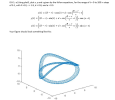
Given two differential equations X= sin(t)(exp(cos(t))-2cos(4t)+sin(t/12)^5)
And Y = cos(t)(exp(cos(t))-2cos(4t)+sin(t/12)^5) where 0<t<20pi is a vector of 5000 points created by using (linspace) command :
Write script to plot X and Y with red color ?
Homework Answers
code:
t=linspace(0,20*pi,5000);
x=sin(t).*(exp(cos(t))-2*cos(4*t)+sin(t/12).^5)
y=cos(t).*(exp(cos(t))-2*cos(4*t)+sin(t/12).^5)
subplot(1,2,1)
plot(t,x,'r')
subplot(1,2,2)
plot(t,y,'r')
figure:

comment if you have any queries or doubts and please like if you get it
Add Answer to:
(USING MATLAB)
Given two differential equations X=
sin(t)(exp(cos(t))-2cos(4t)+sin(t/12)^5)
And Y =
cos(t)(exp(cos(t))-2cos(4t)+sin(t/12)^5) where
0<t<20pi is a...
matlab code please 0 solutions submitted (max Unlimited) Problem2 A staircase of height h is modeled by the parametric equations: x = rcos(1) y = rsin(1) -=- trix where r=h[2 + 5 sin(1/8)]/10, n...
 matlab code please
0 solutions submitted (max Unlimited) Problem2 A staircase of height h is modeled by the parametric equations: x = rcos(1) y = rsin(1) -=- trix where r=h[2 + 5 sin(1/8)]/10, n=4, and h 50m is the staircase height. Make a 3-D plot (shown) of the staircase. (Create a vector , for the domain 0 to 2π and use the pi1ot3 command.) so so nd ion Your Script em of 11% iength of vector t is 40e, use,...
matlab code please
0 solutions submitted (max Unlimited) Problem2 A staircase of height h is modeled by the parametric equations: x = rcos(1) y = rsin(1) -=- trix where r=h[2 + 5 sin(1/8)]/10, n=4, and h 50m is the staircase height. Make a 3-D plot (shown) of the staircase. (Create a vector , for the domain 0 to 2π and use the pi1ot3 command.) so so nd ion Your Script em of 11% iength of vector t is 40e, use,...
Write a script called “faracha” that plots a vs. b as defined in the following equations:...
Write a script called “faracha” that plots a vs. b as defined in the following equations: a = sin(t)[ecos(t) – 2cos(4t) – (sin(t/12)5)] b = cos(t)[ ecos(t) – 2cos(4t) – (sin(t/12)5)] Where t = [-10;10]. Use 0.01 interval for t. Use 0.01 intervals for t.
write MATLAB scripts to solve differential equations. Computing 1: ELE1053 Project 3E:Solving Differential Equations Project Principle...
 write MATLAB scripts to solve differential equations.
Computing 1: ELE1053 Project 3E:Solving Differential Equations Project Principle Objective: Write MATLAB scripts to solve differential equations. Implementation: MatLab is an ideal environment for solving differential equations. Differential equations are a vital tool used by engineers to model, study and make predictions about the behavior of complex systems. It not only allows you to solve complex equations and systems of equations it also allows you to easily present the solutions in graphical form....
write MATLAB scripts to solve differential equations.
Computing 1: ELE1053 Project 3E:Solving Differential Equations Project Principle Objective: Write MATLAB scripts to solve differential equations. Implementation: MatLab is an ideal environment for solving differential equations. Differential equations are a vital tool used by engineers to model, study and make predictions about the behavior of complex systems. It not only allows you to solve complex equations and systems of equations it also allows you to easily present the solutions in graphical form....
solve the exact differential equation (-2sin(x)-ysin(x)+2cos(x))dx+(cos(x))dy=0 where y(0)=5
solve the exact differential equation (-2sin(x)-ysin(x)+2cos(x))dx+(cos(x))dy=0 where y(0)=5
MATLAB ICA 1: a) Using plot3, plot x, y and z given by the follow equations,...
 MATLAB
ICA 1: a) Using plot3, plot x, y and z given by the follow equations, for the range oft of 0.1, with R-10, r = 1.8, d :0.8, and a = 0.5: 0 to 200 in steps x(t) = (R-r) * cos (t) + d * cos R -r 佇r.r) . y(t) = |(R _ r) * sin(t) + d * sin (__ * t)|*cos (a * t) 2(t) = [A-r) * sin(t) + d * sin (--* t)|...
MATLAB
ICA 1: a) Using plot3, plot x, y and z given by the follow equations, for the range oft of 0.1, with R-10, r = 1.8, d :0.8, and a = 0.5: 0 to 200 in steps x(t) = (R-r) * cos (t) + d * cos R -r 佇r.r) . y(t) = |(R _ r) * sin(t) + d * sin (__ * t)|*cos (a * t) 2(t) = [A-r) * sin(t) + d * sin (--* t)|...
The system of non-linear differential equations sin cosy sin x + cos( y), has an equilibrium point at (0,T) (a) Calculate the Jacobian matrix of this system of equations and evaluate this matrix at t...
 The system of non-linear differential equations sin cosy sin x + cos( y), has an equilibrium point at (0,T) (a) Calculate the Jacobian matrix of this system of equations and evaluate this matrix at the given equilibrium point. (b) Use your answer to part (a) to classify this equilibrium point.
The system of non-linear differential equations sin cosy sin x + cos( y), has an equilibrium point at (0,T) (a) Calculate the Jacobian matrix of this system of equations and...
The system of non-linear differential equations sin cosy sin x + cos( y), has an equilibrium point at (0,T) (a) Calculate the Jacobian matrix of this system of equations and evaluate this matrix at the given equilibrium point. (b) Use your answer to part (a) to classify this equilibrium point.
The system of non-linear differential equations sin cosy sin x + cos( y), has an equilibrium point at (0,T) (a) Calculate the Jacobian matrix of this system of equations and...
x(t) and y(t) satisfy the following system of differential equations: di +827-y=0, +3y=e-4t, x(0)=y(0)=0. Find the...
 x(t) and y(t) satisfy the following system of differential equations: di +827-y=0, +3y=e-4t, x(0)=y(0)=0. Find the Laplace transform of y(t) Your answer should be expressed as a function of s using the correct syntax.
Matlab help 1) Given the functions x1()= tu()-tuft-1) and X2(t)=10e-5,11(), do the following: 1. Plotx,(t) and x2(0) using MATLAB 2. Use MATLAB to find and plot x(0=x:@*.x2(t), where * denotes co...
 Matlab help
1) Given the functions x1()= tu()-tuft-1) and X2(t)=10e-5,11(), do the following: 1. Plotx,(t) and x2(0) using MATLAB 2. Use MATLAB to find and plot x(0=x:@*.x2(t), where * denotes convolution. 3. Find x(t)=x;()*X2(1) by hand using Laplace transforms. 4. Plot the result of part 3 in MATLAB and compare it to that found in part 2. 2) Given the transfer function shown below, do the following: 1. Find the system's impulse response and plot it using MATLAB 2. Repeat...
Matlab help
1) Given the functions x1()= tu()-tuft-1) and X2(t)=10e-5,11(), do the following: 1. Plotx,(t) and x2(0) using MATLAB 2. Use MATLAB to find and plot x(0=x:@*.x2(t), where * denotes convolution. 3. Find x(t)=x;()*X2(1) by hand using Laplace transforms. 4. Plot the result of part 3 in MATLAB and compare it to that found in part 2. 2) Given the transfer function shown below, do the following: 1. Find the system's impulse response and plot it using MATLAB 2. Repeat...
(1 point) Let Solve the differential equation using Laplace transforms. t/16-sin(4t)/64+3/4sin(4t)+4cos(4t) ft 4T y(t) = ift>4...
 (1 point) Let Solve the differential equation using Laplace transforms. t/16-sin(4t)/64+3/4sin(4t)+4cos(4t) ft 4T y(t) = ift>4 -cos(4t)/16+1/16+3/4sin(4t)+4cos(4t)
Using Matlab: If x(n) = cos(5π e-n/10) over n=[-10:30] and y(m)=sin(0.03πem/20) over m=[0:40], find z =...
Using Matlab: If x(n) = cos(5π e-n/10) over n=[-10:30] and y(m)=sin(0.03πem/20) over m=[0:40], find z = x*y and its support vector k. Here * means convolution. Stem plot the results setting the axes using the command axis([-20,80,-2. .5,2.5]).
 matlab code please
0 solutions submitted (max Unlimited) Problem2 A staircase of height h is modeled by the parametric equations: x = rcos(1) y = rsin(1) -=- trix where r=h[2 + 5 sin(1/8)]/10, n=4, and h 50m is the staircase height. Make a 3-D plot (shown) of the staircase. (Create a vector , for the domain 0 to 2π and use the pi1ot3 command.) so so nd ion Your Script em of 11% iength of vector t is 40e, use,...
matlab code please
0 solutions submitted (max Unlimited) Problem2 A staircase of height h is modeled by the parametric equations: x = rcos(1) y = rsin(1) -=- trix where r=h[2 + 5 sin(1/8)]/10, n=4, and h 50m is the staircase height. Make a 3-D plot (shown) of the staircase. (Create a vector , for the domain 0 to 2π and use the pi1ot3 command.) so so nd ion Your Script em of 11% iength of vector t is 40e, use,...
 write MATLAB scripts to solve differential equations.
Computing 1: ELE1053 Project 3E:Solving Differential Equations Project Principle Objective: Write MATLAB scripts to solve differential equations. Implementation: MatLab is an ideal environment for solving differential equations. Differential equations are a vital tool used by engineers to model, study and make predictions about the behavior of complex systems. It not only allows you to solve complex equations and systems of equations it also allows you to easily present the solutions in graphical form....
write MATLAB scripts to solve differential equations.
Computing 1: ELE1053 Project 3E:Solving Differential Equations Project Principle Objective: Write MATLAB scripts to solve differential equations. Implementation: MatLab is an ideal environment for solving differential equations. Differential equations are a vital tool used by engineers to model, study and make predictions about the behavior of complex systems. It not only allows you to solve complex equations and systems of equations it also allows you to easily present the solutions in graphical form....
 MATLAB
ICA 1: a) Using plot3, plot x, y and z given by the follow equations, for the range oft of 0.1, with R-10, r = 1.8, d :0.8, and a = 0.5: 0 to 200 in steps x(t) = (R-r) * cos (t) + d * cos R -r 佇r.r) . y(t) = |(R _ r) * sin(t) + d * sin (__ * t)|*cos (a * t) 2(t) = [A-r) * sin(t) + d * sin (--* t)|...
MATLAB
ICA 1: a) Using plot3, plot x, y and z given by the follow equations, for the range oft of 0.1, with R-10, r = 1.8, d :0.8, and a = 0.5: 0 to 200 in steps x(t) = (R-r) * cos (t) + d * cos R -r 佇r.r) . y(t) = |(R _ r) * sin(t) + d * sin (__ * t)|*cos (a * t) 2(t) = [A-r) * sin(t) + d * sin (--* t)|...
 The system of non-linear differential equations sin cosy sin x + cos( y), has an equilibrium point at (0,T) (a) Calculate the Jacobian matrix of this system of equations and evaluate this matrix at the given equilibrium point. (b) Use your answer to part (a) to classify this equilibrium point.
The system of non-linear differential equations sin cosy sin x + cos( y), has an equilibrium point at (0,T) (a) Calculate the Jacobian matrix of this system of equations and...
The system of non-linear differential equations sin cosy sin x + cos( y), has an equilibrium point at (0,T) (a) Calculate the Jacobian matrix of this system of equations and evaluate this matrix at the given equilibrium point. (b) Use your answer to part (a) to classify this equilibrium point.
The system of non-linear differential equations sin cosy sin x + cos( y), has an equilibrium point at (0,T) (a) Calculate the Jacobian matrix of this system of equations and...
 x(t) and y(t) satisfy the following system of differential equations: di +827-y=0, +3y=e-4t, x(0)=y(0)=0. Find the Laplace transform of y(t) Your answer should be expressed as a function of s using the correct syntax.
 Matlab help
1) Given the functions x1()= tu()-tuft-1) and X2(t)=10e-5,11(), do the following: 1. Plotx,(t) and x2(0) using MATLAB 2. Use MATLAB to find and plot x(0=x:@*.x2(t), where * denotes convolution. 3. Find x(t)=x;()*X2(1) by hand using Laplace transforms. 4. Plot the result of part 3 in MATLAB and compare it to that found in part 2. 2) Given the transfer function shown below, do the following: 1. Find the system's impulse response and plot it using MATLAB 2. Repeat...
Matlab help
1) Given the functions x1()= tu()-tuft-1) and X2(t)=10e-5,11(), do the following: 1. Plotx,(t) and x2(0) using MATLAB 2. Use MATLAB to find and plot x(0=x:@*.x2(t), where * denotes convolution. 3. Find x(t)=x;()*X2(1) by hand using Laplace transforms. 4. Plot the result of part 3 in MATLAB and compare it to that found in part 2. 2) Given the transfer function shown below, do the following: 1. Find the system's impulse response and plot it using MATLAB 2. Repeat...
 (1 point) Let Solve the differential equation using Laplace transforms. t/16-sin(4t)/64+3/4sin(4t)+4cos(4t) ft 4T y(t) = ift>4 -cos(4t)/16+1/16+3/4sin(4t)+4cos(4t)
Most questions answered within 3 hours.
-
Where is the error in this code sequence?
String s1 = "Hello";
String s2 = "ello";...
asked 11 months ago -
Financial data for Joel de Paris, Inc., for last year
follow:
Joel de Paris, Inc.
Balance...
asked 11 months ago -
Consider this reaction:
Al2(SO4)3 (aq)+ BaCl3
(aq) Al2Cl6 (aq)- +
3BaSO4(s) . What is the...
asked 11 months ago -
Suppose that Savneet is considering increasing her
recent random sample from 20 car rentals to 40...
asked 11 months ago -
Trucks arrive at an unloading terminal at an average rate of 120
per hour.
Trucks arrive...
asked 11 months ago -
Why are methanol and ethanol completely soluble in water while
octanol is not very little soluble....
asked 11 months ago -
A facilities manager at a university reads in a research report
that the mean amount of...
asked 11 months ago -
When the CuSO4 is rehydrated by adding water to the anhydrous
compound, is this an endothermic...
asked 11 months ago -
A ray of sunlight is passing from diamond into crown glass; the
angle of incidence is...
asked 11 months ago -
A block of mass 0.249 kg is placed on top of a light, vertical
spring of...
asked 11 months ago -
how do the kidneys compensate in the presences of acidosis
a) trigger hyperventilate
b) reserve acid...
asked 11 months ago -
Question 501 pts
The rental rate of capital to the firm increases. Which of the
following...
asked 11 months ago