Which of the below equilibria is forced to shift furthest to the left? Explain.\ a) Lead...
Which of the below equilibria is forced to shift furthest to the left? Explain.\
a) Lead nitrate and Sodium chloride
b) Lead chloride and Sodium chromate
c) Lead chromate and Sodium sulphide
Homework Answers

Add Answer to:
Which of the below equilibria is forced to shift furthest to the
left? Explain.\
a) Lead...
Which of the following equilibria will shift to the left when the temperature is increased? [AH...
 Which of the following equilibria will shift to the left when the temperature is increased? [AH (kl/mol) values are given in parentheses.] (Select all that apply.) (a) S + H2 SH2S AH(-20) (b) C + H2O 55CO + H2 AH (131) (c) H2 + CO2= H2O + CO NH(41) (d) MgO + CO2 = MgCO3 AH (–117) (e) 2CO + O2 = 2CO2 AH (-566)
The following equation represents a saturated solution of lead chromate PbCrO4(s) ⇌ Pb2+(aq) + CrO4 2–...
The following equation represents a saturated solution of lead chromate PbCrO4(s) ⇌ Pb2+(aq) + CrO4 2– (aq) Ksp at 298 K was determined to be 1.8 x10^–14. What will happen if solid lead nitrate is added to the system? (A) Have no effect. (B) Reduce the value of the Ksp for lead chromate. (C) Increase the value of Ksp for lead chromate. (D) Shift the reaction to the right. (E) Shift the reaction to the left.
Lastly, one method used to detect the presence and quantity of lead ions in water involves...
Lastly, one method used to detect the presence and quantity of lead ions in water involves adding sodium chromate to the water. The reaction produces a colored precipitate. a. Write a reaction showing how aqueous lead (II) nitrate reacts with sodium chromate. You will need to research the formula for sodium chromate and the solubility of the products. b. Research and then give the color and formula of the colored product formed. c. Explain how the production of a colored...
. Write the three equations and identify the spectator ions in the following mixtures (your instructor...
. Write the three equations and identify the spectator ions in the following mixtures (your instructor may assign different or additional ones): a. Hydrochloric acid and silver nitrate. b. Silver nitrate and sodium carbonate. c. Potassium chromate and lead (II) acetate. d. Sodium sulfate and barium chloride. e. Lead (II) acetate and ammonium chloride
2. Each of the following are reactions that are being performed in this laboratory. They are...
 2. Each of the following are reactions that are being performed in this laboratory. They are identified by the presence of a precipitate. For each of the following reactions, write a balanced chemical equation. (20 points) a. Aqueous hydrochloric acid reacts with silver (1) nitrate to produce solid silver (1) chloride and aqueous nitric acid b. Aqueous hydrochloric acid reacts with lead (II) bromide to produce solid lead (II) chloride and aqueous hydrobromic acid. C. Aqueous sodium chromate reacts with...
5. Answer questions based on the following two equilibria. Explain your answers. 2Cr042 (aq) + 2H(aq)...
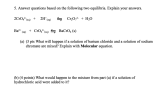 5. Answer questions based on the following two equilibria. Explain your answers. 2Cr042 (aq) + 2H(aq) — Cr2O72- + H20 Ba2+ (aq) + CrO2 (aq) → BaCrO4(s) (a) (3 pts What will happen if a solution of barium chloride and a solution of sodium chromate are mixed? Explain with Molecular equation. (b) (4 points) What would happen to the mixture from part (a) if a solution of hydrochloric acid were added to it? 3. (6 pts) How do you describe...
6. Write a molecular equation for the precipitation reaction that occurs when the following pairs of...
 6. Write a molecular equation for the precipitation reaction that occurs when the following pairs of solutions are mixed. a) calcium chromate and copper (II) nitrate b) potassium bromide and dimercury sulfate H P OD POCO c) lithium nitrate and ammonium sulfide d) lead nitrate and sodium chloride
a) whats the reaction for aqeuous lead (II) nitrate reacting with sodium chromate? b) what's the...
a) whats the reaction for aqeuous lead (II) nitrate reacting with sodium chromate? b) what's the color and formula for the colored product formed? c) how could the production of a colored product be used to find the amount of lead within the water?
If 2.5 mol of lead (II) nitrate reacts with 2.32 mol of sodium chloride in the following unbalanced equation which reactant is the limiting reactant? How many moles of lead (II) chloride should form?
If 2.5 mol of lead (II) nitrate reacts with 2.32 mol of sodium chloride in the following unbalanced equation which reactant is the limiting reactant? How many moles of lead (II) chloride should form?Pb(NO3)2 (aq) + NaCl (aq) --> PbCl2 (s) + NaNo3
5) Which of the following is likely to lead to a right shift in the supply...
5) Which of the following is likely to lead to a right shift in the supply curve of cotton? 5) _______ A) An increase in the price of cotton B) A decrease in the price of cotton C) An increase in labor productivity due to training programs D) A rise in labor costs due to wage demands by labor unions 6) Assume that the supply curve for a commodity shifts to the left and the demand curve shifts to the...
 Which of the following equilibria will shift to the left when the temperature is increased? [AH (kl/mol) values are given in parentheses.] (Select all that apply.) (a) S + H2 SH2S AH(-20) (b) C + H2O 55CO + H2 AH (131) (c) H2 + CO2= H2O + CO NH(41) (d) MgO + CO2 = MgCO3 AH (–117) (e) 2CO + O2 = 2CO2 AH (-566)
 2. Each of the following are reactions that are being performed in this laboratory. They are identified by the presence of a precipitate. For each of the following reactions, write a balanced chemical equation. (20 points) a. Aqueous hydrochloric acid reacts with silver (1) nitrate to produce solid silver (1) chloride and aqueous nitric acid b. Aqueous hydrochloric acid reacts with lead (II) bromide to produce solid lead (II) chloride and aqueous hydrobromic acid. C. Aqueous sodium chromate reacts with...
 5. Answer questions based on the following two equilibria. Explain your answers. 2Cr042 (aq) + 2H(aq) — Cr2O72- + H20 Ba2+ (aq) + CrO2 (aq) → BaCrO4(s) (a) (3 pts What will happen if a solution of barium chloride and a solution of sodium chromate are mixed? Explain with Molecular equation. (b) (4 points) What would happen to the mixture from part (a) if a solution of hydrochloric acid were added to it? 3. (6 pts) How do you describe...
 6. Write a molecular equation for the precipitation reaction that occurs when the following pairs of solutions are mixed. a) calcium chromate and copper (II) nitrate b) potassium bromide and dimercury sulfate H P OD POCO c) lithium nitrate and ammonium sulfide d) lead nitrate and sodium chloride
Most questions answered within 3 hours.
-
Where is the error in this code sequence?
String s1 = "Hello";
String s2 = "ello";...
asked 10 months ago -
Financial data for Joel de Paris, Inc., for last year
follow:
Joel de Paris, Inc.
Balance...
asked 10 months ago -
Consider this reaction:
Al2(SO4)3 (aq)+ BaCl3
(aq) Al2Cl6 (aq)- +
3BaSO4(s) . What is the...
asked 10 months ago -
Suppose that Savneet is considering increasing her
recent random sample from 20 car rentals to 40...
asked 10 months ago -
Trucks arrive at an unloading terminal at an average rate of 120
per hour.
Trucks arrive...
asked 10 months ago -
Why are methanol and ethanol completely soluble in water while
octanol is not very little soluble....
asked 10 months ago -
A facilities manager at a university reads in a research report
that the mean amount of...
asked 10 months ago -
When the CuSO4 is rehydrated by adding water to the anhydrous
compound, is this an endothermic...
asked 10 months ago -
A ray of sunlight is passing from diamond into crown glass; the
angle of incidence is...
asked 10 months ago -
A block of mass 0.249 kg is placed on top of a light, vertical
spring of...
asked 10 months ago -
how do the kidneys compensate in the presences of acidosis
a) trigger hyperventilate
b) reserve acid...
asked 10 months ago -
Question 501 pts
The rental rate of capital to the firm increases. Which of the
following...
asked 10 months ago