what is the heat when 100.0g of mg cool from 725k ti 552k ?
Homework Answers
Heat energy is given as,
Q = mc∆T
m -- mass of substance
C -- specific heat capacity
∆T = change in temperature
Specific heat of Mg = aaa 1.020 j/g °C
To convert temperature from Kelvin to degree Celsius , subtract 273 from it.
725k = 725-273. = 452 °C
552k = 552-273. = 279 °C
m = 100 g
Heat absorbed is ,
Q = 100 × 1.020 × (279 - 452)
Q = 100 × 1.020 × (-173)
Q = -17646 joules.
Negative sign implies that heat is absorbed.
Answer = 17646 joules
Which of the following substances would release the most amount of heat when they cool from...
Which of the following substances would release the most amount of heat when they cool from 50oC to 25oC if you started with equal masses of each? : Magnesium, 1.05 J/goC Aluminum, 0.920 J/goC Lead, 0.126 J/goC
layer2 layer 1 TI Pipe Ti T2 To Heat is transferred from a fluid in the...
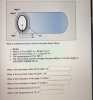 layer2 layer 1 TI Pipe Ti T2 To Heat is transferred from a fluid in the pipe shown above. Given: • Pipe is 1.5 in Sch80 ; k = 60 btu/ft-h-F • layer1 is 1.8 in thick ; k = 1.4 btu/ft-h-F • The temperature at Ti is 725 F • The rate of heat transfer through the pipe wal, per ft of pipe length is 538.64301748698 Btu/hr What is the log mean radius of the pipe, in? What is...
4. The given Heat-Cool Stepping and Gating Circuit has a HIGH for Heat and LOW for Col, which are...
 4. The given Heat-Cool Stepping and Gating Circuit has a HIGH for Heat and LOW for Col, which are at the bottom of the circuit diagram, when the system is in heat subinterval seieerva a. When do the Heat turn to LOW and Cool turn to HIGH. Explain how the circuit do this. b. When does the point of Welding Current Pulsation Count Pulsesha a HIGH points) voltage? (6
4. The given Heat-Cool Stepping and Gating Circuit has a HIGH...
4. The given Heat-Cool Stepping and Gating Circuit has a HIGH for Heat and LOW for Col, which are at the bottom of the circuit diagram, when the system is in heat subinterval seieerva a. When do the Heat turn to LOW and Cool turn to HIGH. Explain how the circuit do this. b. When does the point of Welding Current Pulsation Count Pulsesha a HIGH points) voltage? (6
4. The given Heat-Cool Stepping and Gating Circuit has a HIGH...
If there is a cool wind blowing, what would be the consequences, as far as heat...
If there is a cool wind blowing, what would be the consequences, as far as heat loss from the body is concerned, of wearing wet clothes? Explain your answer. Cloudy nights are usually warmer than cloudless nights. Why?
A single pass heat exchanger is used to cool milk from 65 C to 20 C...
A single pass heat exchanger is used to cool milk from 65 C to 20 C using water initially at 10 C. The exit water is at 24 C. (a). Is this a parallel- or counter flow unit? (b). If U= 2500 W/(m2 K), what is the heat transferred per square meter of the heat exchanger area?
3. "Heating to constant mass” means a. To heat the sample and cool it until its...
 3. "Heating to constant mass” means a. To heat the sample and cool it until its mass is stable on the balance b. To heat the sample and cool it, take its mass, heat it and cool it and retake the mass and averaging the two masses c. To heat the sample, cool it down, take its mass, then again heat it and cool it, retake the mass, and repeat this cycle until the mass in two consecutive weighing is...
A 10.0 kg sample of liquid water is used to cool an engine. Calculate the heat...
A 10.0 kg sample of liquid water is used to cool an engine. Calculate the heat removed (in joules) from the engine when the temperature of the water is raised from 293 K to 373 K. Take Cp = 75.2 J/K•mol for H2O (l)
How much heat would need to be removed to cool 212.3 g of water from 25.6°C...
How much heat would need to be removed to cool 212.3 g of water from 25.6°C to -10.7°C?
If you have 35.0g of Na and 100.0g of Cl2, what is the maximum amount of...
If you have 35.0g of Na and 100.0g of Cl2, what is the maximum amount of NaCl that you can produce?
How much heat must be extracted from 750 mL of white wine to cool it from...
How much heat must be extracted from 750 mL of white wine to cool it from 25 °C to 13 °C, if the wine is 9.6% ethanol by weight? Assume the wine can be treated as an aqueous solution of ethanol, with no other components. The molar heat capacity of water is 75.4 J/mol K and of ethanol is 112.1 J/mol K. Also: Show that this corresponds to a wine that is 12% alcohol by volume, or ABV. Clearly state...
 layer2 layer 1 TI Pipe Ti T2 To Heat is transferred from a fluid in the pipe shown above. Given: • Pipe is 1.5 in Sch80 ; k = 60 btu/ft-h-F • layer1 is 1.8 in thick ; k = 1.4 btu/ft-h-F • The temperature at Ti is 725 F • The rate of heat transfer through the pipe wal, per ft of pipe length is 538.64301748698 Btu/hr What is the log mean radius of the pipe, in? What is...
 4. The given Heat-Cool Stepping and Gating Circuit has a HIGH for Heat and LOW for Col, which are at the bottom of the circuit diagram, when the system is in heat subinterval seieerva a. When do the Heat turn to LOW and Cool turn to HIGH. Explain how the circuit do this. b. When does the point of Welding Current Pulsation Count Pulsesha a HIGH points) voltage? (6
4. The given Heat-Cool Stepping and Gating Circuit has a HIGH...
4. The given Heat-Cool Stepping and Gating Circuit has a HIGH for Heat and LOW for Col, which are at the bottom of the circuit diagram, when the system is in heat subinterval seieerva a. When do the Heat turn to LOW and Cool turn to HIGH. Explain how the circuit do this. b. When does the point of Welding Current Pulsation Count Pulsesha a HIGH points) voltage? (6
4. The given Heat-Cool Stepping and Gating Circuit has a HIGH...
 3. "Heating to constant mass” means a. To heat the sample and cool it until its mass is stable on the balance b. To heat the sample and cool it, take its mass, heat it and cool it and retake the mass and averaging the two masses c. To heat the sample, cool it down, take its mass, then again heat it and cool it, retake the mass, and repeat this cycle until the mass in two consecutive weighing is...
Most questions answered within 3 hours.
-
Where is the error in this code sequence?
String s1 = "Hello";
String s2 = "ello";...
asked 11 months ago -
Financial data for Joel de Paris, Inc., for last year
follow:
Joel de Paris, Inc.
Balance...
asked 11 months ago -
Consider this reaction:
Al2(SO4)3 (aq)+ BaCl3
(aq) Al2Cl6 (aq)- +
3BaSO4(s) . What is the...
asked 11 months ago -
Suppose that Savneet is considering increasing her
recent random sample from 20 car rentals to 40...
asked 11 months ago -
Trucks arrive at an unloading terminal at an average rate of 120
per hour.
Trucks arrive...
asked 11 months ago -
Why are methanol and ethanol completely soluble in water while
octanol is not very little soluble....
asked 11 months ago -
A facilities manager at a university reads in a research report
that the mean amount of...
asked 11 months ago -
When the CuSO4 is rehydrated by adding water to the anhydrous
compound, is this an endothermic...
asked 11 months ago -
A ray of sunlight is passing from diamond into crown glass; the
angle of incidence is...
asked 11 months ago -
A block of mass 0.249 kg is placed on top of a light, vertical
spring of...
asked 11 months ago -
how do the kidneys compensate in the presences of acidosis
a) trigger hyperventilate
b) reserve acid...
asked 11 months ago -
Question 501 pts
The rental rate of capital to the firm increases. Which of the
following...
asked 11 months ago