Why do commands using Extended addressing require 3 bytes of memory?
Why do commands using Extended addressing require 3 bytes of memory?
Homework Answers
Ans:
If the system only supports 3-Byte addressing, the Extended
Address Register mode is an alternative
method that can be used to access memory beyond the 128Mb limit.
The device provides a volatile
8-bit EAR register that is automatically appended to the normal
3-Byte address and in effect creates a
4-Byte address*1. No commands are needed to enter or exit this
mode. EAR mode operates with the
legacy 3-Byte address command set. Hence commands using extended
addressing requires 3 bytes of memory.
Add Answer to:
Why do commands using Extended addressing require 3 bytes of
memory?
A simple paging system has a memory size of 256 bytes and a page size of...
A simple paging system has a memory size of 256 bytes and a page size of 16 bytes. i. What is the size of the page table? ii. How many bits exist for an address, assuming 1-byte incremental addressing? iii. State p and d values (i.e. the page number and the offset). iv. Perform address translation of 64 bytes to physical address space using the page table below. 0 8 1 6 2 3 3 11 4 7
A simple paging system has a memory size of 256 bytes and a page size of...
A simple paging system has a memory size of 256 bytes and a page size of 16 bytes. i. What is the size of the page table? ii. How many bits exist for an address, assuming 1-byte incremental addressing? iii. State p and d values (i.e. the page number and the offset). iv. Perform address translation of 64 bytes to physical address space using the page table below. 0 8 1 6 2 3 3 11 4 7
32 bytes of memory. 16 bytes of 2-way set-associative cache, where blocks can go anywhere within...
32 bytes of memory. 16 bytes of 2-way set-associative cache, where blocks can go anywhere within the set. Block is 2 bytes, set in cache is two blocks. Populate memory starting with upper-case letters, then 0-5. Hint- with full associativity in the set: each block has its own set of Tag bits in the cache. Memory is not organized by sets, though blocks get assigned to sets, and load in the cache per set. 1) Break down the addressing: Tag...
Suppose a computer using a fully associative cache has 232 bytes of byte-addressable main memory and...
Suppose a computer using a fully associative cache has 232 bytes of byte-addressable main memory and a cache of 1024 blocks, were each cache block contains 32 bytes. Consider a memory address as seen by the cache. How many bits are in the tag field?
QUESTION 2 Suppose a computer using direct mapped cache has 216 bytes of byte-addressable main memory...
 QUESTION 2 Suppose a computer using direct mapped cache has 216 bytes of byte-addressable main memory and a cache of 64 blocks, where each cache block contains 32 bytes. a. How many blocks of main memory are there? b) What is the format of a memory address as seen by the cache, (include field names and their sizes) c) To which cache block will the memory address (F8C916 map? What address in that block does it map to?
How many disk accesses are needed to bring byte 4090 of a file into memory when the file is stored using double indirect indexed allocation? Assume that only the file's FCB is in memory, block po...
 How many disk accesses are needed to bring byte 4090 of a file into memory when the file is stored using double indirect indexed allocation? Assume that only the file's FCB is in memory, block pointers require 32 bits, and that blocks hold 1024 bytes each.
How many disk accesses are needed to bring byte 4090 of a file into memory when the file is stored using double indirect indexed allocation? Assume that only the file's FCB is in memory,...
How many disk accesses are needed to bring byte 4090 of a file into memory when the file is stored using double indirect indexed allocation? Assume that only the file's FCB is in memory, block pointers require 32 bits, and that blocks hold 1024 bytes each.
How many disk accesses are needed to bring byte 4090 of a file into memory when the file is stored using double indirect indexed allocation? Assume that only the file's FCB is in memory,...
Suppose a computer using fully-associative cache has 222 words of main memory and a cache of...
Suppose a computer using fully-associative cache has 222 words of main memory and a cache of 32 blocks, where each cache block contains 16 bytes. How many blocks of main memory are there? Assuming memory addressing starts from zero, what is the highest memory address? How many bits are needed to represent all of the memory addresses? What is the format of a memory address as seen by the cache, that is, what are the sizes of the tag and...
memory and process information using the Windows command line and GUI. What two commands did we...
memory and process information using the Windows command line and GUI. What two commands did we use in the command line? What two items did we use in the GUI?
Suppose the page size in a computer system using single-level page-based memory management is 4K bytes,...
Suppose the page size in a computer system using single-level page-based memory management is 4K bytes, calculate the page number and the offset in hexadecimal for logical addresses 0x17C244 and 0x899 (hexadecimal numbers).
Problem 4 (28 points). a) (20 points) Using row and column addressing, design a 64 Mb...
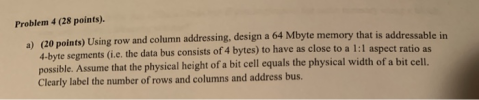 Problem 4 (28 points). a) (20 points) Using row and column addressing, design a 64 Mb yte memory that is addressable in 4-byte segments (i.e. the data bus consists of 4 bytes) to have as close to a 1:1 aspect ratio possible. As Clearly label the number of rows and columns and address bus. as sume that the physical height of a bit cell equals the physical width of a bit cell
 QUESTION 2 Suppose a computer using direct mapped cache has 216 bytes of byte-addressable main memory and a cache of 64 blocks, where each cache block contains 32 bytes. a. How many blocks of main memory are there? b) What is the format of a memory address as seen by the cache, (include field names and their sizes) c) To which cache block will the memory address (F8C916 map? What address in that block does it map to?
 How many disk accesses are needed to bring byte 4090 of a file into memory when the file is stored using double indirect indexed allocation? Assume that only the file's FCB is in memory, block pointers require 32 bits, and that blocks hold 1024 bytes each.
How many disk accesses are needed to bring byte 4090 of a file into memory when the file is stored using double indirect indexed allocation? Assume that only the file's FCB is in memory,...
How many disk accesses are needed to bring byte 4090 of a file into memory when the file is stored using double indirect indexed allocation? Assume that only the file's FCB is in memory, block pointers require 32 bits, and that blocks hold 1024 bytes each.
How many disk accesses are needed to bring byte 4090 of a file into memory when the file is stored using double indirect indexed allocation? Assume that only the file's FCB is in memory,...
 Problem 4 (28 points). a) (20 points) Using row and column addressing, design a 64 Mb yte memory that is addressable in 4-byte segments (i.e. the data bus consists of 4 bytes) to have as close to a 1:1 aspect ratio possible. As Clearly label the number of rows and columns and address bus. as sume that the physical height of a bit cell equals the physical width of a bit cell
Most questions answered within 3 hours.
-
Where is the error in this code sequence?
String s1 = "Hello";
String s2 = "ello";...
asked 11 months ago -
Financial data for Joel de Paris, Inc., for last year
follow:
Joel de Paris, Inc.
Balance...
asked 11 months ago -
Consider this reaction:
Al2(SO4)3 (aq)+ BaCl3
(aq) Al2Cl6 (aq)- +
3BaSO4(s) . What is the...
asked 11 months ago -
Suppose that Savneet is considering increasing her
recent random sample from 20 car rentals to 40...
asked 11 months ago -
Trucks arrive at an unloading terminal at an average rate of 120
per hour.
Trucks arrive...
asked 11 months ago -
Why are methanol and ethanol completely soluble in water while
octanol is not very little soluble....
asked 11 months ago -
A facilities manager at a university reads in a research report
that the mean amount of...
asked 11 months ago -
When the CuSO4 is rehydrated by adding water to the anhydrous
compound, is this an endothermic...
asked 11 months ago -
A ray of sunlight is passing from diamond into crown glass; the
angle of incidence is...
asked 11 months ago -
A block of mass 0.249 kg is placed on top of a light, vertical
spring of...
asked 11 months ago -
how do the kidneys compensate in the presences of acidosis
a) trigger hyperventilate
b) reserve acid...
asked 11 months ago -
Question 501 pts
The rental rate of capital to the firm increases. Which of the
following...
asked 11 months ago