Glucose (C6H12O6) is converted by yeast into ethanol or propenoic acid (aka acrylic acid) by the...
Glucose (C6H12O6) is converted by yeast into ethanol or propenoic acid (aka acrylic acid) by the following two reactions
C6H12O6 à 2 C2H5OH + 2 CO2 (rxn 1)
C6H12O6 à 2 C2H3CO2H + 2 H2O (rxn 2)
Initially an enzymatic reactor is filled with 5700 kg of an aqueous solution of 12 wt% glucose. During the conversion 175.1 kg of carbon dioxide are produced and 133 kg of glucose is left in the reactor after the reactions are complete. Assume that no other reactions are possible, the CO2 exits as a vapor, and use the approximate molar masses given in the table to determine the:
|
Species |
Molar Mass |
|
glucose |
180 |
|
ethanol |
46 |
|
propenoic acid |
72 |
|
carbon dioxide |
44 |
|
water |
18 |
a) kg-mols (aka kmols) of glucose initially present
b) kmols of glucose converted
c) kmols of carbon dioxide produced
d) extent of reaction for reaction 1 in kmols
e) extent of reaction for reaction 2 in kmols
f) mole percent of propenoic acid in the product solution
g) mole percent of ethanol in the product solution
h) mass percent of propenoic acid in the product solution
Homework Answers
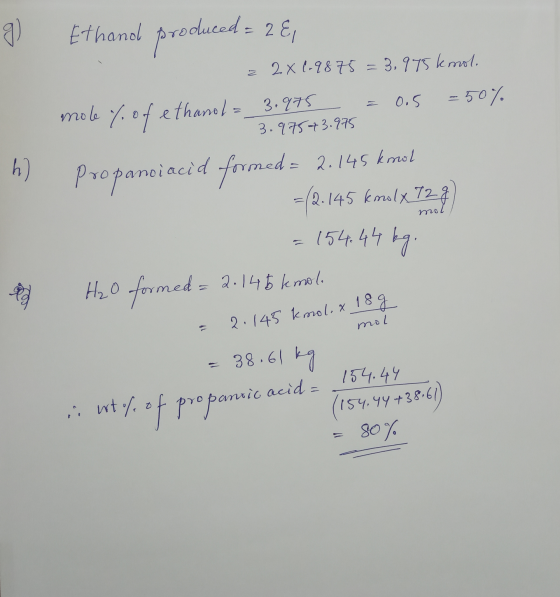
Mole=weight/molar mass
Mole % of I = mole of I/(total nber of mole)×100
Mole balance is done according to stoichiometric coefficient of reactant and product.
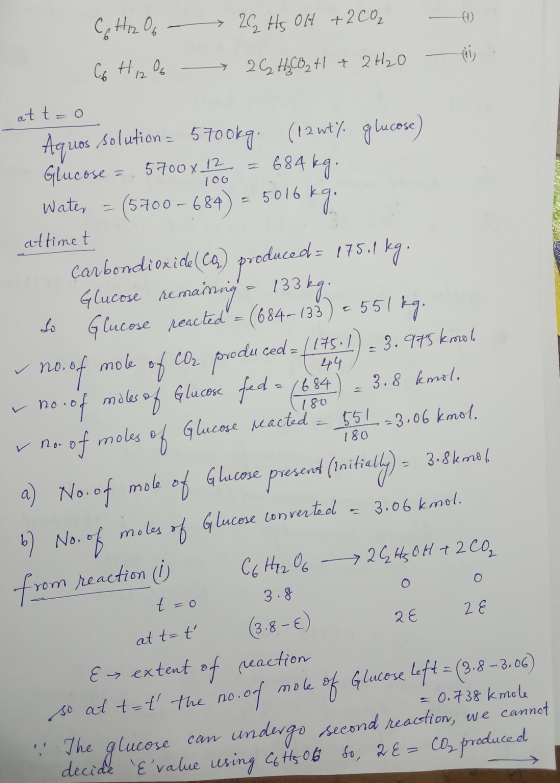
Page 2
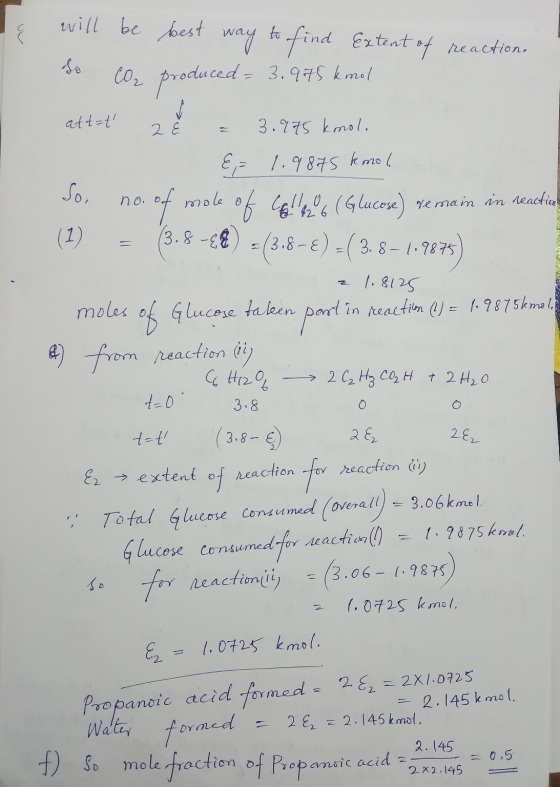
Page 3
a )moles of glucose present initially=3.8kmol
b)Mole of glucose converted=3.06 kmol
c) mole of CO2 formed=3.975 kmol
d)extent of reaction 1= 1.9875 kmol
e) extent of reaction 2= 1.0725 kmol
f) mole % of propanoic acid=50%
g) mole% of ethanol= 50%
h)wt% of propanoic acid= 80%
Hope this will be helpful
Add Answer to:
Glucose (C6H12O6) is converted
by yeast into ethanol or propenoic acid (aka acrylic acid) by the...
In alcohol fermentation, yeast converts glucose to ethanol and carbon dioxide: C6H12O6(s) → 2C2H5OH(l) + 2CO2(g)...
In alcohol fermentation, yeast converts glucose to ethanol and carbon dioxide: C6H12O6(s) → 2C2H5OH(l) + 2CO2(g) If 7.26 g of glucose are reacted and 1.44 L of CO2 gas are collected at 293 K and 0.984 atm, what is the percent yield of the reaction? ______?
1 - Mass balance with reaction a) A certain amount of Pennsylvania coal, in a final...
 1 - Mass balance
with reaction
a) A certain amount of Pennsylvania coal, in a final analysis
(by mass), has 84.36% C, 89% H2, 4.40% O2, 0.63% N2, 0.89% S and
7.83% ash (non-combustible). This coal is burned with a theoretical
amount of air. Disregarding the ash content, determine the molar
fractions of the products.
b) The antimony is obtained by heating the tibite
(Sb2S3) sprayed with iron shavings, removing
the molten antimony from the bottom of the reaction tank:...
1 - Mass balance
with reaction
a) A certain amount of Pennsylvania coal, in a final analysis
(by mass), has 84.36% C, 89% H2, 4.40% O2, 0.63% N2, 0.89% S and
7.83% ash (non-combustible). This coal is burned with a theoretical
amount of air. Disregarding the ash content, determine the molar
fractions of the products.
b) The antimony is obtained by heating the tibite
(Sb2S3) sprayed with iron shavings, removing
the molten antimony from the bottom of the reaction tank:...
Calculate the standard enthalpy change for the fermentation process, in which glucose (C6H12O6) is converted into...
Calculate the standard enthalpy change for the fermentation process, in which glucose (C6H12O6) is converted into ethanol (C2H5OH) and carbon dioxide (CO2). Substance Enthalpy of Formation, CO2 (g) −393.5 kJ/mol CO2 (aq) −412.9 kJ/mol C2H5OH (l) −276.98 kJ/mol C6H12O6 (s) −1,274.5 kJ/mol H2O (g) −241.8 kJ/mol H2O (l) −285.8 kJ/mol O2 (g) 0 kJ/mol ______kJ/mol
Calculate the standard enthalpy change for the fermentation process, in which glucose (C6H12O6) is converted into...
Calculate the standard enthalpy change for the fermentation process, in which glucose (C6H12O6) is converted into ethanol (C2H5OH) and carbon dioxide (CO2). Substance Enthalpy of Formation, Δ H o f CO2 (g) −393.5 kJ/mol CO2 (aq) −412.9 kJ/mol C2H5OH (l) −276.98 kJ/mol C6H12O6 (s) −1,274.5 kJ/mol H2O (g) −241.8 kJ/mol H2O (l) −285.8 kJ/mol O2 (g) 0 kJ/mol
In alcoholic fermentation, glucose is broken down into ethanol and carbon dioxide in the reaction C6H12O6...
 In alcoholic fermentation, glucose is broken down into ethanol and carbon dioxide in the reaction C6H12O6 + 2C2H5OH + 2CO2 Molar concentrations are [0.08], [0.10), and (1.5) from left to right in the above reaction. What is the value of the equilibrium constant at that temperature?
In anaerobic cells, glucose, C6H12O6, is converted to lactic acid in the reaction Glucose --> 2Lactic...
In anaerobic cells, glucose, C6H12O6, is converted to lactic acid in the reaction Glucose --> 2Lactic Acid The DHfo of glucose and lactic acid are -1273.1 and -694.0 kJ/mol, respectively. The Cp,mo for glucose and lactic acid are 219.2 and 127.6 J/mol K, respectively. Calculate the molar enthalpy associated with the formation of lactic acids from glucose at 298 K. What would the quantity in part (a) be if the reaction proceeded at a physiological temperature of 310 K? Based...
To make beer, yeast converts glucose (C6H12O6) into ethanol (� = 0.789 g/mL) in a process...
To make beer, yeast converts glucose (C6H12O6) into ethanol (� = 0.789 g/mL) in a process called fermentation. The unbalanced reaction is written here: _____C6H12O6 (aq) → _____C2H5OH (l) + _____CO2 (g) If 200.0 g of glucose yields 100.0 mL of ethanol, what is the % yield for the reaction? Baking soda (NaHCO3) can be made by the following reaction: NaCl (aq) + NH3 (aq) + CO2 (aq) + H2O (l) → NaHCO3 (s) + NH4Cl (aq) If 7.77 g...
1.How many grams of glucose (C6H12O6) are produced if 17.3 mol of H2O are reacted according...
1.How many grams of glucose (C6H12O6) are produced if 17.3 mol of H2O are reacted according to this balanced chemical equation? 6CO2 + 6H2O → C6H12O6 + 6O2 2. Nitroglycerin [C3H5(ONO2)3] is made by reacting nitric acid (HNO3) with glycerol [C3H5(OH)3] according to this reaction: C3H5(OH)3 + 3HNO3 → C3H5(ONO2)3 + 3H2O If 87.4 g of HNO3 is reacted with excess glycerol, what mass of nitroglycerin can be made? 3. Precipitation reactions, in which a solid (called a precipitate) is...
1. In the reaction between glucose and oxygen below, how many grams of glucose is required...
1. In the reaction between glucose and oxygen below, how many grams of glucose is required to produce 12.2 L of carbon dioxide if the density of Carbon dioxide is 1.26 g/L, C2H5OH, is 0.789g/mL. C6H12O6(s) + 6 O2(g) = 6 CO2(g) +6 H2O 2. When 10.6 g of boron trichloride is reacted with water, 5.12 g of Hydrochloric acid is produced. Using the following balanced equation, calculate the percent yield for HCl for the reaction? (BCl3 = 117.17 g/mol,...
Aqueous glucose (C6H12O6) combines with oxygen gas during metabolism, producing carbon dioxide gas and liquid water....
Aqueous glucose (C6H12O6) combines with oxygen gas during metabolism, producing carbon dioxide gas and liquid water. A. Write a balanced chemical equation (including physical states) for the reaction described above. B. If 0.125 moles of glucose are metabolized, how many moles of carbon dioxide are formed? C. If 0.125 moles of glucose are metabolized, how many moles of water are formed? Zinc reacts with aqueous sulfuric acid, in a single displacement reaction. 1. Write a balanced chemical equation (including physical...
 1 - Mass balance
with reaction
a) A certain amount of Pennsylvania coal, in a final analysis
(by mass), has 84.36% C, 89% H2, 4.40% O2, 0.63% N2, 0.89% S and
7.83% ash (non-combustible). This coal is burned with a theoretical
amount of air. Disregarding the ash content, determine the molar
fractions of the products.
b) The antimony is obtained by heating the tibite
(Sb2S3) sprayed with iron shavings, removing
the molten antimony from the bottom of the reaction tank:...
1 - Mass balance
with reaction
a) A certain amount of Pennsylvania coal, in a final analysis
(by mass), has 84.36% C, 89% H2, 4.40% O2, 0.63% N2, 0.89% S and
7.83% ash (non-combustible). This coal is burned with a theoretical
amount of air. Disregarding the ash content, determine the molar
fractions of the products.
b) The antimony is obtained by heating the tibite
(Sb2S3) sprayed with iron shavings, removing
the molten antimony from the bottom of the reaction tank:...
 In alcoholic fermentation, glucose is broken down into ethanol and carbon dioxide in the reaction C6H12O6 + 2C2H5OH + 2CO2 Molar concentrations are [0.08], [0.10), and (1.5) from left to right in the above reaction. What is the value of the equilibrium constant at that temperature?
Most questions answered within 3 hours.
-
Where is the error in this code sequence?
String s1 = "Hello";
String s2 = "ello";...
asked 11 months ago -
Financial data for Joel de Paris, Inc., for last year
follow:
Joel de Paris, Inc.
Balance...
asked 11 months ago -
Consider this reaction:
Al2(SO4)3 (aq)+ BaCl3
(aq) Al2Cl6 (aq)- +
3BaSO4(s) . What is the...
asked 11 months ago -
Suppose that Savneet is considering increasing her
recent random sample from 20 car rentals to 40...
asked 11 months ago -
Trucks arrive at an unloading terminal at an average rate of 120
per hour.
Trucks arrive...
asked 11 months ago -
Why are methanol and ethanol completely soluble in water while
octanol is not very little soluble....
asked 11 months ago -
A facilities manager at a university reads in a research report
that the mean amount of...
asked 11 months ago -
When the CuSO4 is rehydrated by adding water to the anhydrous
compound, is this an endothermic...
asked 11 months ago -
A ray of sunlight is passing from diamond into crown glass; the
angle of incidence is...
asked 11 months ago -
A block of mass 0.249 kg is placed on top of a light, vertical
spring of...
asked 11 months ago -
how do the kidneys compensate in the presences of acidosis
a) trigger hyperventilate
b) reserve acid...
asked 11 months ago -
Question 501 pts
The rental rate of capital to the firm increases. Which of the
following...
asked 11 months ago