A tennis ball of mass 57.0 g is held just above a basketball of mass 607...
A tennis ball of mass 57.0 g is held just above a basketball of mass 607 g. With their centers vertically aligned, both balls are released from rest at the same time, to fall through a distance of 1.30 m, as shown in the figure below. (a) Find the magnitude of the downward velocity with which the basketball reaches the ground. . m/s (b) Assume that an elastic collision with the ground instantaneously reverses the velocity of the basketball while the tennis ball is still moving down. Next, the two balls meet in an elastic collision. To what height does the tennis ball rebound?
Homework Answers
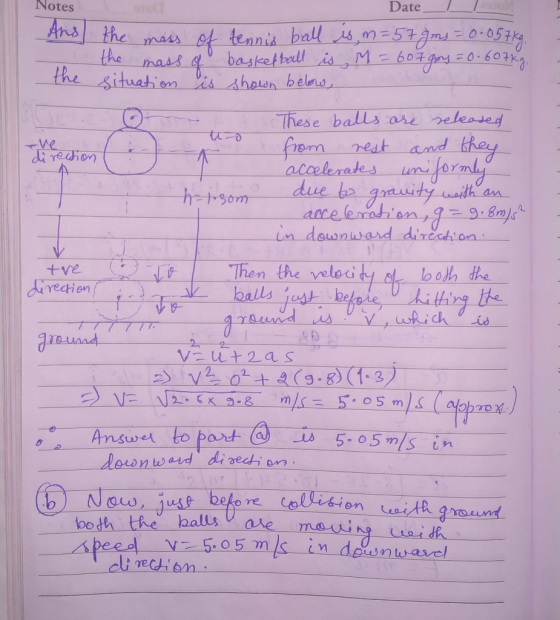
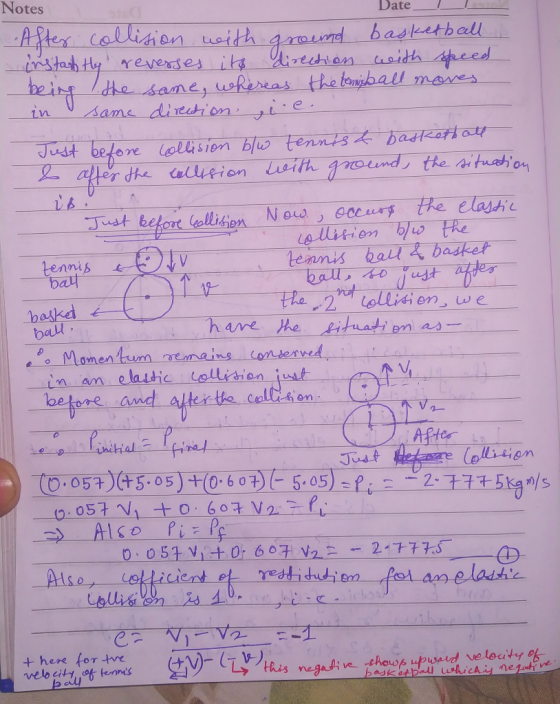
 Note :- coefficient of
restitution is defined as the ratio of relative final velocities
with respect to initial relative velocities of the two balls ,
which is one for a elastic collision.,i.e
Note :- coefficient of
restitution is defined as the ratio of relative final velocities
with respect to initial relative velocities of the two balls ,
which is one for a elastic collision.,i.e
COR=e=1=(v1-v2)/(u2-u1)
u1= initial velocity of tennis ball before collision with Basketball
u2= initial velocity of basketball before collision with tennis ball
V1= velocity of tennis ball after collision with Basketball
V2= velocity of basketball after collision with tennis ball
Add Answer to:
A tennis ball of mass 57.0 g is held just above a basketball of
mass 607...
A tennis ball of mass 57.0 g is held just above a basketball of mass 577...
A tennis ball of mass 57.0 g is held just above a basketball of mass 577 g. With their centers vertically aligned, both balls are released from rest at the same time, to fall through a distance of 1.15 m, as shown in the figure below. (a) Find the magnitude of the downward velocity with which the basketball reaches the ground. (b) Assume that an elastic collision with the ground instantaneously reverses the velocity of the basketball while the tennis...
A tennis ball of mass 57.0 g is held just above a basketball of mass 647...
 A tennis ball of mass 57.0 g is held just above a basketball of
mass 647 g. With their centers
vertically aligned, both balls are released from rest at the same
time, to fall through a distance of 1.00 m, as shown in the figure below.
(a) Find the magnitude of the downward velocity
with which the basketball reaches the ground.
m/s
(b) Assume that an elastic collision with the ground
instantaneously reverses the velocity of the basketball while the...
A tennis ball of mass 57.0 g is held just above a basketball of
mass 647 g. With their centers
vertically aligned, both balls are released from rest at the same
time, to fall through a distance of 1.00 m, as shown in the figure below.
(a) Find the magnitude of the downward velocity
with which the basketball reaches the ground.
m/s
(b) Assume that an elastic collision with the ground
instantaneously reverses the velocity of the basketball while the...
10 6 P073 MIF My N A tennis ball of mass 57.0 g is held just...
 10 6 P073 MIF My N A tennis ball of mass 57.0 g is held just above a basketball qf fall through a distance of 1.10 m, as shown in the figure below. aligned, both balls are released from rest at the same time, to (a) Find the magnitude of the downward velocity with which the basketball reaches the ground. 643 m/s (b) Assume that an elastic collision with the ground instantaneously reverses the velocity of the basketball while the...
A tennis ball of mass 0.063kg is held just above a basketball of mass 0.530kg. With...
 A tennis ball of mass 0.063kg is held just above a basketball of mass 0.530kg. With their centers vertically aligned, both balls are released from rest at the same time and fall through a distance of 1.5m. 1) How fast are the balls moving right before impact? 2) How fast are they moving after impact? Assume an elastic collision 3) How high will be tennis ball travel after collision? ) What is the impulse delivered to the tennis ball? 5)...
1. A ping pong ball (ball #1, mass of 2g) is held just above a tennis...
 1. A ping pong ball (ball #1, mass of 2g) is held just above a tennis ball (ball #2, mass of 57g) with their centers vertically aligned. When the balls are released, they fall through a vertical distance of 1.27 meters. a) Prove that each ball is traveling at 5.00 m/s just before it hits the ground. The tennis ball (#2) hits the ground and bounces elastically off of it before the ping pong ball (#1) actually hits #2. Since...
A ball of mass 2.00 kg is traveling east at 5.00 m/s. Another ball of mass...
A ball of mass 2.00 kg is traveling east at 5.00 m/s. Another ball of mass 4.00kg is traveling west at 2.00 m/s. The two balls meet in a head-on-perfectly elastic collision. If the collision is perfectly (completely) elastic, what is the velocity (magnitude and direction) of each ball after the collision?
The mass of a regulation tennis ball is 57.0 g (although it can vary slightly), and...
The mass of a regulation tennis ball is 57.0 g (although it can vary slightly), and tests have shown that the ball is in contact with the tennis racket for 30.0 ms . (This number can also vary, depending on the racket and swing.) We shall assume a 30.0 ms contact time throughout this problem. The fastest-known served tennis ball was served by "Big Bill" Tilden in 1931, and its speed was measured to be 73.14 m/s. Part A)What impulse...
As shown, tennis ball A rolls off the top of a 10.0 m high wall, falls...
 As shown, tennis ball A rolls off the top of a 10.0 m
high wall, falls 4.00 m, and strikes another tennis ball,
B, obliquely. (Figure 1) Before the collision, tennis ball
Bhas a speed of 19.0 m/s as it moves upward. Each ball's
mass is 57.0 g and the collision's coefficient of restitution is
0.630.(Figure 2) In the figure, ?1=30.0?
and?1=20.0?. What is (vA)1, the
velocity of tennis ball A, immediately before the
collision?
As shown, tennis ball A rolls off the top of a 10.0 m
high wall, falls 4.00 m, and strikes another tennis ball,
B, obliquely. (Figure 1) Before the collision, tennis ball
Bhas a speed of 19.0 m/s as it moves upward. Each ball's
mass is 57.0 g and the collision's coefficient of restitution is
0.630.(Figure 2) In the figure, ?1=30.0?
and?1=20.0?. What is (vA)1, the
velocity of tennis ball A, immediately before the
collision?
A tennis ball machine holds 200 balls and has a mass of 36.0 kg when empty....
A tennis ball machine holds 200 balls and has a mass of 36.0 kg when empty. Each tennis ball has a mass of 57.0 g. A coach has set the machine to launch balls horizontally with a speed of 53.0 m/s.He forgot to set the brakes on the machine. If friction between the machine and the court is negligible and all 200 balls are launched, what is the final speed of the machine?
Need help on part C! As shown, tennis ball A rolls off the top of a...
 Need help on part C!
As shown, tennis ball A rolls off the top of a 10.0 m high wall, falls 4.00 m, and strikes another tennis ball, B, obliquely. (Figure 1) Before the collision, tennis ball B has a speed of 21.0 m/s as it moves upward. Each ball's mass is 57.0 g and the collision's coefficient of restitution is 0.730. (Figure 2) In the figure, a-30.0° and фі-20.0. What is (VA), , the velocity of tennis ball A,...
Need help on part C!
As shown, tennis ball A rolls off the top of a 10.0 m high wall, falls 4.00 m, and strikes another tennis ball, B, obliquely. (Figure 1) Before the collision, tennis ball B has a speed of 21.0 m/s as it moves upward. Each ball's mass is 57.0 g and the collision's coefficient of restitution is 0.730. (Figure 2) In the figure, a-30.0° and фі-20.0. What is (VA), , the velocity of tennis ball A,...
 A tennis ball of mass 57.0 g is held just above a basketball of
mass 647 g. With their centers
vertically aligned, both balls are released from rest at the same
time, to fall through a distance of 1.00 m, as shown in the figure below.
(a) Find the magnitude of the downward velocity
with which the basketball reaches the ground.
m/s
(b) Assume that an elastic collision with the ground
instantaneously reverses the velocity of the basketball while the...
A tennis ball of mass 57.0 g is held just above a basketball of
mass 647 g. With their centers
vertically aligned, both balls are released from rest at the same
time, to fall through a distance of 1.00 m, as shown in the figure below.
(a) Find the magnitude of the downward velocity
with which the basketball reaches the ground.
m/s
(b) Assume that an elastic collision with the ground
instantaneously reverses the velocity of the basketball while the...
 10 6 P073 MIF My N A tennis ball of mass 57.0 g is held just above a basketball qf fall through a distance of 1.10 m, as shown in the figure below. aligned, both balls are released from rest at the same time, to (a) Find the magnitude of the downward velocity with which the basketball reaches the ground. 643 m/s (b) Assume that an elastic collision with the ground instantaneously reverses the velocity of the basketball while the...
 A tennis ball of mass 0.063kg is held just above a basketball of mass 0.530kg. With their centers vertically aligned, both balls are released from rest at the same time and fall through a distance of 1.5m. 1) How fast are the balls moving right before impact? 2) How fast are they moving after impact? Assume an elastic collision 3) How high will be tennis ball travel after collision? ) What is the impulse delivered to the tennis ball? 5)...
 1. A ping pong ball (ball #1, mass of 2g) is held just above a tennis ball (ball #2, mass of 57g) with their centers vertically aligned. When the balls are released, they fall through a vertical distance of 1.27 meters. a) Prove that each ball is traveling at 5.00 m/s just before it hits the ground. The tennis ball (#2) hits the ground and bounces elastically off of it before the ping pong ball (#1) actually hits #2. Since...
 As shown, tennis ball A rolls off the top of a 10.0 m
high wall, falls 4.00 m, and strikes another tennis ball,
B, obliquely. (Figure 1) Before the collision, tennis ball
Bhas a speed of 19.0 m/s as it moves upward. Each ball's
mass is 57.0 g and the collision's coefficient of restitution is
0.630.(Figure 2) In the figure, ?1=30.0?
and?1=20.0?. What is (vA)1, the
velocity of tennis ball A, immediately before the
collision?
As shown, tennis ball A rolls off the top of a 10.0 m
high wall, falls 4.00 m, and strikes another tennis ball,
B, obliquely. (Figure 1) Before the collision, tennis ball
Bhas a speed of 19.0 m/s as it moves upward. Each ball's
mass is 57.0 g and the collision's coefficient of restitution is
0.630.(Figure 2) In the figure, ?1=30.0?
and?1=20.0?. What is (vA)1, the
velocity of tennis ball A, immediately before the
collision?
 Need help on part C!
As shown, tennis ball A rolls off the top of a 10.0 m high wall, falls 4.00 m, and strikes another tennis ball, B, obliquely. (Figure 1) Before the collision, tennis ball B has a speed of 21.0 m/s as it moves upward. Each ball's mass is 57.0 g and the collision's coefficient of restitution is 0.730. (Figure 2) In the figure, a-30.0° and фі-20.0. What is (VA), , the velocity of tennis ball A,...
Need help on part C!
As shown, tennis ball A rolls off the top of a 10.0 m high wall, falls 4.00 m, and strikes another tennis ball, B, obliquely. (Figure 1) Before the collision, tennis ball B has a speed of 21.0 m/s as it moves upward. Each ball's mass is 57.0 g and the collision's coefficient of restitution is 0.730. (Figure 2) In the figure, a-30.0° and фі-20.0. What is (VA), , the velocity of tennis ball A,...
Most questions answered within 3 hours.
-
Where is the error in this code sequence?
String s1 = "Hello";
String s2 = "ello";...
asked 11 months ago -
Financial data for Joel de Paris, Inc., for last year
follow:
Joel de Paris, Inc.
Balance...
asked 11 months ago -
Consider this reaction:
Al2(SO4)3 (aq)+ BaCl3
(aq) Al2Cl6 (aq)- +
3BaSO4(s) . What is the...
asked 11 months ago -
Suppose that Savneet is considering increasing her
recent random sample from 20 car rentals to 40...
asked 11 months ago -
Trucks arrive at an unloading terminal at an average rate of 120
per hour.
Trucks arrive...
asked 11 months ago -
Why are methanol and ethanol completely soluble in water while
octanol is not very little soluble....
asked 11 months ago -
A facilities manager at a university reads in a research report
that the mean amount of...
asked 11 months ago -
When the CuSO4 is rehydrated by adding water to the anhydrous
compound, is this an endothermic...
asked 11 months ago -
A ray of sunlight is passing from diamond into crown glass; the
angle of incidence is...
asked 11 months ago -
A block of mass 0.249 kg is placed on top of a light, vertical
spring of...
asked 11 months ago -
how do the kidneys compensate in the presences of acidosis
a) trigger hyperventilate
b) reserve acid...
asked 11 months ago -
Question 501 pts
The rental rate of capital to the firm increases. Which of the
following...
asked 11 months ago