1. Describe the pathway of a mature egg through ovulation and menstruation. What structures does the...
1. Describe the pathway of a mature egg through ovulation and menstruation. What structures does the oocyte pass through and what interactions occur?
2. Describe the pathway of a mature sperm cell during ejaculation. What structures does the sperm cell pass through and what interactions occur?
Homework Answers
 (1)The figure
shown is of an ovary where in an oocyte is getting matured and
finally is released from the ovary. The Primary follicle matures to
become secondary follicle by developing more layers of granulosa
cells around it ; the secondary gets transformed into tertiary
wherein a fluid filled cavity is formed in it and more granulosa
cells surround it; and tertiary follicle then finally matures into
the graafian follicle.
(1)The figure
shown is of an ovary where in an oocyte is getting matured and
finally is released from the ovary. The Primary follicle matures to
become secondary follicle by developing more layers of granulosa
cells around it ; the secondary gets transformed into tertiary
wherein a fluid filled cavity is formed in it and more granulosa
cells surround it; and tertiary follicle then finally matures into
the graafian follicle.
The release of egg(secondary oocyte from graafian follicle) from ovary is termed as ovulation. Ovulation occurs when luteinizing hormone(LH) is secreted(generally within 24 to 36 hours after secretion of LH).
During fertilization, the released ovum goes to ampullary- isthmic junction (via infundibulum) of the fallopian tube where sperm is already waiting for it and thus the ovum gets fertilized. But, not every time is the case that sperm waits for ovum. In that case, Menstruation occurs.
Menstruation: when the ovum is not fertilized, endometrial lining of uterus and blood vessels breakdown and comes out in the liquid form through vagina. This is a monthly process that occurs in every 28-30 days. The menstrual flow is of 3-5 days.
Menstrual cycle has 3 phases:
1. Menstruation- As we now know that egg is released due to LH secretion, this LH also stimulate secretion of Progesterone which is a hormone that helps maintain the uterus endometrium lining to support pregnancy. But when the egg is not fertilized, corpus luteum gets signals of rupturing and thus no more LH is secreted which hence does'nt stimulate the secretion of progesterone and as a result the uterus endometrial lining breaks off and menstruation takes place. It lasts for 3-5 days.
2. Follicular Phase- After 3-5 days , again in ovary the process of oocyte maturation starts ; eventually graafian follicle is formed , uterus lining builds up again. During this phase the LH and Follicle stimulating hormone(FSH) secretion increases that stimulate follicle growth and development; as well as secretion of estrogen. When LH reaches at its peak ovulation occurs. This phase lasts for 9-10 days.
3. Luteal Phase- After ovulation , the graafian follicle which is left in the ovary is now called corpus luteum, it stimulates the secretion of progesterone (that maintains the endometium which is necessary for implantation of fertilized egg) and its levels are maintained during pregnancy, that time no menstruation occurs(for 9 months; in case of humans). But otherwise, corpus luteum degenerates and leads to shedding of endometrial lining of uterus. This phase lasts till 14 days. After that new cycle starts.
(2)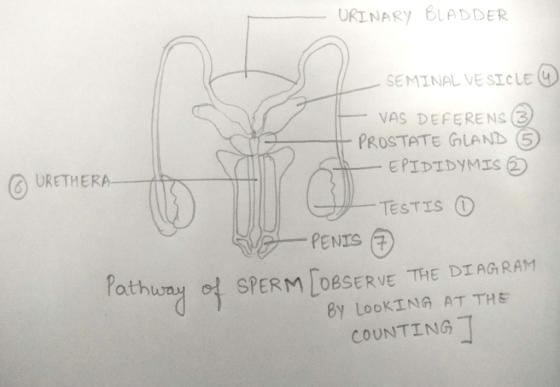
Sperms are formed inside the testes in the seminiferous tubules.
(a) Spermatogonium divide mitotically to from primary spermatocyte which then divide meiotically to form secondary spermatocyte , then the secondary spermatocyte undergo second meiotic division to form (haploid)spermatids.These spermatids mature into the spermatozoa which embed themselves into sertoli cells (present in the seminiferous tubules) to obtain nutrition.
(b) On the top of testes , epididymis is present where sperms migrate from seminiferous tubules and get matured while residing there for a few days. On stimulation , sperms are ejected from epididymis and reach vas deferens.
(c) Vas deferens is a muscular duct that is directed towards abdomen by crossing over the urinary bladder. It pushes the sperm forward after which the sperm reaches ampulla where it gets mixed with the secretions(seminal fluid) of seminal vesicle.
(d) The seminal fluid along with sperms is then passed through the prostate gland wherein a milky fluid is added to this and finally forms SEMEN which is ejaculted through the urethera and finally ejacultes out..
Add Answer to:
1. Describe the pathway of a mature egg through ovulation and
menstruation. What structures does the...
Human Sexuality Question 1 Women no longer undergo menstruation after menopause. Answers: True False Question 2...
 Human Sexuality
Question 1 Women no longer undergo menstruation after menopause. Answers: True False Question 2 Eggs must carry what type of chromosome for the sex-chromosome? Answers: Eggs carry an ONE X chromosome. Eggs carry an ONE Y chromosome Eggs carry an TWO X chromosomes Eggs can carry either a Y or an X chromosome Question 3 How long does a typical menstrual cycle last? Answers: 28 days 14 days 7 days 3 days Question 4 What event occurs on...
Human Sexuality
Question 1 Women no longer undergo menstruation after menopause. Answers: True False Question 2 Eggs must carry what type of chromosome for the sex-chromosome? Answers: Eggs carry an ONE X chromosome. Eggs carry an ONE Y chromosome Eggs carry an TWO X chromosomes Eggs can carry either a Y or an X chromosome Question 3 How long does a typical menstrual cycle last? Answers: 28 days 14 days 7 days 3 days Question 4 What event occurs on...
1. Which is not one of the primary substances regulated by the kidney? A) glucose (B) water (C) salt (D)...
1. Which is not one of the primary substances regulated by the kidney? A) glucose (B) water (C) salt (D) urea. 2. The ‘tube’ leading from the kidney to the bladder is the; (A) urethra (B) renal artery (C) renal vein (D) ureter. 3. Which of the following is a function of the testes (A) sperm production (B) sperm storage (C) seminal fluid production (D) progesterone production (E) none of the above. 4. A single germ cell yields how many mature sperm cells? (A) 1 (B) 2 (C) 3 ...
please help D) Egg A was fertilized internally and egg WUJU In which part of a...
 please help
D) Egg A was fertilized internally and egg WUJU In which part of a flower do both meiosis and fertilization occur? D) petal A) ovule C) anther B) stigma During the normal meiotic division of a diploid cell, the change in chromosome number that is represented by A) nn B) 4n-n C) 2n--n D) 2n-4 For the Riven phrase, choose the term that is best described by that phrase. the entire process of growth and maturation following birth...
please help
D) Egg A was fertilized internally and egg WUJU In which part of a flower do both meiosis and fertilization occur? D) petal A) ovule C) anther B) stigma During the normal meiotic division of a diploid cell, the change in chromosome number that is represented by A) nn B) 4n-n C) 2n--n D) 2n-4 For the Riven phrase, choose the term that is best described by that phrase. the entire process of growth and maturation following birth...
8. Describe the anatomical structure of the female breasts (mammary glands) accessory organs of reproduction. as...
 8. Describe the anatomical structure of the female breasts (mammary glands) accessory organs of reproduction. as 9. When does ovulation occur? 10. Name and explain the four phases of the human sexual response. Fetal Development 1. Contrast mitosis and meiosis. 2, How does the female have an influence on which sperm fertilizes the mature ovum? 3. Describe the events that take place during transport of the zygote through the fallopian tube. 4. Explain the differences between the chorion and the...
Reproductive%205ystem % 20Worksheet Compatibility Mode -Saved to this PC p Search Help Acrobat Mailings Review View...
 Reproductive%205ystem % 20Worksheet Compatibility Mode -Saved to this PC p Search Help Acrobat Mailings Review View References ut Аав Aa AaBbCcl AaBbCcI AaBbC AaBbCcD Heading 2 Title 1 Normal Heading 1 T No Spac... D-A Styles Paragraph Reproductive System Worksheet DIRECTIONS: Put the letter of each word next to the correct definition of the word. The penis or clitoris filling with blood a) Circumcision and getting harder and larger b) Conception 2. The outside parts of the male's or female's...
i know this is a lot but pls and thank you - 66) The diagram below...
 i know this is a lot but pls and thank you
- 66) The diagram below represents processes in the reproduction of a honeybee. As indicated in this diagram, which processes produce a male honeybee? A) meiosis and parthenogenesis C) fertilization and cleavage B) fertilization and parthenogenesis D) meiosis and budding Questions 67 and 68 refer to the following: The diagram below represents a portion of the female reproductive system 67) Which process occurs between A and B? A) fertilization...
i know this is a lot but pls and thank you
- 66) The diagram below represents processes in the reproduction of a honeybee. As indicated in this diagram, which processes produce a male honeybee? A) meiosis and parthenogenesis C) fertilization and cleavage B) fertilization and parthenogenesis D) meiosis and budding Questions 67 and 68 refer to the following: The diagram below represents a portion of the female reproductive system 67) Which process occurs between A and B? A) fertilization...
2. How does the female have an influence on which sperm fertilizes the mature ovum? 3....
 2. How does the female have an influence on which sperm fertilizes the mature ovum? 3. Describe the events that take place during transport of the zygote through the fallopian tube. 4. Explain the differences between the chorion and the amnion. 5. What are the functions of amniotic fluid?
Tau protein 1.)general summary 2.)what the pathway does for the cell 3.)what the pathway does for...
Tau protein 1.)general summary 2.)what the pathway does for the cell 3.)what the pathway does for an organism overall 4.)what other cellular events depend on tau pathway/event or structure
6.What is the name of the cells that secrete insulin in the pancreas? What is the...
6.What is the name of the cells that secrete insulin in the pancreas? What is the function of insulin? What is the difference between type 1 and type 2 diabetes and which one is more prevalent in today’s society? What are the name of the cells that secrete glucagon in the pancreas and what is glucagon’s function? 7.What is the name of the gonad for the male and female, respectively? What is the function of follicle stimulating hormone in males...
a) Describe the VEGFR signal transduction pathway. What is a RTK? How does it transmit an...
a) Describe the VEGFR signal transduction pathway. What is a RTK? How does it transmit an external signal to the interior of the cell? What is the response of the cell? b) How can signal transduction pathways can be used to explore and develop possible new drugs for breast cancer treatment?
 Human Sexuality
Question 1 Women no longer undergo menstruation after menopause. Answers: True False Question 2 Eggs must carry what type of chromosome for the sex-chromosome? Answers: Eggs carry an ONE X chromosome. Eggs carry an ONE Y chromosome Eggs carry an TWO X chromosomes Eggs can carry either a Y or an X chromosome Question 3 How long does a typical menstrual cycle last? Answers: 28 days 14 days 7 days 3 days Question 4 What event occurs on...
Human Sexuality
Question 1 Women no longer undergo menstruation after menopause. Answers: True False Question 2 Eggs must carry what type of chromosome for the sex-chromosome? Answers: Eggs carry an ONE X chromosome. Eggs carry an ONE Y chromosome Eggs carry an TWO X chromosomes Eggs can carry either a Y or an X chromosome Question 3 How long does a typical menstrual cycle last? Answers: 28 days 14 days 7 days 3 days Question 4 What event occurs on...
 please help
D) Egg A was fertilized internally and egg WUJU In which part of a flower do both meiosis and fertilization occur? D) petal A) ovule C) anther B) stigma During the normal meiotic division of a diploid cell, the change in chromosome number that is represented by A) nn B) 4n-n C) 2n--n D) 2n-4 For the Riven phrase, choose the term that is best described by that phrase. the entire process of growth and maturation following birth...
please help
D) Egg A was fertilized internally and egg WUJU In which part of a flower do both meiosis and fertilization occur? D) petal A) ovule C) anther B) stigma During the normal meiotic division of a diploid cell, the change in chromosome number that is represented by A) nn B) 4n-n C) 2n--n D) 2n-4 For the Riven phrase, choose the term that is best described by that phrase. the entire process of growth and maturation following birth...
 8. Describe the anatomical structure of the female breasts (mammary glands) accessory organs of reproduction. as 9. When does ovulation occur? 10. Name and explain the four phases of the human sexual response. Fetal Development 1. Contrast mitosis and meiosis. 2, How does the female have an influence on which sperm fertilizes the mature ovum? 3. Describe the events that take place during transport of the zygote through the fallopian tube. 4. Explain the differences between the chorion and the...
 Reproductive%205ystem % 20Worksheet Compatibility Mode -Saved to this PC p Search Help Acrobat Mailings Review View References ut Аав Aa AaBbCcl AaBbCcI AaBbC AaBbCcD Heading 2 Title 1 Normal Heading 1 T No Spac... D-A Styles Paragraph Reproductive System Worksheet DIRECTIONS: Put the letter of each word next to the correct definition of the word. The penis or clitoris filling with blood a) Circumcision and getting harder and larger b) Conception 2. The outside parts of the male's or female's...
 i know this is a lot but pls and thank you
- 66) The diagram below represents processes in the reproduction of a honeybee. As indicated in this diagram, which processes produce a male honeybee? A) meiosis and parthenogenesis C) fertilization and cleavage B) fertilization and parthenogenesis D) meiosis and budding Questions 67 and 68 refer to the following: The diagram below represents a portion of the female reproductive system 67) Which process occurs between A and B? A) fertilization...
i know this is a lot but pls and thank you
- 66) The diagram below represents processes in the reproduction of a honeybee. As indicated in this diagram, which processes produce a male honeybee? A) meiosis and parthenogenesis C) fertilization and cleavage B) fertilization and parthenogenesis D) meiosis and budding Questions 67 and 68 refer to the following: The diagram below represents a portion of the female reproductive system 67) Which process occurs between A and B? A) fertilization...
 2. How does the female have an influence on which sperm fertilizes the mature ovum? 3. Describe the events that take place during transport of the zygote through the fallopian tube. 4. Explain the differences between the chorion and the amnion. 5. What are the functions of amniotic fluid?
Most questions answered within 3 hours.
-
Where is the error in this code sequence?
String s1 = "Hello";
String s2 = "ello";...
asked 11 months ago -
Financial data for Joel de Paris, Inc., for last year
follow:
Joel de Paris, Inc.
Balance...
asked 11 months ago -
Consider this reaction:
Al2(SO4)3 (aq)+ BaCl3
(aq) Al2Cl6 (aq)- +
3BaSO4(s) . What is the...
asked 11 months ago -
Suppose that Savneet is considering increasing her
recent random sample from 20 car rentals to 40...
asked 11 months ago -
Trucks arrive at an unloading terminal at an average rate of 120
per hour.
Trucks arrive...
asked 11 months ago -
Why are methanol and ethanol completely soluble in water while
octanol is not very little soluble....
asked 11 months ago -
A facilities manager at a university reads in a research report
that the mean amount of...
asked 11 months ago -
When the CuSO4 is rehydrated by adding water to the anhydrous
compound, is this an endothermic...
asked 11 months ago -
A ray of sunlight is passing from diamond into crown glass; the
angle of incidence is...
asked 11 months ago -
A block of mass 0.249 kg is placed on top of a light, vertical
spring of...
asked 11 months ago -
how do the kidneys compensate in the presences of acidosis
a) trigger hyperventilate
b) reserve acid...
asked 11 months ago -
Question 501 pts
The rental rate of capital to the firm increases. Which of the
following...
asked 11 months ago