define and discuss isocratic and gradient HPLC elution.
define and discuss isocratic and gradient HPLC elution.
Homework Answers
A separation in which the mobile phasecomposition remains constant throughout the procedure is termed isocratic (meaning constant composition). (The example of these the percentage of methanol throughout the procedure will remain constant i.e 10%) The word was coined by csabhorvath who was one of the pioneers of HPLC.
The mobile phase composition does not have to remain constant. A separation in which the mobile phase composition is changed during the separation process is described as a gradient elution. One example is a gradient starting at 10% methanol and ending at 90% methanol after 20 minutes. The two components of the mobile phase are typically termed "A" and "B"; A is the "weak" solvent which allows the solute to elute only slowly, while B is the "strong" solvent which rapidly elutes the solutes from the column. In reversed-phase chromatography, solvent A is often water or an aqueous buffer, while B is an organic solvent miscible with water, such as acetonitrile, methanol, THF, or isopropanol.
In isocratic elution, peak width increases with retention time
linearly according to the equation for N, the number of theoretical
plates. This leads to the disadvantage that late-eluting peaks get
very flat and broad. Their shape and width may keep them from being
recognized as peaks.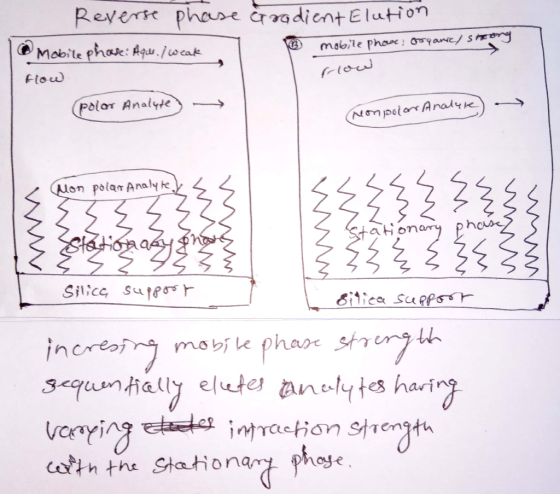
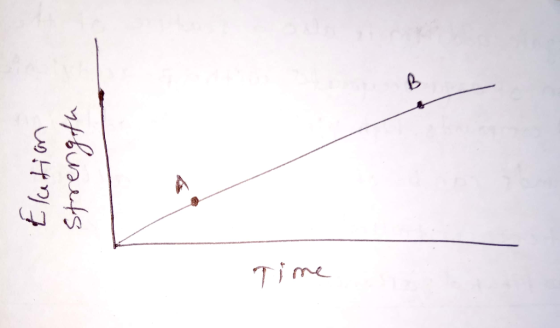
Gradient elution decreases the retention of the later-eluting components so that they elute faster, giving narrower (and taller) peaks for most components. This also improves the peak shape for tailed peaks, as the increasing concentration of the organic eluent pushes the tailing part of a peak forward. This also increases the peak height (the peak looks "sharper"), which is important in trace analysis. The gradient program may include sudden "step" increases in the percentage of the organic component, or different slopes at different times – all according to the desire for optimum separation in minimum time.
In isocratic elution, the selectivity does not change if the column dimensions (length and inner diameter) change – that is, the peaks elute in the same order. In gradient elution, the elution order may change as the dimensions or flow rate change.
The driving force in reversed phase chromatography originates in the high order of the water structure. The role of the organic component of the mobile phase is to reduce this high order and thus reduce the retarding strength of the aqueous component.
What is gradient elution and what are the advantages to using a gradient in HPLC?
What is gradient elution and what are the advantages to using a gradient in HPLC?
Define isocratic, gradient, and stepwise elution. What is the difference between them? Provide a situation (ie....
Define isocratic, gradient, and stepwise elution. What is the difference between them? Provide a situation (ie. type of mixture and type of chromatography) for each elution where one method would be more beneficial than the others?
Choose from (3 marks) Choose an appropriate detector for the following chromatography: i) Gradient elution from...
 Choose from
(3 marks) Choose an appropriate detector for the following chromatography: i) Gradient elution from normal phase of a series of benzene derivatives ii) Separation of monosaccharide sugars by isocratic elution from a ligand d) exchange column. iii) Gradient elution from reversed phase of a series of steroids
Choose from
(3 marks) Choose an appropriate detector for the following chromatography: i) Gradient elution from normal phase of a series of benzene derivatives ii) Separation of monosaccharide sugars by isocratic elution from a ligand d) exchange column. iii) Gradient elution from reversed phase of a series of steroids
1. What is the gas chromatography equivalent of the isocratic vs. gradient elution method? (What variable...
1. What is the gas chromatography equivalent of the isocratic vs. gradient elution method? (What variable do you change over time to improve separation efficiency?) 2. How does a separatory funnel work? Which layer will be on the top after mixing, the aqueous layer or methylene chloride
How do dipole moments predict the order of elution in reverse phase High-Performance Liquid Chromatography (HPLC)?
How do dipole moments predict the order of elution in reverse phase High-Performance Liquid Chromatography (HPLC)?
4) What is the order of elution of the following compounds from a reverse-phase packed HPLC...
4) What is the order of elution of the following compounds from a reverse-phase packed HPLC column? Briefly justify your reasoning. Benzyl alcohol (C6H5CH2OH), benzaldehyde (C6H5CHO), benzoic acid (C6H5COOH), Acetophenone (C6H5C(O)CH3)
In reverse-phase HPLC, the liquid stationary phase is _____ polar than the mobile phase, and elution...
In reverse-phase HPLC, the liquid stationary phase is _____ polar than the mobile phase, and elution of the ______ polar compounds occurs first, with the ______ polar compounds adsorbed more tightly to the stationary phase. Select one: a. less, less, less b. more, more, more c. less, more, less
Extra Credit: In a biopharmaceutical process Proteins A and B were separated by the HPLC with...
 Extra Credit: In a biopharmaceutical process Proteins A and B
were separated by the HPLC with elution times labeled in the
chromatogram. Determine Retention Factors for proteins A and B and
Selectivity between them. (4 marks)
• Extra Credit: In a biopharmaceutical process Proteins A and B were separated by the HPLC with elution times labeled in the chromatogram. Determine Retention Factors for proteins A and B and Selectivity between them. (4 marks) 0.14 0.12 Buffer components Peak B AU...
Extra Credit: In a biopharmaceutical process Proteins A and B
were separated by the HPLC with elution times labeled in the
chromatogram. Determine Retention Factors for proteins A and B and
Selectivity between them. (4 marks)
• Extra Credit: In a biopharmaceutical process Proteins A and B were separated by the HPLC with elution times labeled in the chromatogram. Determine Retention Factors for proteins A and B and Selectivity between them. (4 marks) 0.14 0.12 Buffer components Peak B AU...
In preparing a hexane acetone gradient on a normal phase HPLC column, is it desirable to...
In preparing a hexane acetone gradient on a normal phase HPLC column, is it desirable to increase or decrease the proportion of hexane as the column is eluted?
In preparing a hexane acetone gradient on a normal phase HPLC column, is it desirable to...
In preparing a hexane acetone gradient on a normal phase HPLC column, is it desirable to increase or decrease the proportion of hexane as the column is eluted?
 Choose from
(3 marks) Choose an appropriate detector for the following chromatography: i) Gradient elution from normal phase of a series of benzene derivatives ii) Separation of monosaccharide sugars by isocratic elution from a ligand d) exchange column. iii) Gradient elution from reversed phase of a series of steroids
Choose from
(3 marks) Choose an appropriate detector for the following chromatography: i) Gradient elution from normal phase of a series of benzene derivatives ii) Separation of monosaccharide sugars by isocratic elution from a ligand d) exchange column. iii) Gradient elution from reversed phase of a series of steroids
 Extra Credit: In a biopharmaceutical process Proteins A and B
were separated by the HPLC with elution times labeled in the
chromatogram. Determine Retention Factors for proteins A and B and
Selectivity between them. (4 marks)
• Extra Credit: In a biopharmaceutical process Proteins A and B were separated by the HPLC with elution times labeled in the chromatogram. Determine Retention Factors for proteins A and B and Selectivity between them. (4 marks) 0.14 0.12 Buffer components Peak B AU...
Extra Credit: In a biopharmaceutical process Proteins A and B
were separated by the HPLC with elution times labeled in the
chromatogram. Determine Retention Factors for proteins A and B and
Selectivity between them. (4 marks)
• Extra Credit: In a biopharmaceutical process Proteins A and B were separated by the HPLC with elution times labeled in the chromatogram. Determine Retention Factors for proteins A and B and Selectivity between them. (4 marks) 0.14 0.12 Buffer components Peak B AU...
Most questions answered within 3 hours.
-
Where is the error in this code sequence?
String s1 = "Hello";
String s2 = "ello";...
asked 10 months ago -
Financial data for Joel de Paris, Inc., for last year
follow:
Joel de Paris, Inc.
Balance...
asked 10 months ago -
Consider this reaction:
Al2(SO4)3 (aq)+ BaCl3
(aq) Al2Cl6 (aq)- +
3BaSO4(s) . What is the...
asked 10 months ago -
Suppose that Savneet is considering increasing her
recent random sample from 20 car rentals to 40...
asked 10 months ago -
Trucks arrive at an unloading terminal at an average rate of 120
per hour.
Trucks arrive...
asked 10 months ago -
Why are methanol and ethanol completely soluble in water while
octanol is not very little soluble....
asked 10 months ago -
A facilities manager at a university reads in a research report
that the mean amount of...
asked 10 months ago -
When the CuSO4 is rehydrated by adding water to the anhydrous
compound, is this an endothermic...
asked 10 months ago -
A ray of sunlight is passing from diamond into crown glass; the
angle of incidence is...
asked 10 months ago -
A block of mass 0.249 kg is placed on top of a light, vertical
spring of...
asked 10 months ago -
how do the kidneys compensate in the presences of acidosis
a) trigger hyperventilate
b) reserve acid...
asked 10 months ago -
Question 501 pts
The rental rate of capital to the firm increases. Which of the
following...
asked 10 months ago