Show a comparator that can compare two 2 - bit binary numbers with help of a...
Show a comparator that can compare two 2 - bit binary numbers with help of a logic diagram, and write the corresponding Boolean expressions, and truth table.
Homework Answers
2-BIT COMPARATOR
Let's consider we have two 2-bit binary numbers i.e., A1A0 and B1B0.
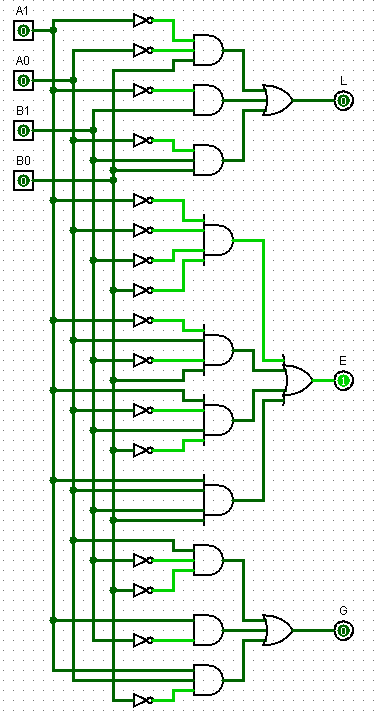
Login circuit diagram:
Boolean expressions:
K-map for L (A < B):
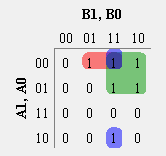
L (A < B) = ~A1 ~A0 B0 + ~A1 B1 + ~A0 B1 B0
K-map for E (A = B):
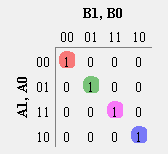
E (A = B) = ~A1 ~A0 ~B1 ~B0 + ~A1 A0 ~B1 B0 + A1 ~A0 B1 ~B0 + A1 A0 B1 B0
K-map for G (A > B):
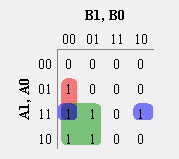
G (A > B) = A0 ~B1 ~B0 + A1 ~B1 + A1 A0 ~B0
Truth table:
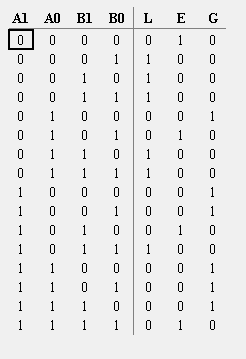
In the above circuit and truth table:
- L represents A < B
- E represents A = B
- G represents A > B
Add Answer to:
Show a comparator that can compare two 2 - bit binary numbers
with help of a...
Show a comparator that can compare two 2-bit binary numbers with help of a logic diagram,...
Show a comparator that can compare two 2-bit binary numbers with help of a logic diagram, and write the corresponding Boolean expressions, and truth table.
Showa one-bit Arithmetic Logic Unit (ALU) with help of a logic diagram, and write the corresponding...
Showa one-bit Arithmetic Logic Unit (ALU) with help of a logic diagram, and write the corresponding Boolean expressions, and truth table.
Need help with this digital logic problem please show work for all parts thanks [2] [20...
 Need help with this digital logic problem please show work for
all parts thanks
[2] [20 points] A 2-bit Binary Comparator logic circuit receives 2-bit numbers, P = P.P, and Q = Q.Qo, and has three outputs Y2, Y1, and Yo: Output Y2 is 1 if and only if P < Q, otherwise it is 0. Output Y1 is 1 if and only if P > Q, otherwise it is 0. Output Yo is 1 if and only if P...
Need help with this digital logic problem please show work for
all parts thanks
[2] [20 points] A 2-bit Binary Comparator logic circuit receives 2-bit numbers, P = P.P, and Q = Q.Qo, and has three outputs Y2, Y1, and Yo: Output Y2 is 1 if and only if P < Q, otherwise it is 0. Output Y1 is 1 if and only if P > Q, otherwise it is 0. Output Yo is 1 if and only if P...
To compare the two binary numbers, first the most significant bits (MSBs) are compared. If the MS...
 To compare the two binary numbers, first the most significant bits (MSBs) are compared. If the MSBs are equal, then the next significant bits are compared. However, if the MSBs are not equal, then either A is greater than or less than B hence further comparison is not needed. For example, when comparing two 2-bit numbers given by A A1A2 and B-B,B2. If Al B1, then A > B if A1 = 1, B1 = 0 or A < B...
Design a magnitude comparator that is able to detect whether ? > ?, ? = ?,...
Design a magnitude comparator that is able to detect whether ? > ?, ? = ?, ? < ?, where ? and ? are two 4-bit binary numbers. Use equations to design the circuit instead of truth table (truth table becomes length approach). Hint: You may first design a 1-bit comparator, and extend it to design 2-bit comparator. Now use the same method of extension to design 4-bit comparator from 2-bit comparator.
1. A 2-bit adder may be constructed by connection two full adders (i.e. 1-bit adders) or directly...
 Can you please show the work!plzz
1. A 2-bit adder may be constructed by connection two full adders (i.e. 1-bit adders) or directly. For the latter, suppose the inputs (corresponding to the operands A and B) are A, Ao, B1 and Bo; and the outputs are So and S, for the 2-bit sum, S, and a carry-out, C . Give a truth table for the "direct" adder » From the truth table, derive a logic expression in sum-of-products form Give...
Can you please show the work!plzz
1. A 2-bit adder may be constructed by connection two full adders (i.e. 1-bit adders) or directly. For the latter, suppose the inputs (corresponding to the operands A and B) are A, Ao, B1 and Bo; and the outputs are So and S, for the 2-bit sum, S, and a carry-out, C . Give a truth table for the "direct" adder » From the truth table, derive a logic expression in sum-of-products form Give...
Design a circuit to add two 2-bit binary numbers and display the results of the addition...
Design a circuit to add two 2-bit binary numbers and display the results of the addition as a 3-bit binary number, with the most significant bit be the carry out. To do this, you will use the four switches on your Breadboard Companion as your two 2-bit number inputs. Three of your LEDs will be used to represent the 3-bit output of your circuit. Complete a truth table for the expected output values on the lab data sheet attached. Use...
Design a combinational circuit that adds 1 to 3-bit unsigned binary number and produces an unsigned...
 Design a combinational circuit that adds 1 to 3-bit unsigned binary number and produces an unsigned binary result. Do the following: (1) determine the number of inputs/outputs, (2) write the truth table, (3) simplify the output functions by using maps and (4) draw the logic diagram by using AND OR and NOT gates. Show the truth table, the map, and the logic diagram. Do NOT use adders.
A comparator circuit has two 2-bit inputs, A(0,1) and B(0,1) [4 total inputs], and three 1-bit...
A comparator circuit has two 2-bit inputs, A(0,1) and B(0,1) [4 total inputs], and three 1-bit outputs, G (A greater than B), E (equal), and L (A less than B) (hint: Compare two bits against two bits, for example, if inputs are 0010, then B is greater than A). Write the logic equation for each output, and draw the logic diagram for each output using 8 to 1 Multiplexers (3).
1. (10 points) We want to compare the numbers 3 and -6. Using 4-bit signed 2's complement numbers, show how we can use the process of binary addition to calculate a result that will tell us how t...
 1. (10 points) We want to compare the numbers 3 and -6. Using 4-bit signed 2's complement numbers, show how we can use the process of binary addition to calculate a result that will tell us how these two numbers compare. (Just show the calculation here. The next part will be the interpretation of the result.) Now briefly explain how this result can be interpreted by a hardware circuit to indicate how the two numbers compare. (You don't need to...
 Need help with this digital logic problem please show work for
all parts thanks
[2] [20 points] A 2-bit Binary Comparator logic circuit receives 2-bit numbers, P = P.P, and Q = Q.Qo, and has three outputs Y2, Y1, and Yo: Output Y2 is 1 if and only if P < Q, otherwise it is 0. Output Y1 is 1 if and only if P > Q, otherwise it is 0. Output Yo is 1 if and only if P...
Need help with this digital logic problem please show work for
all parts thanks
[2] [20 points] A 2-bit Binary Comparator logic circuit receives 2-bit numbers, P = P.P, and Q = Q.Qo, and has three outputs Y2, Y1, and Yo: Output Y2 is 1 if and only if P < Q, otherwise it is 0. Output Y1 is 1 if and only if P > Q, otherwise it is 0. Output Yo is 1 if and only if P...
 To compare the two binary numbers, first the most significant bits (MSBs) are compared. If the MSBs are equal, then the next significant bits are compared. However, if the MSBs are not equal, then either A is greater than or less than B hence further comparison is not needed. For example, when comparing two 2-bit numbers given by A A1A2 and B-B,B2. If Al B1, then A > B if A1 = 1, B1 = 0 or A < B...
 Can you please show the work!plzz
1. A 2-bit adder may be constructed by connection two full adders (i.e. 1-bit adders) or directly. For the latter, suppose the inputs (corresponding to the operands A and B) are A, Ao, B1 and Bo; and the outputs are So and S, for the 2-bit sum, S, and a carry-out, C . Give a truth table for the "direct" adder » From the truth table, derive a logic expression in sum-of-products form Give...
Can you please show the work!plzz
1. A 2-bit adder may be constructed by connection two full adders (i.e. 1-bit adders) or directly. For the latter, suppose the inputs (corresponding to the operands A and B) are A, Ao, B1 and Bo; and the outputs are So and S, for the 2-bit sum, S, and a carry-out, C . Give a truth table for the "direct" adder » From the truth table, derive a logic expression in sum-of-products form Give...
 Design a combinational circuit that adds 1 to 3-bit unsigned binary number and produces an unsigned binary result. Do the following: (1) determine the number of inputs/outputs, (2) write the truth table, (3) simplify the output functions by using maps and (4) draw the logic diagram by using AND OR and NOT gates. Show the truth table, the map, and the logic diagram. Do NOT use adders.
 1. (10 points) We want to compare the numbers 3 and -6. Using 4-bit signed 2's complement numbers, show how we can use the process of binary addition to calculate a result that will tell us how these two numbers compare. (Just show the calculation here. The next part will be the interpretation of the result.) Now briefly explain how this result can be interpreted by a hardware circuit to indicate how the two numbers compare. (You don't need to...
Most questions answered within 3 hours.
-
Where is the error in this code sequence?
String s1 = "Hello";
String s2 = "ello";...
asked 10 months ago -
Financial data for Joel de Paris, Inc., for last year
follow:
Joel de Paris, Inc.
Balance...
asked 10 months ago -
Consider this reaction:
Al2(SO4)3 (aq)+ BaCl3
(aq) Al2Cl6 (aq)- +
3BaSO4(s) . What is the...
asked 10 months ago -
Suppose that Savneet is considering increasing her
recent random sample from 20 car rentals to 40...
asked 10 months ago -
Trucks arrive at an unloading terminal at an average rate of 120
per hour.
Trucks arrive...
asked 10 months ago -
Why are methanol and ethanol completely soluble in water while
octanol is not very little soluble....
asked 10 months ago -
A facilities manager at a university reads in a research report
that the mean amount of...
asked 10 months ago -
When the CuSO4 is rehydrated by adding water to the anhydrous
compound, is this an endothermic...
asked 10 months ago -
A ray of sunlight is passing from diamond into crown glass; the
angle of incidence is...
asked 10 months ago -
A block of mass 0.249 kg is placed on top of a light, vertical
spring of...
asked 10 months ago -
how do the kidneys compensate in the presences of acidosis
a) trigger hyperventilate
b) reserve acid...
asked 10 months ago -
Question 501 pts
The rental rate of capital to the firm increases. Which of the
following...
asked 10 months ago