Which of the following statements is FALSE? Km is the [S] at which V0=Vmax V0 is...
- Which of the following statements is FALSE?
- Km is the [S] at which V0=Vmax
- V0 is the closest to Vmax when [S] is less than Km
- As [S] increases, V0 gets closer to Vmax
- Vmax occurs when the enzyme is saturated with substrate
Homework Answers
The false is A. Actually, Km is [S] when V0 = Vmax / 2
If you liked the answer, please rate it in a positive way, you would help me a lot, thank you.
Add Answer to:
Which of the following statements is FALSE?
Km is the [S] at which V0=Vmax
V0 is...
QUESTION 6 Which of the following statements is false? A An enzyme's Km is the concentration...
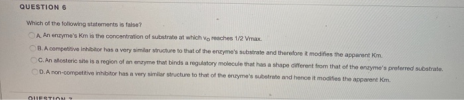 QUESTION 6 Which of the following statements is false? A An enzyme's Km is the concentration of substrate at which Voreaches 1/2 Vmax. B. A competitive inhibitor has a very similar structure to that of the enzyme's substrate and therefore it modifies the apparent Km. C. An Nlosteric site is a region of an enzyme that binds a regulatory molecule that has a shape different from that of the enzyme's preferred substrate. D. A non-competitive inhibitor has a very similar...
An enzyme catalyzes a reaction with a Km of 9.00 mM and a Vmax of 3.95...
An enzyme catalyzes a reaction with a Km of 9.00 mM and a Vmax of 3.95 mM·s–1. Calculate the reaction velocity, v0, for the following substrate concentrations: A. 1 mM B. 9 mM C. 11 mM
An enzyme catalyzes a reaction with a Km of 7.00 mM and a Vmax of 4.00...
An enzyme catalyzes a reaction with a Km of 7.00 mM and a Vmax of 4.00 mM·s–1. Calculate the reaction velocity, v0, for the following substrate concentrations. A) 1.25 mM B) 7.00 mM C) 10.0 mM
QUESTION 27 Which of the following statements is a true conclusion from the kinetics and equilibrium...
 QUESTION 27 Which of the following statements is a true conclusion from the kinetics and equilibrium plots shown for two reaction (A and B) shown below? 100% Y х Х 0% Sec Sec A B In the given plots, Y is the reactant and X is the product Reaction B Involves a catalyst only in the forward direction Reaction A Involves a catalyst for the forward direction. Both reactions A and B are unimolecular reversible reactions QUESTION 28 Which of...
1. Define Vmax and Km (Michaelis constant). What is the mathematical relationship between these two values?...
1. Define Vmax and Km (Michaelis constant). What is the mathematical relationship between these two values? 2.What does Km tell you about the affinity of an enzyme for its substrate? 3.Why do we use the slope between the first two data points of Absorbance vs Time to determine V0 when studying enzyme kinetics? Why not use the slope of the entire line?
An enzyme catalyzes a reaction with a Km of 9.50 and a Vmax of 1.75 An...
 An enzyme catalyzes a reaction with a Km of 9.50 and a Vmax of
1.75
An enzyme catalyzes a reaction with a K_m of 9.50 mM and a of 1.75 mM- s^-1. Calculate the reaction velocity, V_0, for the following substrate concentrations. 2.50 mM 9.50 mM 12.0 mM
An enzyme catalyzes a reaction with a Km of 9.50 and a Vmax of
1.75
An enzyme catalyzes a reaction with a K_m of 9.50 mM and a of 1.75 mM- s^-1. Calculate the reaction velocity, V_0, for the following substrate concentrations. 2.50 mM 9.50 mM 12.0 mM
Match the following: [ES] A. Equal to the velocity (V0) at saturating conditions. Km B. Approximately...
Match the following: [ES] A. Equal to the velocity (V0) at saturating conditions. Km B. Approximately equal to [Etotal] at saturating conditions. kcat C. Is directly proportional to the rate of the slowest step of the enzyme. Vmax D. The [S] required to reach ½ Vmax for enzymes that exhibit hyperbolic kinetic behavior.
Enzyme X has a Km for substrate A which is twice as large as its Km...
Enzyme X has a Km for substrate A which is twice as large as its Km for substrate B. If the enzyme is added to a solution containing equal, but low concentrations of A and B and Vmax for A and B are equal: substrate A will be used at a rate equal to substrate B substrate A will be used at a rate greater than substrate substrate B will be used at a rate greater than substrate A. substrate...
How many tetrahedral intermediates occur during the serine protease mechanism. Which of the following is not...
How many tetrahedral intermediates occur during the serine protease mechanism. Which of the following is not a general property of most enzymes. Answer by placing the number in the box. There is only one correct answer. 1. The active site takes up a small portion of the enzyme's surface. 2. The enzyme binds to the substrate via a few strong interactions. 3. Amino acids that make up the active site can be far apart in the primary sequence. Which of...
Biochemistry inhibitors! Pls answer 1 through 11 For each of the following items, indicate whether the...
 Biochemistry inhibitors! Pls answer 1 through 11
For each of the following items, indicate whether the item pertains to: • Competitive inhibitor . Uncompetitive inhibitor • Noncompetitive inhibitor • Noncompetitive activator • None of the above Choose only one of the above for each item. 1. Binds to the enzyme-substrate complex only 2. Prevents substrate from binding enzyme 3. Forms inactive El or inactive ESI complex 4. When present, Vmax increases 5. When present, Vmax increases and Km decreases 6....
Biochemistry inhibitors! Pls answer 1 through 11
For each of the following items, indicate whether the item pertains to: • Competitive inhibitor . Uncompetitive inhibitor • Noncompetitive inhibitor • Noncompetitive activator • None of the above Choose only one of the above for each item. 1. Binds to the enzyme-substrate complex only 2. Prevents substrate from binding enzyme 3. Forms inactive El or inactive ESI complex 4. When present, Vmax increases 5. When present, Vmax increases and Km decreases 6....
 QUESTION 6 Which of the following statements is false? A An enzyme's Km is the concentration of substrate at which Voreaches 1/2 Vmax. B. A competitive inhibitor has a very similar structure to that of the enzyme's substrate and therefore it modifies the apparent Km. C. An Nlosteric site is a region of an enzyme that binds a regulatory molecule that has a shape different from that of the enzyme's preferred substrate. D. A non-competitive inhibitor has a very similar...
 QUESTION 27 Which of the following statements is a true conclusion from the kinetics and equilibrium plots shown for two reaction (A and B) shown below? 100% Y х Х 0% Sec Sec A B In the given plots, Y is the reactant and X is the product Reaction B Involves a catalyst only in the forward direction Reaction A Involves a catalyst for the forward direction. Both reactions A and B are unimolecular reversible reactions QUESTION 28 Which of...
 An enzyme catalyzes a reaction with a Km of 9.50 and a Vmax of
1.75
An enzyme catalyzes a reaction with a K_m of 9.50 mM and a of 1.75 mM- s^-1. Calculate the reaction velocity, V_0, for the following substrate concentrations. 2.50 mM 9.50 mM 12.0 mM
An enzyme catalyzes a reaction with a Km of 9.50 and a Vmax of
1.75
An enzyme catalyzes a reaction with a K_m of 9.50 mM and a of 1.75 mM- s^-1. Calculate the reaction velocity, V_0, for the following substrate concentrations. 2.50 mM 9.50 mM 12.0 mM
 Biochemistry inhibitors! Pls answer 1 through 11
For each of the following items, indicate whether the item pertains to: • Competitive inhibitor . Uncompetitive inhibitor • Noncompetitive inhibitor • Noncompetitive activator • None of the above Choose only one of the above for each item. 1. Binds to the enzyme-substrate complex only 2. Prevents substrate from binding enzyme 3. Forms inactive El or inactive ESI complex 4. When present, Vmax increases 5. When present, Vmax increases and Km decreases 6....
Biochemistry inhibitors! Pls answer 1 through 11
For each of the following items, indicate whether the item pertains to: • Competitive inhibitor . Uncompetitive inhibitor • Noncompetitive inhibitor • Noncompetitive activator • None of the above Choose only one of the above for each item. 1. Binds to the enzyme-substrate complex only 2. Prevents substrate from binding enzyme 3. Forms inactive El or inactive ESI complex 4. When present, Vmax increases 5. When present, Vmax increases and Km decreases 6....
Most questions answered within 3 hours.
-
Where is the error in this code sequence?
String s1 = "Hello";
String s2 = "ello";...
asked 11 months ago -
Financial data for Joel de Paris, Inc., for last year
follow:
Joel de Paris, Inc.
Balance...
asked 11 months ago -
Consider this reaction:
Al2(SO4)3 (aq)+ BaCl3
(aq) Al2Cl6 (aq)- +
3BaSO4(s) . What is the...
asked 11 months ago -
Suppose that Savneet is considering increasing her
recent random sample from 20 car rentals to 40...
asked 11 months ago -
Trucks arrive at an unloading terminal at an average rate of 120
per hour.
Trucks arrive...
asked 11 months ago -
Why are methanol and ethanol completely soluble in water while
octanol is not very little soluble....
asked 11 months ago -
A facilities manager at a university reads in a research report
that the mean amount of...
asked 11 months ago -
When the CuSO4 is rehydrated by adding water to the anhydrous
compound, is this an endothermic...
asked 11 months ago -
A ray of sunlight is passing from diamond into crown glass; the
angle of incidence is...
asked 11 months ago -
A block of mass 0.249 kg is placed on top of a light, vertical
spring of...
asked 11 months ago -
how do the kidneys compensate in the presences of acidosis
a) trigger hyperventilate
b) reserve acid...
asked 11 months ago -
Question 501 pts
The rental rate of capital to the firm increases. Which of the
following...
asked 11 months ago