How does the immune system distinguish between food antigens and the antigens of invading bacteria that...
- How does the immune system distinguish between food antigens and the antigens of invading bacteria that it must fight? (Describe 2 routes of Ag presentation of soluble food antigens)
- Explain the mechanism of food allergy. How an oral tolerance can be breached?
Homework Answers
Antigens are proteins that are found on the surface of the pathogen. ... The antibodies destroy the antigen (pathogen) which is then engulfed and digested by macrophages. White blood cells can also produce chemicals called antitoxins which destroy the toxins (poisons) some bacteria produce when they have invaded the body.
The immune system recognizes antigens.
Antigens are substances (usually proteins) on the surface of cells, viruses, fungi, or bacteria. Nonliving substances such as toxins, chemicals, drugs, and foreign particles (such as a splinter) can also be antigens. The immune system recognizes and destroys, or tries to destroy, substances that contain antigens
Antigen, a substance that is capable of stimulating an immune response, specifically activating lymphocytes, which are the body’s infection-fighting white blood cells. In general, two main divisions of antigens are recognized: foreign antigens (or heteroantigens) and autoantigens (or self-antigens). Foreign antigens originate from outside the body. Examples include parts of or substances produced by viruses or microorganisms (such as bacteria and protozoa), as well as substances in snake venom, certain proteins in foods, and components of serum and red blood cells from other individuals. Autoantigens, on the other hand, originate within the body. Normally, the body is able to distinguish self from non-self, but in persons with autoimmune disorders, normal bodily substances provoke an immune response, leading to the generation of autoantibodies. An antigen that induces an immune response—i.e., stimulates the lymphocytes to produce the antibody or to attack the antigen directly—is called an immunogen.
On the surface of antigens are regions, called antigenic determinants, that fit and bind to receptor molecules of complementary structure on the surface of the lymphocytes. The binding of the lymphocytes’ receptors to the antigens’ surface molecules stimulates the lymphocytes to multiply and to initiate an immune response—including the production of antibody, the activation of cytotoxic cells, or both—against the antigen. The amount of antibody formed in response to stimulation depends on the kind and amount of antigen involved, the route of entry to the body, and individual characteristics of the host.
Oral tolerance is a complex, active process that occurs in the gut-associated immune system. Although the precise mechanisms have not been completely elucidated, regulatory T cells seem to be essential for its development and maintenance. Other, overlapping mechanisms, including immune deviation, energy, and deletion, also play a role. Many factors affect the balance between allergy and oral tolerance. They include genetic variations, the dose, timing and route of antigen exposure, the microbial milieu, and probably other dietary factors. This field is still young, and much remains to be done to identify the mechanisms of allergic sensitization. Because of the complexity of the system, some things will not be known until interventional studies in humans are carried out.
Food antigen- When ingested food antigens bind to IgE on the surface of intestinal mast cells, causing an immediate hypersensitivity reaction. Basophils may also participate if food antigens appear in the circulation. Foods that commonly cause true food allergies include peanuts, true nuts, shellfish, eggs, milk proteins, and wheat. Cooking may destroy allergenic substances in some foods.
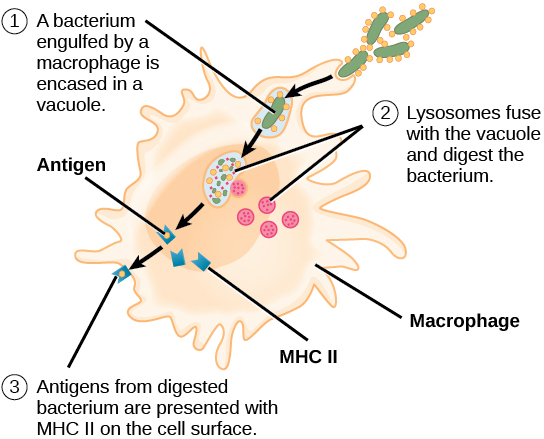
The prevalence of food allergy is increasing, and the development of more accurate diagnostic methods, prevention, and treatment require a better understanding of the underlying mechanisms. Oral tolerance is the normal physiologic response to ingested antigens, and a breakdown in this process results in sensitization to food allergens
ANTIGEN-SPECIFIC IMMUNE RESPONSE DEVELOPMENT TO FOOD ANTIGENS Sensitization to food antigens can take place in the gastrointestinal tract, oral cavity, and skin and occasionally in the respiratory tract. After ingestion, the vast majority of food proteins are broken down largely by gastric acid and digestive enzymes in the stomach and intestine. Subsequently, the remaining intact food proteins and peptides are transported from the lumen to the mucosa through gut epithelial cells (ECs) and by specialized ECs called M cells that are localized above Peyer patches. In addition, direct sampling of ingested antigens/allergens can occur when mucosal dendritic cells (DCs) extend dendrites into the gut lumen. In the mucosa, DCs internalize and process these proteins and peptides and move to T-cell areas of draining lymph nodes, where the DCs can interact with naive T cells and present antigen on MHC class II molecules The activation of anaphylaxis by targeting mast cells.5 Migration and activation of intraepithelial lymphocytes, including gd T cells, also occurs in response to allergic sensitization in mice. Recently, it was reported that injection of a mAb to IL-25, IL-33 receptor or thymic stromal lymphopoietin strongly inhibited food allergy development in mice. Administration of a single mAb targeting either of these cytokines could not suppress established food allergy and optimal food allergy suppression required treatment with a cocktail of all 3 anti– pro-TH2 mAbs.
Add Answer to:
How does the immune system distinguish between food
antigens and the antigens of invading bacteria that...
How does your immune system tell the difference between invading pathogens and regular healthy cells that...
How does your immune system tell the difference between invading pathogens and regular healthy cells that belong to our body? Describe the mechanism in detail, including the terms "cell surface marker", "cytokines" and "white blood cells". What happens when this mechanism fails and a person exhibits an autoimmune disease?
What’s the difference between a primary immune response and secondary immune response? Answer both in terms...
What’s the difference between a primary immune response and secondary immune response? Answer both in terms of the physiological responses and in terms of the mechanism by which it is achieved. Adaptive immunity is a response to a specific antigen. How does the adaptive immune system mount a specific response to an invading antigen? How is it possible to mount such a response to a wide array of antigens?
Our immune system is so multi-faceted because it has to deal with invading pathogens who have...
 Our immune system is so multi-faceted because it has to deal
with invading pathogens who have many different invasion
strategies. Explain how organisms with each of the following
invasion strategies attempt to avoid our immune
system. Then state AT LEAST TWO ways our immune system can still
protects us against infection by each of them.
A. Bacteria such as Staphylococcus that remain
extracellular and disseminate in the blood
B. Bacteria such as Shigella that reside in the
epithelial cells within...
Our immune system is so multi-faceted because it has to deal
with invading pathogens who have many different invasion
strategies. Explain how organisms with each of the following
invasion strategies attempt to avoid our immune
system. Then state AT LEAST TWO ways our immune system can still
protects us against infection by each of them.
A. Bacteria such as Staphylococcus that remain
extracellular and disseminate in the blood
B. Bacteria such as Shigella that reside in the
epithelial cells within...
What is an antigen? How does the immune system recognize antigens? Please be as specific as...
What is an antigen? How does the immune system recognize antigens? Please be as specific as possible.
Describe the basic features of how the immune system works in your body. Name and tell...
Describe the basic features of how the immune system works in your body. Name and tell the function of at least two kinds of specialized cells that work to fight various antigens. Describe several ways that good nutrition supports the immune system. Describe the difference between HIV and AIDS. Tell how AIDS develops and how good nutrition can support people with HIV infections. Describe several risk factors for Hypertension and Coronary Heart Disease. Specifically for each, explain how someone with...
1.Distinguish the lymphatic system from the immune system. 2.Describe the structure and distri...
1.Distinguish the lymphatic system from the immune system. 2.Describe the structure and distribution of lymphatic vessels. 3.Explain how lymph forms, and describe the mechanisms by which it is transported. 4.List and explain the important functions of the lymphatic vessels. 5.Describe how lymph nodes function as lymphatic organs. Describe the path of lymph through a node.
1. Western blotting, ELISA, and IP/Co-IP all manipulate the immune system interaction between antibodies and antigens....
1. Western blotting, ELISA, and IP/Co-IP all manipulate the immune system interaction between antibodies and antigens. Briefly describe this interaction. 2. If you are using ELISA or Western blotting for quantitative analysis, what types of controls might you need?
1) What is the difference between non-pathogen, pathogen and opportunistic pathogen? 2)How does HIV affect the...
1) What is the difference between non-pathogen, pathogen and opportunistic pathogen? 2)How does HIV affect the immune system? 3)Describe how B-cells and T-cells get activated in the adaptive immune response. 4)Describe how the immune cells can distinguish from self and non-self.
Chapter 18: Immune system function,Assessment and Therapeutic measures Scott and Anaphylaxis 1.How might those with food...
Chapter 18: Immune system function,Assessment and Therapeutic measures Scott and Anaphylaxis 1.How might those with food allergies be exposed to the allergen? 2.what should someone with food allergy have a precaution? 3. What symptoms of an allergic reaction did Scott experience?
How can the immune system orchestrate protection from disease without killing us in the process IQ4:...
How can the immune system orchestrate protection from disease without killing us in the process IQ4: Homeostasis: A balance of the good and bad B- and T-lymphocytes are derived from bone marrow- derived lymphoid precursors. Before maturation, naive T-lymphocytes (T-cells) must pass through the thymus where they undergo positive and negative selection. A tumour encounters the immune system frequently during its progression from a neoplasia to carcinoma, which can often take several years. There are a number of host mechanisms...
 Our immune system is so multi-faceted because it has to deal
with invading pathogens who have many different invasion
strategies. Explain how organisms with each of the following
invasion strategies attempt to avoid our immune
system. Then state AT LEAST TWO ways our immune system can still
protects us against infection by each of them.
A. Bacteria such as Staphylococcus that remain
extracellular and disseminate in the blood
B. Bacteria such as Shigella that reside in the
epithelial cells within...
Our immune system is so multi-faceted because it has to deal
with invading pathogens who have many different invasion
strategies. Explain how organisms with each of the following
invasion strategies attempt to avoid our immune
system. Then state AT LEAST TWO ways our immune system can still
protects us against infection by each of them.
A. Bacteria such as Staphylococcus that remain
extracellular and disseminate in the blood
B. Bacteria such as Shigella that reside in the
epithelial cells within...
Most questions answered within 3 hours.
-
Where is the error in this code sequence?
String s1 = "Hello";
String s2 = "ello";...
asked 10 months ago -
Financial data for Joel de Paris, Inc., for last year
follow:
Joel de Paris, Inc.
Balance...
asked 10 months ago -
Consider this reaction:
Al2(SO4)3 (aq)+ BaCl3
(aq) Al2Cl6 (aq)- +
3BaSO4(s) . What is the...
asked 10 months ago -
Suppose that Savneet is considering increasing her
recent random sample from 20 car rentals to 40...
asked 10 months ago -
Trucks arrive at an unloading terminal at an average rate of 120
per hour.
Trucks arrive...
asked 10 months ago -
Why are methanol and ethanol completely soluble in water while
octanol is not very little soluble....
asked 10 months ago -
A facilities manager at a university reads in a research report
that the mean amount of...
asked 10 months ago -
When the CuSO4 is rehydrated by adding water to the anhydrous
compound, is this an endothermic...
asked 10 months ago -
A ray of sunlight is passing from diamond into crown glass; the
angle of incidence is...
asked 10 months ago -
A block of mass 0.249 kg is placed on top of a light, vertical
spring of...
asked 10 months ago -
how do the kidneys compensate in the presences of acidosis
a) trigger hyperventilate
b) reserve acid...
asked 10 months ago -
Question 501 pts
The rental rate of capital to the firm increases. Which of the
following...
asked 10 months ago