Calculate the pH of the following buffer solutions: (a) a solution made by dissolving 3.198 g...
Calculate the pH of the following buffer solutions: (a) a solution made by dissolving 3.198 g KH2PO4 (136.09 g/mol) and 2.833 g K2HPO4 (174.18 g/mol) in water to give 100. mL of solution. Stepwise acid dissociation constants for phosphoric acid may be found in your textbook. (b) a solution made by mixing 40.00 mL 0.21 M C5H5N with 10.00 mL 0.34 M C5H5NHCl. The base dissociation constant Kb is 1.50 x 10⁻⁹ for C5H5N. Assume that the final volume is the sum of the volunes of the two solutions that are mixed.
Homework Answers


Add Answer to:
Calculate the pH of the following buffer solutions: (a) a
solution made by dissolving 3.198 g...
Calculate the pH of the following buffer solutions: (a) a solution made by dissolving 4.550 g...
Calculate the pH of the following buffer solutions: (a) a solution made by dissolving 4.550 g KH2PO4 and 1.871 g K2HPO4 in water to give 350. mL of solution. (b) a solution made by mixing 35.00 mL 0.35 M N2H4 with 15.00 mL 0.21 M N2H5Cl. The base dissociation constant Kb is 8.50 x 10⁻⁷ for N2H4 . Assume that the final volume is the sum of the volunes of the two solutions that are mixed.
PO, and of K2HPO, PM phosphate buffer for KH2PO4 and 1/4.10 YM 15. (LO 12) Calculate...
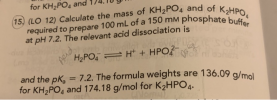 PO, and of K2HPO, PM phosphate buffer for KH2PO4 and 1/4.10 YM 15. (LO 12) Calculate the mass of KH2PO4 and of ko required to prepare 100 mL of a 150 mm phospha at pH 7.2. The relevant acid dissociation is te H2PO4 = H+ + HPO2-nas and the pk, = 7.2. The formula weights are 136.09 g/mol for KH2PO4 and 174.18 g/mol for K2HPO4.
Use the Henderson-Hasselbalch equation to calculate the pH of each of the following solutions. A. a...
Use the Henderson-Hasselbalch equation to calculate the pH of each of the following solutions. A. a solution that contains 0.800% C5H5N by mass and 0.950% C5H5NHCl by mass (where pKa=5.23 for C5H5NHCl B. a solution that has 17.0 g g of HF and 27.0 g g of NaF in 125 mL m L of solution (where pKa=3.17 for HF acid)
What is the pH of a solution prepared by mixing 25.00 mL of 0.10 M methylamine,...
 What is the pH of a solution prepared by mixing 25.00 mL of 0.10 M methylamine, CH3NH2, with 25.00 mL of 0.10 M methylammonium chloride, CH3NH3C1? Assume that the volume of the solutions are additive and that Kb = 3.70 times 10-4 for methylamine. 10.27 10.57 10.87 11.78 Which statement about buffers is true? Buffers have a pH = 7. Buffers consist of a strong acid and its conjugate base. A buffer does not change pH on addition of a...
6. What is the pH of a buffered system made by dissolving 17.42 g of KH2PO4 and 20.41 g of K2HPO4 in water to give...
 6. What is the pH of a buffered system made by dissolving 17.42 g of KH2PO4 and 20.41 g of K2HPO4 in water to give a volume of 200.0 mL? The Ka2 for dihydrogen phosphate is 6.2 x 10⁻⁸ and the equilibrium reaction of interest is H2PO4 (4) + H20 <-> H30* ( HPO4 (4) 7. Determine the pH of a 0.188 M NH3 solution at 25°C. The Kh of NH3 is 1.76 x 10⁻⁵. 8. Calculate the pH of...
Calculate the pH of a solution made by adding 42 g of sodium acetate, NaCH3COO, to...
 Calculate the pH of a solution made by adding 42 g of sodium acetate, NaCH3COO, to 22 g of acetic acid, CH3COOH, and dissolving in water to make 300. mL of solution. Hint given in feedback. The K, for CH3COOH is 1.8 x 10⁻⁵ M. As usual, report pH to 2 decimal places. Answer: Calculate the pH of a solution made by adding 59 g of sodium acetate, NaCH3COO, to 22 g of acetic acid, CH3COOH, and dissolving in water...
What is the pH of a buffer solution that is made by dissolving 16.6 g of...
What is the pH of a buffer solution that is made by dissolving 16.6 g of KClO in 495 mL of 0.355 M HClO? (Assume the total volume is 495 mL).
A stock solution of analyte is made by dissolving 34.83 mg of copper (II) acetate hexahydrate...
A stock solution of analyte is made by dissolving 34.83 mg of copper (II) acetate hexahydrate (fw = 289.73 g/mol) in 25.000 mL of water. A second stock solution of internal standard is made by dissolving 28.43 mg of germanium (I) acetate (fw = 190.74 g/mol) into 25.000 mL of water. These solutions are used to make a series of standards for flame atomic absorption analysis calibration. The standard solutions (each 10.00 mL total volume) should have the following concentrations...
An aqueous solution is made by dissolving 11.24 g of sodium phosphate (tribasic) anhydrous salt in...
An aqueous solution is made by dissolving 11.24 g of sodium phosphate (tribasic) anhydrous salt in water to make 250 mL of solution. What is the expected pH of this solution? The pKa values for phosphoric acid are 2.15, 7.2, and 12.38.
What is the pH of a solution made by mixing 40.00 mL of 0.100 M HCl...
What is the pH of a solution made by mixing 40.00 mL of 0.100 M HCl with 35.00 mL of 0.100 M KOH? Assume that the volumes of the solutions are additive. 1.64 10.00 12.36 13.36 2.17
 PO, and of K2HPO, PM phosphate buffer for KH2PO4 and 1/4.10 YM 15. (LO 12) Calculate the mass of KH2PO4 and of ko required to prepare 100 mL of a 150 mm phospha at pH 7.2. The relevant acid dissociation is te H2PO4 = H+ + HPO2-nas and the pk, = 7.2. The formula weights are 136.09 g/mol for KH2PO4 and 174.18 g/mol for K2HPO4.
 What is the pH of a solution prepared by mixing 25.00 mL of 0.10 M methylamine, CH3NH2, with 25.00 mL of 0.10 M methylammonium chloride, CH3NH3C1? Assume that the volume of the solutions are additive and that Kb = 3.70 times 10-4 for methylamine. 10.27 10.57 10.87 11.78 Which statement about buffers is true? Buffers have a pH = 7. Buffers consist of a strong acid and its conjugate base. A buffer does not change pH on addition of a...
 6. What is the pH of a buffered system made by dissolving 17.42 g of KH2PO4 and 20.41 g of K2HPO4 in water to give a volume of 200.0 mL? The Ka2 for dihydrogen phosphate is 6.2 x 10⁻⁸ and the equilibrium reaction of interest is H2PO4 (4) + H20 <-> H30* ( HPO4 (4) 7. Determine the pH of a 0.188 M NH3 solution at 25°C. The Kh of NH3 is 1.76 x 10⁻⁵. 8. Calculate the pH of...
 Calculate the pH of a solution made by adding 42 g of sodium acetate, NaCH3COO, to 22 g of acetic acid, CH3COOH, and dissolving in water to make 300. mL of solution. Hint given in feedback. The K, for CH3COOH is 1.8 x 10⁻⁵ M. As usual, report pH to 2 decimal places. Answer: Calculate the pH of a solution made by adding 59 g of sodium acetate, NaCH3COO, to 22 g of acetic acid, CH3COOH, and dissolving in water...
Most questions answered within 3 hours.
-
Where is the error in this code sequence?
String s1 = "Hello";
String s2 = "ello";...
asked 10 months ago -
Financial data for Joel de Paris, Inc., for last year
follow:
Joel de Paris, Inc.
Balance...
asked 10 months ago -
Consider this reaction:
Al2(SO4)3 (aq)+ BaCl3
(aq) Al2Cl6 (aq)- +
3BaSO4(s) . What is the...
asked 10 months ago -
Suppose that Savneet is considering increasing her
recent random sample from 20 car rentals to 40...
asked 10 months ago -
Trucks arrive at an unloading terminal at an average rate of 120
per hour.
Trucks arrive...
asked 10 months ago -
Why are methanol and ethanol completely soluble in water while
octanol is not very little soluble....
asked 10 months ago -
A facilities manager at a university reads in a research report
that the mean amount of...
asked 10 months ago -
When the CuSO4 is rehydrated by adding water to the anhydrous
compound, is this an endothermic...
asked 10 months ago -
A ray of sunlight is passing from diamond into crown glass; the
angle of incidence is...
asked 10 months ago -
A block of mass 0.249 kg is placed on top of a light, vertical
spring of...
asked 10 months ago -
how do the kidneys compensate in the presences of acidosis
a) trigger hyperventilate
b) reserve acid...
asked 10 months ago -
Question 501 pts
The rental rate of capital to the firm increases. Which of the
following...
asked 10 months ago