1) Cr3+ (and other metal ions with a charge ≥ 2) is acidic by virtue of...
1) Cr3+ (and other metal ions with a charge ≥ 2) is acidic by virtue of the hydrolysis reaction. Cr3+ + H2O equilibrium reaction arrow Cr(OH)2+ + H+ Ka1 = 10−3.66 [Further reactions produce Cr(OH)2+, Cr(OH)3, and Cr(OH)4−.]
a) Considering only the Ka1 reaction, find the pH of 0.019 M Cr(ClO4)3.
b) What fraction of chromium is in the form Cr(OH)2+?
2) Find the pH of 0.061 M NaCN. (Assume Kw = 1.01 ✕ 10−14.)
Homework Answers
Cr3+ + H2O  Cr(OH)2+ + H+
Initial 0.016M 0 0
Final (0.016-x) x x
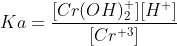
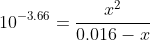

assuming 0.016-x is approximately equal to 0.016 we get


Fraction of chromium in the form of Cr(OH)2+ = 1.870 * 10^(-3)/0.016 = 0.116925
Add Answer to:
1) Cr3+ (and other metal ions with a charge ≥ 2) is acidic by
virtue of...
Cr3+ (and other metal ions with a charge ≥ 2) is acidic by virtue of the...
Cr3+ (and other metal ions with a charge ≥ 2) is acidic by virtue of the hydrolysis reaction. Cr3+ + H2O equilibrium reaction arrow Cr(OH)2+ + H+ Ka1 = 10−3.66 [Further reactions produce Cr(OH)2+, Cr(OH)3, and Cr(OH)4−.] a) Considering only the Ka1 reaction, find the pH of 0.019 M Cr(ClO4)3. b) What fraction of chromium is in the form Cr(OH)2+?
3. Cr** is acidic by virtue of the following hydrolysis reaction: Cr3+ + H2O + Cr(OH)2+...
 3. Cr** is acidic by virtue of the following hydrolysis reaction: Cr3+ + H2O + Cr(OH)2+ + H+ pka;=3.66 Find the pH of 0.010 M Cr(ClO4)3
Calculate the number of milliliters of 0.766 M Ba(OH)2 required to precipitate all of the Cr3+ions...
 Calculate the number of milliliters of 0.766 M
Ba(OH)2 required to precipitate all of
the Cr3+ions in 151 mL
of 0.486 M CrBr3
solution as Cr(OH)3. The equation for
the reaction is:
2 CrBr3(aq) +
3 Ba(OH)2(aq)
2
Cr(OH)3(s) + 3
BaBr2(aq
Calculate the number of milliliters of 0.766 M
Ba(OH)2 required to precipitate all of
the Cr3+ions in 151 mL
of 0.486 M CrBr3
solution as Cr(OH)3. The equation for
the reaction is:
2 CrBr3(aq) +
3 Ba(OH)2(aq)
2
Cr(OH)3(s) + 3
BaBr2(aq
1- Calculating [H+] for Pure Water: In a certain acidic solution at 25 ∘C, [H+] is...
1- Calculating [H+] for Pure Water: In a certain acidic solution at 25 ∘C, [H+] is 100 times greater than [OH −]. What is the value for [OH −] for the solution? In a certain acidic solution at 25 , [] is 100 times greater than [ ]. What is the value for [ ] for the solution? 1.0×10⁻⁸ M 1.0×10⁻⁷ M 1.0×10⁻⁶ M 1.0×10⁻² M 1.0×10⁻⁹ M 2. ± Acid-Base Relationships in Water: Water ionizes by the equation H2O(l)⇌H+(aq)+OH−(aq)The...
An acidic solution is 2 mM in each of the following metal ions: Zn2+, Cu2+, Co2+,...
An acidic solution is 2 mM in each of the following metal ions: Zn2+, Cu2+, Co2+, Ca2+. a) Which of the metals would precipitate as their hydroxides at pH = 6.00? (Select all that apply. See theappendix.) -zinc -copper -cobalt -calcium b) Which of the metals would precipitate as their hydroxides at pH = 8.00? -zinc -copper -cobalt -calcium c) At what pH do the metal hydroxides begin to participate? Zn(OH)2 ____ Cu(OH)2 ____ Co(OH)2 ____ Ca(OH)2 ____ Substance Ksp...
1. Which metal can reduce Ni2+ ions but not Fe2+ ions? Cd²⁺,Cr,Sn²⁺,Sn,Cd 2.Which species can oxidize...
 1. Which metal can reduce Ni2+ ions but not Fe2+ ions?
Cd²⁺,Cr,Sn²⁺,Sn,Cd
2.Which species can oxidize Sn but not Fe?
Ni,Ni²⁺,Pb²⁺,Cd,Pb
1.68 1.51 1.50 1.09 1.00 0.96 0.95 FAO) + 2 H,0,1a) + 2H(aq) + 2e PO4 + 4H"(aq) + S0,00) + 2€ Mno. (aq) + 4H(aq) + 3e Mno,aq) + 8H(aq) + 5e Au?+ (aq) + 3€ PbO (8) + 4H(aq) + 2 Cl@) + 2 Cr,0,?" (aq) + 14 H*(aq) + 6e 0,(@) + 4H(aq) + 4e MnO...
1. Which metal can reduce Ni2+ ions but not Fe2+ ions?
Cd²⁺,Cr,Sn²⁺,Sn,Cd
2.Which species can oxidize Sn but not Fe?
Ni,Ni²⁺,Pb²⁺,Cd,Pb
1.68 1.51 1.50 1.09 1.00 0.96 0.95 FAO) + 2 H,0,1a) + 2H(aq) + 2e PO4 + 4H"(aq) + S0,00) + 2€ Mno. (aq) + 4H(aq) + 3e Mno,aq) + 8H(aq) + 5e Au?+ (aq) + 3€ PbO (8) + 4H(aq) + 2 Cl@) + 2 Cr,0,?" (aq) + 14 H*(aq) + 6e 0,(@) + 4H(aq) + 4e MnO...
(1 pt) Table 12-2 of Harris gives formation constants (as log K) for many metal ions. Calculate c...
 (1 pt) Table 12-2 of Harris gives formation constants (as log K) for many metal ions. Calculate conditional formation constants (Kf) for EDTA complexation of Mn2+ and Cu2+ at pH 6.00. Explain why we can no longer titrate Mn2+ but can still titrate Cu2+ if we reduce the pH to 4.00. TABLE 12-2 Formation constants for metal-EDTA complexes Ion log Kr Ion log K Ion log Kr 2.95 V3+ 1.86 Cr3+ 0.8Mn3+ 9.7 Fe3+ 8.79 Co3 10.65Zr*+ 8.72 | Нґ+...
1. If your original unknown is colorless, what ions are absent from your unknown? 2. If...
 1. If your original unknown is colorless, what ions are absent
from your unknown?
2. If you get no precipitate with just the 6 M NH3 in step B,
what ions are absent from your unknown?
pls help are my answers correct ty
17 Page 4 Aperiment 24. Qualitative Analysis Group III-NI, Mn, Fe, Al, Cr, Zn 1. PROCEDURES A. Observations of Samples. Obtain an unknown and record code. Observe color of unknown solution Common color correlations are: dark blue...
1. If your original unknown is colorless, what ions are absent
from your unknown?
2. If you get no precipitate with just the 6 M NH3 in step B,
what ions are absent from your unknown?
pls help are my answers correct ty
17 Page 4 Aperiment 24. Qualitative Analysis Group III-NI, Mn, Fe, Al, Cr, Zn 1. PROCEDURES A. Observations of Samples. Obtain an unknown and record code. Observe color of unknown solution Common color correlations are: dark blue...
Please help with the blank starred problems!! if more info needs to be given, please tell...
 Please help with the blank starred problems!! if more info needs
to be given, please tell me what else you'd need because I don't
know.
VOOL Data report sheet. Name Desk # Room # Box 3. Weak base: data and calculations Measurements (a) Volume of weak base stock solution diluted 11.60mL 700 (b) Concentration of weak base stock solution = 0.100M (c) Concentration of weak base after dilution - find (d) Weak base measured pH : trial I - 10:41...
Please help with the blank starred problems!! if more info needs
to be given, please tell me what else you'd need because I don't
know.
VOOL Data report sheet. Name Desk # Room # Box 3. Weak base: data and calculations Measurements (a) Volume of weak base stock solution diluted 11.60mL 700 (b) Concentration of weak base stock solution = 0.100M (c) Concentration of weak base after dilution - find (d) Weak base measured pH : trial I - 10:41...
Based on the document below, 1. Describe the hypothesis Chaudhuri et al ids attempting to evaluate;...
 Based on the document below,
1. Describe the hypothesis Chaudhuri et al ids attempting to
evaluate; in other words, what is the goal of this paper? Why is he
writing it?
2. Does the data presented in the paper support the hypothesis
stated in the introduction? Explain.
3.According to Chaudhuri, what is the potential role of thew
alkaline phosphatase in the cleanup of industrial waste.
CHAUDHURI et al: KINETIC BEHAVIOUR OF CALF INTESTINAL ALP WITH PNPP 8.5, 9, 9.5, 10,...
Based on the document below,
1. Describe the hypothesis Chaudhuri et al ids attempting to
evaluate; in other words, what is the goal of this paper? Why is he
writing it?
2. Does the data presented in the paper support the hypothesis
stated in the introduction? Explain.
3.According to Chaudhuri, what is the potential role of thew
alkaline phosphatase in the cleanup of industrial waste.
CHAUDHURI et al: KINETIC BEHAVIOUR OF CALF INTESTINAL ALP WITH PNPP 8.5, 9, 9.5, 10,...
 3. Cr** is acidic by virtue of the following hydrolysis reaction: Cr3+ + H2O + Cr(OH)2+ + H+ pka;=3.66 Find the pH of 0.010 M Cr(ClO4)3
 Calculate the number of milliliters of 0.766 M
Ba(OH)2 required to precipitate all of
the Cr3+ions in 151 mL
of 0.486 M CrBr3
solution as Cr(OH)3. The equation for
the reaction is:
2 CrBr3(aq) +
3 Ba(OH)2(aq)
2
Cr(OH)3(s) + 3
BaBr2(aq
Calculate the number of milliliters of 0.766 M
Ba(OH)2 required to precipitate all of
the Cr3+ions in 151 mL
of 0.486 M CrBr3
solution as Cr(OH)3. The equation for
the reaction is:
2 CrBr3(aq) +
3 Ba(OH)2(aq)
2
Cr(OH)3(s) + 3
BaBr2(aq
 1. Which metal can reduce Ni2+ ions but not Fe2+ ions?
Cd²⁺,Cr,Sn²⁺,Sn,Cd
2.Which species can oxidize Sn but not Fe?
Ni,Ni²⁺,Pb²⁺,Cd,Pb
1.68 1.51 1.50 1.09 1.00 0.96 0.95 FAO) + 2 H,0,1a) + 2H(aq) + 2e PO4 + 4H"(aq) + S0,00) + 2€ Mno. (aq) + 4H(aq) + 3e Mno,aq) + 8H(aq) + 5e Au?+ (aq) + 3€ PbO (8) + 4H(aq) + 2 Cl@) + 2 Cr,0,?" (aq) + 14 H*(aq) + 6e 0,(@) + 4H(aq) + 4e MnO...
1. Which metal can reduce Ni2+ ions but not Fe2+ ions?
Cd²⁺,Cr,Sn²⁺,Sn,Cd
2.Which species can oxidize Sn but not Fe?
Ni,Ni²⁺,Pb²⁺,Cd,Pb
1.68 1.51 1.50 1.09 1.00 0.96 0.95 FAO) + 2 H,0,1a) + 2H(aq) + 2e PO4 + 4H"(aq) + S0,00) + 2€ Mno. (aq) + 4H(aq) + 3e Mno,aq) + 8H(aq) + 5e Au?+ (aq) + 3€ PbO (8) + 4H(aq) + 2 Cl@) + 2 Cr,0,?" (aq) + 14 H*(aq) + 6e 0,(@) + 4H(aq) + 4e MnO...
 (1 pt) Table 12-2 of Harris gives formation constants (as log K) for many metal ions. Calculate conditional formation constants (Kf) for EDTA complexation of Mn2+ and Cu2+ at pH 6.00. Explain why we can no longer titrate Mn2+ but can still titrate Cu2+ if we reduce the pH to 4.00. TABLE 12-2 Formation constants for metal-EDTA complexes Ion log Kr Ion log K Ion log Kr 2.95 V3+ 1.86 Cr3+ 0.8Mn3+ 9.7 Fe3+ 8.79 Co3 10.65Zr*+ 8.72 | Нґ+...
 1. If your original unknown is colorless, what ions are absent
from your unknown?
2. If you get no precipitate with just the 6 M NH3 in step B,
what ions are absent from your unknown?
pls help are my answers correct ty
17 Page 4 Aperiment 24. Qualitative Analysis Group III-NI, Mn, Fe, Al, Cr, Zn 1. PROCEDURES A. Observations of Samples. Obtain an unknown and record code. Observe color of unknown solution Common color correlations are: dark blue...
1. If your original unknown is colorless, what ions are absent
from your unknown?
2. If you get no precipitate with just the 6 M NH3 in step B,
what ions are absent from your unknown?
pls help are my answers correct ty
17 Page 4 Aperiment 24. Qualitative Analysis Group III-NI, Mn, Fe, Al, Cr, Zn 1. PROCEDURES A. Observations of Samples. Obtain an unknown and record code. Observe color of unknown solution Common color correlations are: dark blue...
 Please help with the blank starred problems!! if more info needs
to be given, please tell me what else you'd need because I don't
know.
VOOL Data report sheet. Name Desk # Room # Box 3. Weak base: data and calculations Measurements (a) Volume of weak base stock solution diluted 11.60mL 700 (b) Concentration of weak base stock solution = 0.100M (c) Concentration of weak base after dilution - find (d) Weak base measured pH : trial I - 10:41...
Please help with the blank starred problems!! if more info needs
to be given, please tell me what else you'd need because I don't
know.
VOOL Data report sheet. Name Desk # Room # Box 3. Weak base: data and calculations Measurements (a) Volume of weak base stock solution diluted 11.60mL 700 (b) Concentration of weak base stock solution = 0.100M (c) Concentration of weak base after dilution - find (d) Weak base measured pH : trial I - 10:41...
 Based on the document below,
1. Describe the hypothesis Chaudhuri et al ids attempting to
evaluate; in other words, what is the goal of this paper? Why is he
writing it?
2. Does the data presented in the paper support the hypothesis
stated in the introduction? Explain.
3.According to Chaudhuri, what is the potential role of thew
alkaline phosphatase in the cleanup of industrial waste.
CHAUDHURI et al: KINETIC BEHAVIOUR OF CALF INTESTINAL ALP WITH PNPP 8.5, 9, 9.5, 10,...
Based on the document below,
1. Describe the hypothesis Chaudhuri et al ids attempting to
evaluate; in other words, what is the goal of this paper? Why is he
writing it?
2. Does the data presented in the paper support the hypothesis
stated in the introduction? Explain.
3.According to Chaudhuri, what is the potential role of thew
alkaline phosphatase in the cleanup of industrial waste.
CHAUDHURI et al: KINETIC BEHAVIOUR OF CALF INTESTINAL ALP WITH PNPP 8.5, 9, 9.5, 10,...
Most questions answered within 3 hours.
-
Where is the error in this code sequence?
String s1 = "Hello";
String s2 = "ello";...
asked 11 months ago -
Financial data for Joel de Paris, Inc., for last year
follow:
Joel de Paris, Inc.
Balance...
asked 11 months ago -
Consider this reaction:
Al2(SO4)3 (aq)+ BaCl3
(aq) Al2Cl6 (aq)- +
3BaSO4(s) . What is the...
asked 11 months ago -
Suppose that Savneet is considering increasing her
recent random sample from 20 car rentals to 40...
asked 11 months ago -
Trucks arrive at an unloading terminal at an average rate of 120
per hour.
Trucks arrive...
asked 11 months ago -
Why are methanol and ethanol completely soluble in water while
octanol is not very little soluble....
asked 11 months ago -
A facilities manager at a university reads in a research report
that the mean amount of...
asked 11 months ago -
When the CuSO4 is rehydrated by adding water to the anhydrous
compound, is this an endothermic...
asked 11 months ago -
A ray of sunlight is passing from diamond into crown glass; the
angle of incidence is...
asked 11 months ago -
A block of mass 0.249 kg is placed on top of a light, vertical
spring of...
asked 11 months ago -
how do the kidneys compensate in the presences of acidosis
a) trigger hyperventilate
b) reserve acid...
asked 11 months ago -
Question 501 pts
The rental rate of capital to the firm increases. Which of the
following...
asked 11 months ago