The average weight of a house mouse is 0.68 ounces, with a standard deviation of 0.02...
The average weight of a house mouse is 0.68 ounces, with a standard deviation of 0.02 ounces. Assuming that the weight of house mice is normally distributed, what proportion of house mice weigh less than 0.67 ounces? (Select the answer that is closest to the answer that you calculated.)
a) -0.5
b) 0.309
c) 0.691
d) 0.5
e) 0.01
Homework Answers
X ~ N ( µ = 0.68 , σ = 0.02 )
We convert this to standard normal as
P ( X < x ) = P ( Z < ( X - µ ) / σ )
P ( ( X < 0.67 ) = P ( Z < 0.67 - 0.68 ) / 0.02 )
= P ( Z < -0.5 )
P ( X < 0.67 ) = 0.309 (from Z table)
Add Answer to:
The average weight of a house mouse is 0.68 ounces, with a
standard deviation of 0.02...
A study of 45 white mice showed that their average weight was 4.7 ounces. The standard...
 A study of 45 white mice showed that their average weight was
4.7 ounces. The standard deviation of the population is 0.7 ounces.
Which of the following is the 80% confidence interval for the mean
weight per white mouse?
A study of 45 white mice showed that their average weight was
4.7 ounces. The standard deviation of the population is 0.7 ounces.
Which of the following is the 80% confidence interval for the mean
weight per white mouse?
Suppose that the weight of sweet cherries is normally distributed with mean μ=6 ounces and standard...
Suppose that the weight of sweet cherries is normally distributed with mean μ=6 ounces and standard deviation σ=1.4 ounces. What proportion of sweet cherries weigh more than 4.7 ounces? Round your answer to four decimal places.
AC. Suppose the weight of a 1-year-old perch is normally distributed with mean 8.4 ounces and...
 AC. Suppose the weight of a 1-year-old perch is normally distributed with mean 8.4 ounces and standard deviation 2 ounces (i) What proportion of 1-year-old perch weigh less than 9 ounces? (ii) Find the 43rd percentile of the weights of 1-year-old perch. AD. Cerebral blood flow (CBF) in the brains of healthy people is normally distributed with mean 74 and standard deviation 16. What proportion of healthy people will have a CBF reading above 110? (ii) Find the 27th percentile...
A packaging system fills boxes to an average weight of 19 ounces with a standard deviation...
A packaging system fills boxes to an average weight of 19 ounces with a standard deviation of 0.4 ounce. It is reasonable to assume that the weights are normally distributed. Calculate the 1st, 2nd, and 3rd quartiles of the box weight. (You may find it useful to reference the z table. Round "z" value to 3 decimal places and final answers to 2 decimal places.)
Cucumbers grown on a certain farm have weights with a standard deviation of 2 ounces. Assuming...
Cucumbers grown on a certain farm have weights with a standard deviation of 2 ounces. Assuming the weights vary normally, what is the mean weight if 70% of the cucumbers weigh less than 14 ounces? Question 8 options: 14.45 13.25 15.05 12.95
A packaging system fills boxes to an average weight of 15 ounces with a standard deviation...
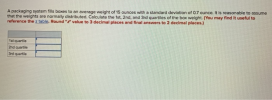 A packaging system fills boxes to an average weight of 15 ounces with a standard deviation of 0.7 ounce. It is reasonable to assume that the weights are normally distributed. Calculate the 1st, 2nd, and 3rd quartiles of the box weight. (You may find it useful to reference the z table. Round " value to 3 decimal places and final answers to 2 decimal places.) 1st quartile 2nd quartile 3rd quartile
The mean weight of a box of cereal filled by a machine is 18.0 ounces
 The mean weight of a box of cereal filled by a machine is 18.0 ounces, with a standard deviation of 0.4 ounce. If the weights of all the boxes filled by the machine are normally distributed, what percent of the boxes will weigh the following amounts? (Round your answers to two decimal places.) (a) less than 17.5 ounces (b) between 17.8 and 18.2 ounces
Suppose that the weight of navel oranges is normally distributed with mean=8 ounces and standard deviation...
Suppose that the weight of navel oranges is normally distributed with mean=8 ounces and standard deviation = 1.5 ounces. What is the weight of the navel orange larger than only 10% of navel oranges.
The weights of ice cream cartons are normally distributed with a mean weight of 20 ounces...
The weights of ice cream cartons are normally distributed with a mean weight of 20 ounces and a standard deviation of 0.5 ounces. You randomly select 25 cartons. What is the probability that their mean weight is greater than 20.06 ounces? 1. 0.274 2. 0.452 3. 0.548 4. 0.726
The weight of ducks is normally distributed with a mean of 20lbs and a standard deviation...
The weight of ducks is normally distributed with a mean of 20lbs and a standard deviation of 2lbs. If a duck is selected at random, what is the probability that it will weigh less than 21.67lbs?
 A study of 45 white mice showed that their average weight was
4.7 ounces. The standard deviation of the population is 0.7 ounces.
Which of the following is the 80% confidence interval for the mean
weight per white mouse?
A study of 45 white mice showed that their average weight was
4.7 ounces. The standard deviation of the population is 0.7 ounces.
Which of the following is the 80% confidence interval for the mean
weight per white mouse?
 AC. Suppose the weight of a 1-year-old perch is normally distributed with mean 8.4 ounces and standard deviation 2 ounces (i) What proportion of 1-year-old perch weigh less than 9 ounces? (ii) Find the 43rd percentile of the weights of 1-year-old perch. AD. Cerebral blood flow (CBF) in the brains of healthy people is normally distributed with mean 74 and standard deviation 16. What proportion of healthy people will have a CBF reading above 110? (ii) Find the 27th percentile...
 A packaging system fills boxes to an average weight of 15 ounces with a standard deviation of 0.7 ounce. It is reasonable to assume that the weights are normally distributed. Calculate the 1st, 2nd, and 3rd quartiles of the box weight. (You may find it useful to reference the z table. Round " value to 3 decimal places and final answers to 2 decimal places.) 1st quartile 2nd quartile 3rd quartile
 The mean weight of a box of cereal filled by a machine is 18.0 ounces, with a standard deviation of 0.4 ounce. If the weights of all the boxes filled by the machine are normally distributed, what percent of the boxes will weigh the following amounts? (Round your answers to two decimal places.) (a) less than 17.5 ounces (b) between 17.8 and 18.2 ounces
Most questions answered within 3 hours.
-
Where is the error in this code sequence?
String s1 = "Hello";
String s2 = "ello";...
asked 11 months ago -
Financial data for Joel de Paris, Inc., for last year
follow:
Joel de Paris, Inc.
Balance...
asked 11 months ago -
Consider this reaction:
Al2(SO4)3 (aq)+ BaCl3
(aq) Al2Cl6 (aq)- +
3BaSO4(s) . What is the...
asked 11 months ago -
Suppose that Savneet is considering increasing her
recent random sample from 20 car rentals to 40...
asked 11 months ago -
Trucks arrive at an unloading terminal at an average rate of 120
per hour.
Trucks arrive...
asked 11 months ago -
Why are methanol and ethanol completely soluble in water while
octanol is not very little soluble....
asked 11 months ago -
A facilities manager at a university reads in a research report
that the mean amount of...
asked 11 months ago -
When the CuSO4 is rehydrated by adding water to the anhydrous
compound, is this an endothermic...
asked 11 months ago -
A ray of sunlight is passing from diamond into crown glass; the
angle of incidence is...
asked 11 months ago -
A block of mass 0.249 kg is placed on top of a light, vertical
spring of...
asked 11 months ago -
how do the kidneys compensate in the presences of acidosis
a) trigger hyperventilate
b) reserve acid...
asked 11 months ago -
Question 501 pts
The rental rate of capital to the firm increases. Which of the
following...
asked 11 months ago