3.Given is a population of wolves (W) and rabbits (R). R[t+1] = R[t]+ g*R[t] * (1...
3.Given is a population of wolves (W) and rabbits (R).
R[t+1] = R[t]+ g*R[t] * (1 – R[t]/K) - sR[t]W[t]
W[t+1] = (1-u)W[t] + vR[t]W[t]
The carrying capacity of rabbits is 1 million. The growth rate of rabbits is 10% a year and s is equal to 0.00001, v is 0.0000001, and u is equal to 0.01.
a. How many wolves and how many rabbits exist in the equilibrium
b. Implement the model into Excel with the initial populations of 200,000 sheep and 10,000 wolves
c. Look at the effect of the carrying capacity of rabbits. Suppose environmental pollution decrease the carrying capacity for the rabbits. After trying different values of K, what can you conclude is the minimum carrying capacity needed to have a population of wolves surviving in this environment?
d. Show the dynamics over time.
Homework Answers
Request Answer!
We need at least 10 more requests to produce the answer.
0 / 10 have requested this problem solution
The more requests, the faster the answer.
Add Answer to:
3.Given is a population of wolves (W) and rabbits (R).
R[t+1] = R[t]+ g*R[t] * (1...
Problem # 3: A vector y R() F(t)]T describes the populations of some rabbits R(t) and...
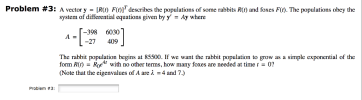 Problem # 3: A vector y R() F(t)]T describes the populations of some rabbits R(t) and foxes F(t). The populations obey the system of differential equations given by y' - Ay where 398 6030 27 409 The rabbit population begins at 85500. If we want the rabbit population to grow as a simple exponential of the form R)Roe4 with no other terms, how many foxes are needed at time 0? Note that the eigenvalues of A are i -4 and...
1. Consider the Lotka-Volterra model for the interaction between a predator population (wolves W(t)) and a...
 1. Consider the Lotka-Volterra model for the interaction between a predator population (wolves W(t)) and a prey population (moose M(t)), À = aM - bmw W = -cW+dMW with the four constants all positive. (a) Explain the meaning of the terms. (b) Non-dimensionalize the equations in the form dx/dt = *(1 - y) and dy/dt = xy(x - 1). (c) Find the fixed points, linearize, classify their stability and draw a phase diagram for various initial conditions (again, using a...
Problem 1 In simple predator-prey models, sinusoidal functions can be used to model the oscillating populations...
Problem 1 In simple predator-prey models, sinusoidal functions can be used to model the oscillating populations of two species of animals in the same environment. As the population of the predator species increases, the population of the prey species will decrease. If the number of prey gets too low, the population of the predator species will suffer from limited resources and start to decline. In this problem we will be modeling one population of rabbits (the prey) and one population...
POPULATION MODELS: PLEASE ANSWSER ASAP: ALL 3 AND WILL RATE U ASAP. The logistic growth model...
 POPULATION MODELS: PLEASE
ANSWSER ASAP: ALL 3 AND WILL RATE U ASAP.
The logistic growth model describes population growth when
resources are constrained. It
is an extension to the exponential growth model that includes an
additional term introducing
the carrying capacity of the habitat.
The differential equation for this model is:
dP/dt=kP(t)(1-P(t)/M)
Where P(t) is the population (or population density) at time t,
k > 0 is a growth constant,
and M is the carrying capacity of the habitat. This...
POPULATION MODELS: PLEASE
ANSWSER ASAP: ALL 3 AND WILL RATE U ASAP.
The logistic growth model describes population growth when
resources are constrained. It
is an extension to the exponential growth model that includes an
additional term introducing
the carrying capacity of the habitat.
The differential equation for this model is:
dP/dt=kP(t)(1-P(t)/M)
Where P(t) is the population (or population density) at time t,
k > 0 is a growth constant,
and M is the carrying capacity of the habitat. This...
[4 marks) (Scaling) In Fisher's equation, и Ut = DUcx + ru(1 K the variables t,...
 [4 marks) (Scaling) In Fisher's equation, и Ut = DUcx + ru(1 K the variables t, 2, and u have dimensions is time, length, and population (animal) per area respectively. The parameters are the growth rate r with units of 1/time, the carrying capacity K with units of population (animals) per area and the diffusion constant D with dimensions length-squared per time. Use the following scales to build dimensionless variables and rewrite the equation in a dimensionless form. t х...
Exercises 1. Verify equation (3) 2. Use the techniques of Section 13.7 and the fact that...
 Exercises 1. Verify equation (3) 2. Use the techniques of Section 13.7 and the fact that P(0) = 10 to solve equation (5). 3. The carrying capacity of Atlantic harp seals has been estimated to be C = 10 million seals. Let 1 = 0 correspond to the year 1980 when this seal population was estimated to be about 2 mil- lion. (Data from: Fisheries and Oceans Canada.) (a) Use a logistic growth model = kP(C - P) with k...
Given this bird population growth data, answer the followign questions: 1) Explain why you think the...
 Given this bird population growth data, answer the followign
questions:
1) Explain why you think the population grew in the pattern it
did
2) Model the population as closely as possible using the
logistic equation. Lowever to do so, you'll need to predict the
intrinsic rate of increase and carrying capacity. Estimate these
vales as must as possible. Report the estimated R and K and graph
1) the populations (both modeled and real on the same graph)
against time, 2)...
Given this bird population growth data, answer the followign
questions:
1) Explain why you think the population grew in the pattern it
did
2) Model the population as closely as possible using the
logistic equation. Lowever to do so, you'll need to predict the
intrinsic rate of increase and carrying capacity. Estimate these
vales as must as possible. Report the estimated R and K and graph
1) the populations (both modeled and real on the same graph)
against time, 2)...
2. Given the columns of the matrix u v w 0 1 2 0-1 0 0 r S t -1 021 01 0 For each of the sets of ...
 Please solve using matrices and not equations.
Thanks.
2. Given the columns of the matrix u v w 0 1 2 0-1 0 0 r S t -1 021 01 0 For each of the sets of vectors given below, answer the following questions: (i) Is the set linearly independent? 1 Does the set span (iii Does the vector a- (a) S (r, s, t, u) (b) T fr,t, 0, u) (c) U = {r, t, w, u, v} (3,2,1,5)...
Please solve using matrices and not equations.
Thanks.
2. Given the columns of the matrix u v w 0 1 2 0-1 0 0 r S t -1 021 01 0 For each of the sets of vectors given below, answer the following questions: (i) Is the set linearly independent? 1 Does the set span (iii Does the vector a- (a) S (r, s, t, u) (b) T fr,t, 0, u) (c) U = {r, t, w, u, v} (3,2,1,5)...
Population growth problems BIDE model: No.1 N, +(B + 1) - ( D Rates: b =...
 Population growth problems BIDE model: No.1 N, +(B + 1) - ( D Rates: b = B/N; d = D/N: E) Net growth rate: R = b-d Exponential growth (discrete): N, NR* where R = 1+b-d Intrinsic rate of increase: r = InR Exponential growth (continuous): N:Noe -or-dN/dt = IN Logistic growth 1. Suppose a species of fish in a lake is modeled by a logistic population model with relative growth rate ofr 0.3 per year and carrying capacity of...
1. Consider a feedback system given below: T(s) Disturbance Controller Dynamics R(S) + Gc(s) G.(s) U(s)...
 1. Consider a feedback system given below: T(s) Disturbance Controller Dynamics R(S) + Gc(s) G.(s) U(s) Sensor H(s) IMs) Sensor noise where the input and transfer functions are given as follows: R(s) = –,7,(s) = 0, N(s) = 0, G, - 15,6, -_- , and H(s) = 1. s's + 3) a. Derive the system transfer function Y(s)/R(s) = G,, poles, $, On, and, from the response function y(t), the performance measures: rise time Tr, peak time Tp, percent overshoot...
 Problem # 3: A vector y R() F(t)]T describes the populations of some rabbits R(t) and foxes F(t). The populations obey the system of differential equations given by y' - Ay where 398 6030 27 409 The rabbit population begins at 85500. If we want the rabbit population to grow as a simple exponential of the form R)Roe4 with no other terms, how many foxes are needed at time 0? Note that the eigenvalues of A are i -4 and...
 1. Consider the Lotka-Volterra model for the interaction between a predator population (wolves W(t)) and a prey population (moose M(t)), À = aM - bmw W = -cW+dMW with the four constants all positive. (a) Explain the meaning of the terms. (b) Non-dimensionalize the equations in the form dx/dt = *(1 - y) and dy/dt = xy(x - 1). (c) Find the fixed points, linearize, classify their stability and draw a phase diagram for various initial conditions (again, using a...
 POPULATION MODELS: PLEASE
ANSWSER ASAP: ALL 3 AND WILL RATE U ASAP.
The logistic growth model describes population growth when
resources are constrained. It
is an extension to the exponential growth model that includes an
additional term introducing
the carrying capacity of the habitat.
The differential equation for this model is:
dP/dt=kP(t)(1-P(t)/M)
Where P(t) is the population (or population density) at time t,
k > 0 is a growth constant,
and M is the carrying capacity of the habitat. This...
POPULATION MODELS: PLEASE
ANSWSER ASAP: ALL 3 AND WILL RATE U ASAP.
The logistic growth model describes population growth when
resources are constrained. It
is an extension to the exponential growth model that includes an
additional term introducing
the carrying capacity of the habitat.
The differential equation for this model is:
dP/dt=kP(t)(1-P(t)/M)
Where P(t) is the population (or population density) at time t,
k > 0 is a growth constant,
and M is the carrying capacity of the habitat. This...
 [4 marks) (Scaling) In Fisher's equation, и Ut = DUcx + ru(1 K the variables t, 2, and u have dimensions is time, length, and population (animal) per area respectively. The parameters are the growth rate r with units of 1/time, the carrying capacity K with units of population (animals) per area and the diffusion constant D with dimensions length-squared per time. Use the following scales to build dimensionless variables and rewrite the equation in a dimensionless form. t х...
 Exercises 1. Verify equation (3) 2. Use the techniques of Section 13.7 and the fact that P(0) = 10 to solve equation (5). 3. The carrying capacity of Atlantic harp seals has been estimated to be C = 10 million seals. Let 1 = 0 correspond to the year 1980 when this seal population was estimated to be about 2 mil- lion. (Data from: Fisheries and Oceans Canada.) (a) Use a logistic growth model = kP(C - P) with k...
 Given this bird population growth data, answer the followign
questions:
1) Explain why you think the population grew in the pattern it
did
2) Model the population as closely as possible using the
logistic equation. Lowever to do so, you'll need to predict the
intrinsic rate of increase and carrying capacity. Estimate these
vales as must as possible. Report the estimated R and K and graph
1) the populations (both modeled and real on the same graph)
against time, 2)...
Given this bird population growth data, answer the followign
questions:
1) Explain why you think the population grew in the pattern it
did
2) Model the population as closely as possible using the
logistic equation. Lowever to do so, you'll need to predict the
intrinsic rate of increase and carrying capacity. Estimate these
vales as must as possible. Report the estimated R and K and graph
1) the populations (both modeled and real on the same graph)
against time, 2)...
 Please solve using matrices and not equations.
Thanks.
2. Given the columns of the matrix u v w 0 1 2 0-1 0 0 r S t -1 021 01 0 For each of the sets of vectors given below, answer the following questions: (i) Is the set linearly independent? 1 Does the set span (iii Does the vector a- (a) S (r, s, t, u) (b) T fr,t, 0, u) (c) U = {r, t, w, u, v} (3,2,1,5)...
Please solve using matrices and not equations.
Thanks.
2. Given the columns of the matrix u v w 0 1 2 0-1 0 0 r S t -1 021 01 0 For each of the sets of vectors given below, answer the following questions: (i) Is the set linearly independent? 1 Does the set span (iii Does the vector a- (a) S (r, s, t, u) (b) T fr,t, 0, u) (c) U = {r, t, w, u, v} (3,2,1,5)...
 Population growth problems BIDE model: No.1 N, +(B + 1) - ( D Rates: b = B/N; d = D/N: E) Net growth rate: R = b-d Exponential growth (discrete): N, NR* where R = 1+b-d Intrinsic rate of increase: r = InR Exponential growth (continuous): N:Noe -or-dN/dt = IN Logistic growth 1. Suppose a species of fish in a lake is modeled by a logistic population model with relative growth rate ofr 0.3 per year and carrying capacity of...
 1. Consider a feedback system given below: T(s) Disturbance Controller Dynamics R(S) + Gc(s) G.(s) U(s) Sensor H(s) IMs) Sensor noise where the input and transfer functions are given as follows: R(s) = –,7,(s) = 0, N(s) = 0, G, - 15,6, -_- , and H(s) = 1. s's + 3) a. Derive the system transfer function Y(s)/R(s) = G,, poles, $, On, and, from the response function y(t), the performance measures: rise time Tr, peak time Tp, percent overshoot...
Most questions answered within 3 hours.
-
Where is the error in this code sequence?
String s1 = "Hello";
String s2 = "ello";...
asked 11 months ago -
Financial data for Joel de Paris, Inc., for last year
follow:
Joel de Paris, Inc.
Balance...
asked 11 months ago -
Consider this reaction:
Al2(SO4)3 (aq)+ BaCl3
(aq) Al2Cl6 (aq)- +
3BaSO4(s) . What is the...
asked 11 months ago -
Suppose that Savneet is considering increasing her
recent random sample from 20 car rentals to 40...
asked 11 months ago -
Trucks arrive at an unloading terminal at an average rate of 120
per hour.
Trucks arrive...
asked 11 months ago -
Why are methanol and ethanol completely soluble in water while
octanol is not very little soluble....
asked 11 months ago -
A facilities manager at a university reads in a research report
that the mean amount of...
asked 11 months ago -
When the CuSO4 is rehydrated by adding water to the anhydrous
compound, is this an endothermic...
asked 11 months ago -
A ray of sunlight is passing from diamond into crown glass; the
angle of incidence is...
asked 11 months ago -
A block of mass 0.249 kg is placed on top of a light, vertical
spring of...
asked 11 months ago -
how do the kidneys compensate in the presences of acidosis
a) trigger hyperventilate
b) reserve acid...
asked 11 months ago -
Question 501 pts
The rental rate of capital to the firm increases. Which of the
following...
asked 11 months ago