A cell with 18 chromosomes divides by meiosis. Which of the following statements best describes the...
A cell with 18 chromosomes divides by meiosis. Which of the following statements best describes the expected daughter cells?
a. The result would be two daughter cells, each with 18 chromosomes.
b. The result would be four daughter cells, each with 18 chromosomes.
c. The result would be four daughter cells, each with 9 chromosomes
d. The result would be two daughter cells, each with 9 chromosomes.
Homework Answers
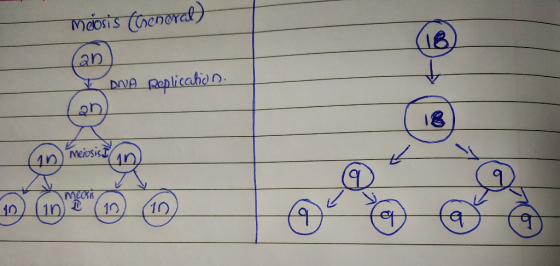
The result would be four daughter cells, each with 9 chromosomes.
Meiosis has two parts meiosis I and meiosis II, you can refer to the following drawing for the explanation:-
Add Answer to:
A cell with 18 chromosomes divides by meiosis. Which of the
following statements best describes the...
Which of the following statements is/are true about meiosis? Select all that apply. Meiosis produces growth...
 Which of the following statements is/are true about meiosis? Select all that apply. Meiosis produces growth in humans. Meiosis produces gametes Meiosis produces four haploid cells Meiosis produces two diploid cells. Melosis produces nonidentical cells. The daughter cells of meiosis have half as many chromosomes as the parent cell
When does the separation of homologous chromosomes occur? • O A. Meiosis 2 • O B....
 When does the separation of homologous chromosomes occur? • O A. Meiosis 2 • O B. Before Meiosis • . C. Meiosis 1 D. After Meiosis Reset Selection If a cell has 24 pairs of chromosomes in its diploid state, how many chromosomes will it have after Meiosis 2? • • • • A. 24 B. 12 C. 48 D.6 Dan What structure is responsible for separating the chromosomes during Meiosis? A. Spindle Fibers B. Cytoplasm C. Metaphase plate •...
Which of the following statements BEST describes the importance of meiosis in human evolution? Crossing over...
Which of the following statements BEST describes the importance of meiosis in human evolution? Crossing over creates novel genetic sequences that can be passed to the next generation. Meiosis produces cells that contain varied and heritable DNA so that humans have variation (that ultimately allows us to adapt to changing environments). Mutation shuffles variation during meiosis ensuring that the new daughter cells are not identical to the parent cells. All of the above.
A cell with 10 chromosomes undergoes Meiosis. How many daughter cells are formed? How many chromosomes...
 A cell with 10 chromosomes undergoes Meiosis. How many daughter
cells are formed? How many chromosomes are in each daughter
cell?
A cell with 10 chromosomes undergoes Meiosis. How many daughter cells are formed? How many chromosomes are in each daughter cell? 0 2,10 0 2,5 0 4,10 0 4,5
A cell with 10 chromosomes undergoes Meiosis. How many daughter
cells are formed? How many chromosomes are in each daughter
cell?
A cell with 10 chromosomes undergoes Meiosis. How many daughter cells are formed? How many chromosomes are in each daughter cell? 0 2,10 0 2,5 0 4,10 0 4,5
Which of the following is the result of meiosis? (Select all that apply) A The production...
 Which of the following is the result of meiosis? (Select all that apply) A The production of four genetically identical daughter cells B. The production of four genetically different daughter cels C. No change in chromosome number from the parent cel D. A doubling of the chromosome number E. A reduction in the chromosome number by haif 13. Mitosis and cytokinesis function in which of the following? (Select all that apply) A. Asexual reproduction in unicellular eukaryotic organisms B. Gamete...
1. If the diploid number of chromosomes in a cell is 16 and the cell divides...
 1. If the diploid number of chromosomes in a cell is 16 and the cell divides by using mitosis, how many chromosomes will be present in each of the new daughter cells?
QUESTION 1 A cell divides by mitosis. The result is: A. diploid gametes. B. two identical...
 QUESTION 1 A cell divides by mitosis. The result is: A. diploid gametes. B. two identical daughter cells. C. haploid gametes. D.four identical daughter cells. E. somatic cells with a unique collection of alleles. QUESTION 2 line of the DNA it did during prophase I. During metaphase Il in meiosis, a cell contains i A. twice as much B. 1/2 OC. 1/4 D.four times as much E. the same amount QUESTION 3 A cell spends the majority of its time...
3. A diploid cell with eight chromosomes undergoes meiosis. (7 pt) a. How many chromosomes are...
 3. A diploid cell with eight chromosomes undergoes meiosis. (7 pt) a. How many chromosomes are there in each cell after meiosis I? How many daughter cells are made after meiosis I? Are the daughter cells diploid or haploid? (1.5 pt) How many chromosomes are there in each cell after meiosis ll? How many daughter cells are made after meiosis II? Are the daughter cells diploid or haploid? (1.5 pt) What two mechanisms allow genetic variation among the gametes produced...
This question concerns cell division. For each of the following statements, say whether it is true...
This question concerns cell division. For each of the following statements, say whether it is true for mitosis only, meiosis only, both, or neither (1 mark per statement): (a) The DNA is replicated before cell division starts. (b) The homologous chromosomes pair up during division. ( c) The cell divides only once during the process. (d) The daughter cells contain precisely the same genetic material as each other. (e) The number of chromosomes in each cell increases during the process...
The following figure shows a cell containing a pair of homologous chromosomes. The alleles for the...
 The following figure shows a cell containing a pair of
homologous chromosomes. The alleles for the F gene are indicated on
each chromosome. Which of the following most accurately represents
the configuration of chromosomes within the cell following DNA
replication, prior to meiosis?
Select one:
a.
b.
c.
d.
Which term is used to describe a pair of similar chromosomes in
a cell:
Select one:
a. bifurcates
b. homologous
c. chromatids
d. replicants
Which of the following statements is TRUE...
The following figure shows a cell containing a pair of
homologous chromosomes. The alleles for the F gene are indicated on
each chromosome. Which of the following most accurately represents
the configuration of chromosomes within the cell following DNA
replication, prior to meiosis?
Select one:
a.
b.
c.
d.
Which term is used to describe a pair of similar chromosomes in
a cell:
Select one:
a. bifurcates
b. homologous
c. chromatids
d. replicants
Which of the following statements is TRUE...
 Which of the following statements is/are true about meiosis? Select all that apply. Meiosis produces growth in humans. Meiosis produces gametes Meiosis produces four haploid cells Meiosis produces two diploid cells. Melosis produces nonidentical cells. The daughter cells of meiosis have half as many chromosomes as the parent cell
 When does the separation of homologous chromosomes occur? • O A. Meiosis 2 • O B. Before Meiosis • . C. Meiosis 1 D. After Meiosis Reset Selection If a cell has 24 pairs of chromosomes in its diploid state, how many chromosomes will it have after Meiosis 2? • • • • A. 24 B. 12 C. 48 D.6 Dan What structure is responsible for separating the chromosomes during Meiosis? A. Spindle Fibers B. Cytoplasm C. Metaphase plate •...
 A cell with 10 chromosomes undergoes Meiosis. How many daughter
cells are formed? How many chromosomes are in each daughter
cell?
A cell with 10 chromosomes undergoes Meiosis. How many daughter cells are formed? How many chromosomes are in each daughter cell? 0 2,10 0 2,5 0 4,10 0 4,5
A cell with 10 chromosomes undergoes Meiosis. How many daughter
cells are formed? How many chromosomes are in each daughter
cell?
A cell with 10 chromosomes undergoes Meiosis. How many daughter cells are formed? How many chromosomes are in each daughter cell? 0 2,10 0 2,5 0 4,10 0 4,5
 Which of the following is the result of meiosis? (Select all that apply) A The production of four genetically identical daughter cells B. The production of four genetically different daughter cels C. No change in chromosome number from the parent cel D. A doubling of the chromosome number E. A reduction in the chromosome number by haif 13. Mitosis and cytokinesis function in which of the following? (Select all that apply) A. Asexual reproduction in unicellular eukaryotic organisms B. Gamete...
 1. If the diploid number of chromosomes in a cell is 16 and the cell divides by using mitosis, how many chromosomes will be present in each of the new daughter cells?
 QUESTION 1 A cell divides by mitosis. The result is: A. diploid gametes. B. two identical daughter cells. C. haploid gametes. D.four identical daughter cells. E. somatic cells with a unique collection of alleles. QUESTION 2 line of the DNA it did during prophase I. During metaphase Il in meiosis, a cell contains i A. twice as much B. 1/2 OC. 1/4 D.four times as much E. the same amount QUESTION 3 A cell spends the majority of its time...
 3. A diploid cell with eight chromosomes undergoes meiosis. (7 pt) a. How many chromosomes are there in each cell after meiosis I? How many daughter cells are made after meiosis I? Are the daughter cells diploid or haploid? (1.5 pt) How many chromosomes are there in each cell after meiosis ll? How many daughter cells are made after meiosis II? Are the daughter cells diploid or haploid? (1.5 pt) What two mechanisms allow genetic variation among the gametes produced...
 The following figure shows a cell containing a pair of
homologous chromosomes. The alleles for the F gene are indicated on
each chromosome. Which of the following most accurately represents
the configuration of chromosomes within the cell following DNA
replication, prior to meiosis?
Select one:
a.
b.
c.
d.
Which term is used to describe a pair of similar chromosomes in
a cell:
Select one:
a. bifurcates
b. homologous
c. chromatids
d. replicants
Which of the following statements is TRUE...
The following figure shows a cell containing a pair of
homologous chromosomes. The alleles for the F gene are indicated on
each chromosome. Which of the following most accurately represents
the configuration of chromosomes within the cell following DNA
replication, prior to meiosis?
Select one:
a.
b.
c.
d.
Which term is used to describe a pair of similar chromosomes in
a cell:
Select one:
a. bifurcates
b. homologous
c. chromatids
d. replicants
Which of the following statements is TRUE...
Most questions answered within 3 hours.
-
Where is the error in this code sequence?
String s1 = "Hello";
String s2 = "ello";...
asked 11 months ago -
Financial data for Joel de Paris, Inc., for last year
follow:
Joel de Paris, Inc.
Balance...
asked 11 months ago -
Consider this reaction:
Al2(SO4)3 (aq)+ BaCl3
(aq) Al2Cl6 (aq)- +
3BaSO4(s) . What is the...
asked 11 months ago -
Suppose that Savneet is considering increasing her
recent random sample from 20 car rentals to 40...
asked 11 months ago -
Trucks arrive at an unloading terminal at an average rate of 120
per hour.
Trucks arrive...
asked 11 months ago -
Why are methanol and ethanol completely soluble in water while
octanol is not very little soluble....
asked 11 months ago -
A facilities manager at a university reads in a research report
that the mean amount of...
asked 11 months ago -
When the CuSO4 is rehydrated by adding water to the anhydrous
compound, is this an endothermic...
asked 11 months ago -
A ray of sunlight is passing from diamond into crown glass; the
angle of incidence is...
asked 11 months ago -
A block of mass 0.249 kg is placed on top of a light, vertical
spring of...
asked 11 months ago -
how do the kidneys compensate in the presences of acidosis
a) trigger hyperventilate
b) reserve acid...
asked 11 months ago -
Question 501 pts
The rental rate of capital to the firm increases. Which of the
following...
asked 11 months ago