given a graph G, and a subset S of its vertices, find a spanning tree of...
given a graph G, and a subset S of its vertices, find a spanning tree of G such that the set S is exactly the set of leaves of that spanning tree. Prove or disprove that this problem is NP-complete.
Homework Answers
Let us consider the following Graph G
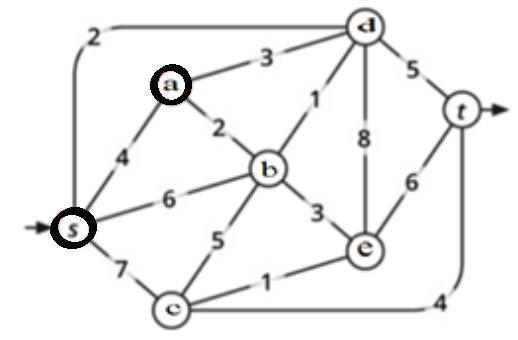
Kruskal’s Algorithm to find the Minimum Cost Spanning Tree (MCST) of a graph G as follows:
Step 1:

Step 2:

Step 3:
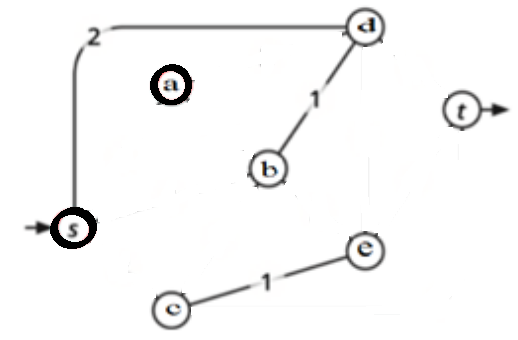
Step 4:

Step 5:

Step 6:
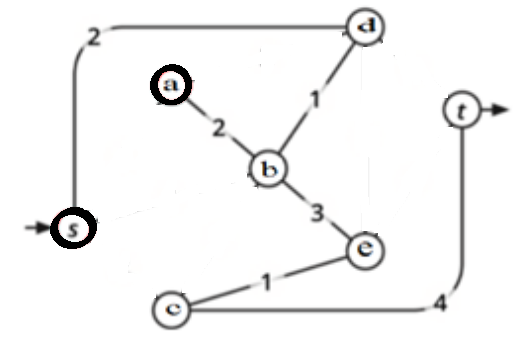
For n- Vertices we get (n-1) Edges in MCST. Here in graph having 7 Vertices so we get 6 Edges
Which is Required MCST of a graph
Add Answer to:
given a graph G, and a subset S of its vertices, find a spanning
tree of...
Let G = (V;E) be an undirected and unweighted graph. Let S be a subset of the vertices. The graph...
Let G = (V;E) be an undirected and unweighted graph. Let S be a subset of the vertices. The graph induced on S, denoted G[S] is a graph that has vertex set S and an edge between two vertices u, v that is an element of S provided that {u,v} is an edge of G. A subset K of V is called a killer set of G if the deletion of K kills all the edges of G, that is...
7. An independent set in a graph G is a subset S C V(G) of vertices...
 7. An independent set in a graph G is a subset S C V(G) of vertices of G which are pairwise non-adjacent (i.e., such that there are no edges between any of the vertices in S). Let Q(G) denote the size of the largest independent set in G. Prove that for a graph G with n vertices, GX(G)n- a(G)+ 1.
Let G be an undirected graph and let X be a subset of the vertices of...
Let G be an undirected graph and let X be a subset of the vertices of G. A connecting tree on X is a tree composed out of the edges of G that contains all the vertices in X. One way to compute a connecting tree consists of two steps: (1) Compute a minimum spanning tree T over G. (2) Delete all the edges out of T not needed to connect vertices in X. Give an algorithm(Pseudo-code) to carry out...
Let G be an undirected graph and let X be a subset of the vertices of...
Let G be an undirected graph and let X be a subset of the vertices of G. A connecting tree on X is a tree composed out of the edges of G that contains all the vertices in X. One way to compute a connecting tree consists of two steps: (1) Compute a minimum spanning tree T over G. (2) Delete all the edges out of T not needed to connect vertices in X. The Steiner tree for X is...
Problem 3: Bounded-Degree Spanning Trees (10 points). Recall the minimum spanning tree problem studied in class....
Problem 3: Bounded-Degree Spanning Trees (10 points). Recall the minimum spanning tree problem studied in class. We define a variant of the problem in which we are no longer concerned with the total cost of the spanning tree, but rather with the maximum degree of any vertex in the tree. Formally, given an undirected graph G = (V,E) and T ⊆ E, we say T is a k-degree spanning tree of G if T is a spanning tree of G,...
You are given an undirected graph G with weighted edges and a minimum spanning tree T of G.
You are given an undirected graph G with weighted edges and a minimum spanning tree T of G. Design an algorithm to update the minimum spanning tree when the weight of a single edge is increased. The input to your algorithm should be the edge e and its new weight: your algorithm should modify T so that it is still a MST. Analyze the running time of your algorithm and prove its correctness.
You are given an undirected graph G with weighted edges and a minimum spanning tree T of G.
You are given an undirected graph G with weighted edges and a minimum spanning tree T of G. Design an algorithm to update the minimum spanning tree when the weight of a single edge is decreased. The input to your algorithm should be the edge e and its new weight; your algorithm should modify T so that it is still a MST. Analyze the running time of your algorithm and prove its correctness.
The input to SPANNINGTREEWITHKLEAVES is a graph G and an integer K. The question asked by...
 The input to SPANNINGTREEWITHKLEAVES is a graph G and an integer K. The question asked by SPAN NINGTREEWITHKLEAVES is whether G has a spanning tree with exactly K leaves. Problem 3. Show that SPANNINGTREEWITIIKLEAVES is NP-complete. Hint: There is a simple polynomial time reduction from HAMILTONIANPATH to SPANNINGTREEWITHKLEAVES.
2. This question concerns the graph G shown below. (a) Mark the spanning tree for G...
 2. This question concerns the graph G shown below. (a) Mark the spanning tree for G obtained by performing a depth-first search starting at the vertex A, and using the convention that nearby vertices should be explored in a counter-clockwise fasion, beginning with east; so E comes first, then NE, then N, ... (b) Mark the spanning tree for G obtained by performing a breadth-first search starting at the vertex A, and using the convention that nearby vertices should be...
2. This question concerns the graph G shown below. (a) Mark the spanning tree for G...
 2. This question concerns the graph G shown below. (a) Mark the spanning tree for G obtained by performing a depth-first search starting at the vertex A, and using the convention that nearby vertices should be explored in a counter-clockwise fasion, beginning with east; so E comes first, then NE, then N, ... (b) Mark the spanning tree for G obtained by performing a breadth-first search starting at the vertex A, and using the convention that nearby vertices should be...
 7. An independent set in a graph G is a subset S C V(G) of vertices of G which are pairwise non-adjacent (i.e., such that there are no edges between any of the vertices in S). Let Q(G) denote the size of the largest independent set in G. Prove that for a graph G with n vertices, GX(G)n- a(G)+ 1.
 The input to SPANNINGTREEWITHKLEAVES is a graph G and an integer K. The question asked by SPAN NINGTREEWITHKLEAVES is whether G has a spanning tree with exactly K leaves. Problem 3. Show that SPANNINGTREEWITIIKLEAVES is NP-complete. Hint: There is a simple polynomial time reduction from HAMILTONIANPATH to SPANNINGTREEWITHKLEAVES.
 2. This question concerns the graph G shown below. (a) Mark the spanning tree for G obtained by performing a depth-first search starting at the vertex A, and using the convention that nearby vertices should be explored in a counter-clockwise fasion, beginning with east; so E comes first, then NE, then N, ... (b) Mark the spanning tree for G obtained by performing a breadth-first search starting at the vertex A, and using the convention that nearby vertices should be...
 2. This question concerns the graph G shown below. (a) Mark the spanning tree for G obtained by performing a depth-first search starting at the vertex A, and using the convention that nearby vertices should be explored in a counter-clockwise fasion, beginning with east; so E comes first, then NE, then N, ... (b) Mark the spanning tree for G obtained by performing a breadth-first search starting at the vertex A, and using the convention that nearby vertices should be...
Most questions answered within 3 hours.
-
Where is the error in this code sequence?
String s1 = "Hello";
String s2 = "ello";...
asked 10 months ago -
Financial data for Joel de Paris, Inc., for last year
follow:
Joel de Paris, Inc.
Balance...
asked 10 months ago -
Consider this reaction:
Al2(SO4)3 (aq)+ BaCl3
(aq) Al2Cl6 (aq)- +
3BaSO4(s) . What is the...
asked 10 months ago -
Suppose that Savneet is considering increasing her
recent random sample from 20 car rentals to 40...
asked 10 months ago -
Trucks arrive at an unloading terminal at an average rate of 120
per hour.
Trucks arrive...
asked 10 months ago -
Why are methanol and ethanol completely soluble in water while
octanol is not very little soluble....
asked 10 months ago -
A facilities manager at a university reads in a research report
that the mean amount of...
asked 10 months ago -
When the CuSO4 is rehydrated by adding water to the anhydrous
compound, is this an endothermic...
asked 10 months ago -
A ray of sunlight is passing from diamond into crown glass; the
angle of incidence is...
asked 10 months ago -
A block of mass 0.249 kg is placed on top of a light, vertical
spring of...
asked 10 months ago -
how do the kidneys compensate in the presences of acidosis
a) trigger hyperventilate
b) reserve acid...
asked 10 months ago -
Question 501 pts
The rental rate of capital to the firm increases. Which of the
following...
asked 10 months ago