By itself, _______________ would increase the rate of diffusion of sodium ions into a cell. Group...
By itself, _______________ would increase the rate of diffusion of sodium ions into a cell.
Group of answer choices
A) a decrease in extracellular osmolarity
B) an increase in the intracellular concentration of potassium ions
C) a decrease in the permeability of the membrane to sodium ions
D) Two of the answers are correct.
E) an increase in the extracellular concentration of sodium ions
Homework Answers
Answer.
E. An increase in the extracellular concentration of sodium ions.
- Diffusion rate mostly depends on concentration of solute.
- Permeability ( as permeability increases diffusion increases ).
Add Answer to:
By itself, _______________ would increase the rate of diffusion
of sodium ions into a cell.
Group...
1. If the membrane potential of sodium ions in a cell is equal to +60 mV,...
1. If the membrane potential of sodium ions in a cell is equal to +60 mV, what is its membrane potential for chloride ions if they are found in the exact same concentrations as sodium? Give your answer in mV. 2. Given a cell membrane with the following parameters- Ion Extracellular concentration (mmol/L) Intracellular concentration (mmol/L) Permeability K+ 10 150 1 Na+ 140 15 0.04 Cl- 100 7 0.45 calculate the membrane potential of the cell in mV. (Round your...
Exposure to a drug that inhibits the sodium-potassium pump would in the long term cause a/an...
Exposure to a drug that inhibits the sodium-potassium pump would in the long term cause a/an _____________ in the intracellular potassium concentration and a/an _____________ in the sodium concentration of the extracellular solution, assuming everything else stays the same A. decrease ; decrease B. decrease ; increase C. increase ; decrease D. increase ; increase
B3. Cell Membrane and Cell Transport a) What kind of solution should a cell be placed...
 B3. Cell Membrane and Cell Transport a) What kind of solution should a cell be placed in for it to become lysed? [1 mark] b) Give an example of a transmembrane protein. [1 mark] c) Which form of membrane transport does NOT require the expenditure of energy by the cell? [1 Mark] d) Given a cell with concentration of solutes in the environment lesser than the concentration of solutes in the surrounding fluid.. i. the extracellular fluid is said to...
Although the extracellular environment has a high sodium ion concentration and the intracellular environment has a...
Although the extracellular environment has a high sodium ion concentration and the intracellular environment has a high potassium ion concentration, both must be neutralized by negatively charged molecules. In the intracellular case, what is the principal anion? Group of answer choices organic anions chloride ion lipids hydrogen ions
cell biology Which of the following is an active transport mechanism? a Facilitated diffusion of potassium...
cell biology Which of the following is an active transport mechanism? a Facilitated diffusion of potassium ions across the membrane through an open potassium channel b Movement of water into a cell c Sodium ions moving out of an animal cell bathed in physiological saline d Movement of CO2 out of a cell e None of the above
According to biophysics As a result of an experiment following measurements were obtained from a cell:...
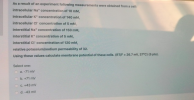 According to biophysics
As a result of an experiment following measurements were obtained from a cell: intracellular Na* concentration of 10 mm, intracellular K* concentration of 140 mm, intracellular Cl' concentration of 5 mm, interstitial Na* concentration of 150 mm, interstitial K concentration of 5 mm, interstitial Cl' concentration of 120 mm, relative potassium/sodium permeability of 32. Using these values calculate membrane potential of these cells. (RT/F = 26.7 mV, 37°C) (5 pts). Select one: a. -71 mV b. +71...
According to biophysics
As a result of an experiment following measurements were obtained from a cell: intracellular Na* concentration of 10 mm, intracellular K* concentration of 140 mm, intracellular Cl' concentration of 5 mm, interstitial Na* concentration of 150 mm, interstitial K concentration of 5 mm, interstitial Cl' concentration of 120 mm, relative potassium/sodium permeability of 32. Using these values calculate membrane potential of these cells. (RT/F = 26.7 mV, 37°C) (5 pts). Select one: a. -71 mV b. +71...
33) Which of the following is most likely true of a protein that cotransports glucose and...
 33) Which of the following is most likely true of a protein that cotransports glucose and sodium ions into the intestinal cells of an animal? A) Sodium and glucose bind to the same site on the cotransporter. B) Transport of glucose against its concentration gradient provides energy for uptake of sodium ions against the electrochemical gradient. C) Sodium ions can be transported whether or not glucose is present outside the cell, but glucose transport requires cotransport of sodium ions. D)...
25. Water intoxication, also known asrefers to low blood levels of sodium. a. hyponatremia b. hypokalemia c. hypoca...
 25. Water intoxication, also known asrefers to low blood levels of sodium. a. hyponatremia b. hypokalemia c. hypocalcemia d. achlorhydria 26. The pump, a cell membrane protein, helps maintain fluid balance in the body. a. sodium-phosphate b. sodium-chloride c. sodium-potassium d. sodium-iodine 27. Potassium helps maintain the a. extracellular b. intracellular fluid volume. c. intravascular d. interstitial 28. Water may be described as being a. essential b. organic c. caloric d. all of the above 29. Electrolytes arethat form ions...
Please answer ALL questions. 1. Select the correct combination for a sympathetic increase in heart rate...
Please answer ALL questions. 1. Select the correct combination for a sympathetic increase in heart rate A. acetylcholine -- alpha receptors -- increased potassium permeability B. norepinephrine and epinephrine -- beta 2 receptors --increased permeability to sodium, potassium, and calcium C. acetylcholine --muscarinic receptors --increased potassium permability D. norepinephrine and epinephrine -- nicotinic receptors --increased permeability to calcium E. norepinephrine and epinephrine -- beta 1 receptors -- increased permeability to sodium and calcium 2. If there is loss of plasma...
please explain steps and show work no pictures were provided. table 3.13 is given above. 3.46...
 please explain steps and show work
no pictures were provided. table 3.13 is given above.
3.46 The cell membrane is covered with protein complexes called Na-K+ pumps. Each pump moves 3 Nations from the intracellular space to the extracellular milieu for every 2 K ions it moves into the cell. During normal function, the pumps work constantly. Under normal conditions, there is a gradient of Nat and K ions between the cell and the extracellular space; the concentrations of these...
please explain steps and show work
no pictures were provided. table 3.13 is given above.
3.46 The cell membrane is covered with protein complexes called Na-K+ pumps. Each pump moves 3 Nations from the intracellular space to the extracellular milieu for every 2 K ions it moves into the cell. During normal function, the pumps work constantly. Under normal conditions, there is a gradient of Nat and K ions between the cell and the extracellular space; the concentrations of these...
 B3. Cell Membrane and Cell Transport a) What kind of solution should a cell be placed in for it to become lysed? [1 mark] b) Give an example of a transmembrane protein. [1 mark] c) Which form of membrane transport does NOT require the expenditure of energy by the cell? [1 Mark] d) Given a cell with concentration of solutes in the environment lesser than the concentration of solutes in the surrounding fluid.. i. the extracellular fluid is said to...
 According to biophysics
As a result of an experiment following measurements were obtained from a cell: intracellular Na* concentration of 10 mm, intracellular K* concentration of 140 mm, intracellular Cl' concentration of 5 mm, interstitial Na* concentration of 150 mm, interstitial K concentration of 5 mm, interstitial Cl' concentration of 120 mm, relative potassium/sodium permeability of 32. Using these values calculate membrane potential of these cells. (RT/F = 26.7 mV, 37°C) (5 pts). Select one: a. -71 mV b. +71...
According to biophysics
As a result of an experiment following measurements were obtained from a cell: intracellular Na* concentration of 10 mm, intracellular K* concentration of 140 mm, intracellular Cl' concentration of 5 mm, interstitial Na* concentration of 150 mm, interstitial K concentration of 5 mm, interstitial Cl' concentration of 120 mm, relative potassium/sodium permeability of 32. Using these values calculate membrane potential of these cells. (RT/F = 26.7 mV, 37°C) (5 pts). Select one: a. -71 mV b. +71...
 33) Which of the following is most likely true of a protein that cotransports glucose and sodium ions into the intestinal cells of an animal? A) Sodium and glucose bind to the same site on the cotransporter. B) Transport of glucose against its concentration gradient provides energy for uptake of sodium ions against the electrochemical gradient. C) Sodium ions can be transported whether or not glucose is present outside the cell, but glucose transport requires cotransport of sodium ions. D)...
 25. Water intoxication, also known asrefers to low blood levels of sodium. a. hyponatremia b. hypokalemia c. hypocalcemia d. achlorhydria 26. The pump, a cell membrane protein, helps maintain fluid balance in the body. a. sodium-phosphate b. sodium-chloride c. sodium-potassium d. sodium-iodine 27. Potassium helps maintain the a. extracellular b. intracellular fluid volume. c. intravascular d. interstitial 28. Water may be described as being a. essential b. organic c. caloric d. all of the above 29. Electrolytes arethat form ions...
 please explain steps and show work
no pictures were provided. table 3.13 is given above.
3.46 The cell membrane is covered with protein complexes called Na-K+ pumps. Each pump moves 3 Nations from the intracellular space to the extracellular milieu for every 2 K ions it moves into the cell. During normal function, the pumps work constantly. Under normal conditions, there is a gradient of Nat and K ions between the cell and the extracellular space; the concentrations of these...
please explain steps and show work
no pictures were provided. table 3.13 is given above.
3.46 The cell membrane is covered with protein complexes called Na-K+ pumps. Each pump moves 3 Nations from the intracellular space to the extracellular milieu for every 2 K ions it moves into the cell. During normal function, the pumps work constantly. Under normal conditions, there is a gradient of Nat and K ions between the cell and the extracellular space; the concentrations of these...
Most questions answered within 3 hours.
-
Where is the error in this code sequence?
String s1 = "Hello";
String s2 = "ello";...
asked 10 months ago -
Financial data for Joel de Paris, Inc., for last year
follow:
Joel de Paris, Inc.
Balance...
asked 10 months ago -
Consider this reaction:
Al2(SO4)3 (aq)+ BaCl3
(aq) Al2Cl6 (aq)- +
3BaSO4(s) . What is the...
asked 10 months ago -
Suppose that Savneet is considering increasing her
recent random sample from 20 car rentals to 40...
asked 10 months ago -
Trucks arrive at an unloading terminal at an average rate of 120
per hour.
Trucks arrive...
asked 10 months ago -
Why are methanol and ethanol completely soluble in water while
octanol is not very little soluble....
asked 10 months ago -
A facilities manager at a university reads in a research report
that the mean amount of...
asked 10 months ago -
When the CuSO4 is rehydrated by adding water to the anhydrous
compound, is this an endothermic...
asked 10 months ago -
A ray of sunlight is passing from diamond into crown glass; the
angle of incidence is...
asked 10 months ago -
A block of mass 0.249 kg is placed on top of a light, vertical
spring of...
asked 10 months ago -
how do the kidneys compensate in the presences of acidosis
a) trigger hyperventilate
b) reserve acid...
asked 10 months ago -
Question 501 pts
The rental rate of capital to the firm increases. Which of the
following...
asked 10 months ago