In making decisions about whether to sell or further process joint products, allocated joint cost amounts...
In making decisions about whether to sell or further process joint products, allocated joint cost amounts are __________.
essential
useful
not relevant
useful depending on the method chosen
Homework Answers
Option C
Allocated common or joint costs should be ignored (not relevant) in deciding whether to sell or process further. So option C is the answer
Add Answer to:
In making decisions about whether to sell or further process
joint products, allocated joint cost amounts...
SELL AT SPLIT – OFF POINT OR PROCESS FURTHER & JOINT COST ALLOCATION Lauricella Inc. produces...
SELL AT SPLIT – OFF POINT OR PROCESS FURTHER & JOINT COST ALLOCATION Lauricella Inc. produces three products from a common set of inputs for $95,000. Other sales and cost data follow: Unit Sales Price ____ Costs After At After further Split-off Product Quantity Split-off Processing Point__ Regular 8,000 $ 8 $ 10 $ 10,000 Special 5,000 5 8 15,000 Premium 4,000 6 10 20,000 REQUIRED: Which products should...
Which of the following decisions focuses on whether or not to perform further actions on joint...
 Which of the following decisions focuses on whether or not to perform further actions on joint products? Oa. The sell-or-process-further decision Ob. The step decision Oc. The restructuring-order decision Od. The make-or-buy decision Oe. The keep-or-drop decision Next All work saved. We were unable to transcribe this image
Options for 1-6: (1): process further / sell as is (2): decreases / increases (3): process further / sell as...
 Options for 1-6:
(1): process further / sell as is
(2): decreases / increases (3): process
further / sell as is (4): be higher if they
do / be lower if they do (5): different / the same
(6): is / is not
3. Interlock Soy Products (USP) buys soybeans and processes them into other soy products. Each ton of soybeans that USP purchases for $320 can be converted for an additional $200 into 675 lbs of soy meal and 120 gallons of soy oil....
Options for 1-6:
(1): process further / sell as is
(2): decreases / increases (3): process
further / sell as is (4): be higher if they
do / be lower if they do (5): different / the same
(6): is / is not
3. Interlock Soy Products (USP) buys soybeans and processes them into other soy products. Each ton of soybeans that USP purchases for $320 can be converted for an additional $200 into 675 lbs of soy meal and 120 gallons of soy oil....
Please provide explanation. Thank you. Process/Not Process Further Indicate whether each of the two products below...
 Please provide explanation.
Thank you.
Process/Not Process Further Indicate whether each of the two products below should be sold at split-off or processed further. Product per Unit Amounts Product per Unit Amounts АА BB Product Joint cost Cost to process further Sales value at split-off Sales value after further processing Sell both as split-off Sell only AA at split-off (and process BB further) Sell only BB as split off (and process AA further) Sell neither at split-off (i.e., process both...
Please provide explanation.
Thank you.
Process/Not Process Further Indicate whether each of the two products below should be sold at split-off or processed further. Product per Unit Amounts Product per Unit Amounts АА BB Product Joint cost Cost to process further Sales value at split-off Sales value after further processing Sell both as split-off Sell only AA at split-off (and process BB further) Sell only BB as split off (and process AA further) Sell neither at split-off (i.e., process both...
32. When producing joint products, what are the relevant costs for a decision to sell or process...
32. When producing joint products, what are the relevant costs for a decision to sell or process further? a. Joint costs b. Costs incurred before the splitoff point c. Costs incurred at the splitoff point d. Costs incurred after the splitoff point. 33. Which of the following describes the cost of maintaining warehouse facilities? a. carrying costs. b. set-up costs. c. order costs. d. sunk costs. 34. Which of the following is a method of managing purchasing, production, and sales, by which the...
(c) Identify the revenue or expense amounts necessary to make a sell-or-process-further decision and the reasons...
 (c) Identify the revenue or expense amounts necessary to make a sell-or-process-further decision and the reasons behind them. [5 marks) (d) Identify the four methods of allocating joint costs to individual products and the most preferred method among accountants. (5 marks]
please complete P25-33 and all requirements in excel. thanks! P25-33 Making sell or process further decisions...
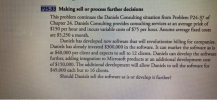 please complete P25-33 and all requirements in excel. thanks!
P25-33 Making sell or process further decisions This problem continues the Daniels Consulting situation from Problem P24-37 of Chapter 24. Daniels Consulting provides consulting services at an average pride of $150 per hour and incurs variable costs of $75 per hour. Assume average fixed costs are $5,250 a month. Daniels has developed new software that will revolutionize billing for companies. Daniels has already invested $300,000 in the software. It can market...
please complete P25-33 and all requirements in excel. thanks!
P25-33 Making sell or process further decisions This problem continues the Daniels Consulting situation from Problem P24-37 of Chapter 24. Daniels Consulting provides consulting services at an average pride of $150 per hour and incurs variable costs of $75 per hour. Assume average fixed costs are $5,250 a month. Daniels has developed new software that will revolutionize billing for companies. Daniels has already invested $300,000 in the software. It can market...
Net Realizable Value Method, Decision to Sell at Split-off or Process Further Pacheco, Inc., produces two...
Net Realizable Value Method, Decision to Sell at Split-off or Process Further Pacheco, Inc., produces two products, overs and unders, in a single process. The joint costs of this process were $50,000, and 14,000 units of overs and 35,000 units of unders were produced. Separable processing costs beyond the split-off point were as follows: overs, $18,000; unders, $19,900. Overs sell for $2.00 per unit; unders sell for $3.14 per unit. Required: 1. Allocate the $50,000 joint costs using the estimated...
Net Realizable Value Method, Decision to Sell at Split-off or Process Further Pacheco, Inc., produces two...
Net Realizable Value Method, Decision to Sell at Split-off or Process Further Pacheco, Inc., produces two products, overs and unders, in a single process. The joint costs of this process were $50,000, and 15,000 units of overs and 35,000 units of unders were produced. Separable processing costs beyond the split-off point were as follows: overs, $20,000; unders, $19,900. Overs sell for $2.00 per unit; unders sell for $3.14 per unit. Required: 1. Allocate the $50,000 joint costs using the estimated...
plzz help quick 10 Required information Problem 17-31 Joint Products; Sell or Process Further (LO 17-4,...
 plzz help quick
10 Required information Problem 17-31 Joint Products; Sell or Process Further (LO 17-4, 17-5) (The following information applies to the questions displayed below.) Part 3 of 3 Winchester Chemicals uses a joint process to produce VX-4, a chemical used in the manufacture of paints and varnishes; HD-10, a chemical used in household cleaning products; and FT-5, a by-product that is sold to fertilizer manufacturers. Joint production costs are allocated to the main products on the basis of...
plzz help quick
10 Required information Problem 17-31 Joint Products; Sell or Process Further (LO 17-4, 17-5) (The following information applies to the questions displayed below.) Part 3 of 3 Winchester Chemicals uses a joint process to produce VX-4, a chemical used in the manufacture of paints and varnishes; HD-10, a chemical used in household cleaning products; and FT-5, a by-product that is sold to fertilizer manufacturers. Joint production costs are allocated to the main products on the basis of...
 Which of the following decisions focuses on whether or not to perform further actions on joint products? Oa. The sell-or-process-further decision Ob. The step decision Oc. The restructuring-order decision Od. The make-or-buy decision Oe. The keep-or-drop decision Next All work saved. We were unable to transcribe this image
 Options for 1-6:
(1): process further / sell as is
(2): decreases / increases (3): process
further / sell as is (4): be higher if they
do / be lower if they do (5): different / the same
(6): is / is not
3. Interlock Soy Products (USP) buys soybeans and processes them into other soy products. Each ton of soybeans that USP purchases for $320 can be converted for an additional $200 into 675 lbs of soy meal and 120 gallons of soy oil....
Options for 1-6:
(1): process further / sell as is
(2): decreases / increases (3): process
further / sell as is (4): be higher if they
do / be lower if they do (5): different / the same
(6): is / is not
3. Interlock Soy Products (USP) buys soybeans and processes them into other soy products. Each ton of soybeans that USP purchases for $320 can be converted for an additional $200 into 675 lbs of soy meal and 120 gallons of soy oil....
 Please provide explanation.
Thank you.
Process/Not Process Further Indicate whether each of the two products below should be sold at split-off or processed further. Product per Unit Amounts Product per Unit Amounts АА BB Product Joint cost Cost to process further Sales value at split-off Sales value after further processing Sell both as split-off Sell only AA at split-off (and process BB further) Sell only BB as split off (and process AA further) Sell neither at split-off (i.e., process both...
Please provide explanation.
Thank you.
Process/Not Process Further Indicate whether each of the two products below should be sold at split-off or processed further. Product per Unit Amounts Product per Unit Amounts АА BB Product Joint cost Cost to process further Sales value at split-off Sales value after further processing Sell both as split-off Sell only AA at split-off (and process BB further) Sell only BB as split off (and process AA further) Sell neither at split-off (i.e., process both...
 (c) Identify the revenue or expense amounts necessary to make a sell-or-process-further decision and the reasons behind them. [5 marks) (d) Identify the four methods of allocating joint costs to individual products and the most preferred method among accountants. (5 marks]
 please complete P25-33 and all requirements in excel. thanks!
P25-33 Making sell or process further decisions This problem continues the Daniels Consulting situation from Problem P24-37 of Chapter 24. Daniels Consulting provides consulting services at an average pride of $150 per hour and incurs variable costs of $75 per hour. Assume average fixed costs are $5,250 a month. Daniels has developed new software that will revolutionize billing for companies. Daniels has already invested $300,000 in the software. It can market...
please complete P25-33 and all requirements in excel. thanks!
P25-33 Making sell or process further decisions This problem continues the Daniels Consulting situation from Problem P24-37 of Chapter 24. Daniels Consulting provides consulting services at an average pride of $150 per hour and incurs variable costs of $75 per hour. Assume average fixed costs are $5,250 a month. Daniels has developed new software that will revolutionize billing for companies. Daniels has already invested $300,000 in the software. It can market...
 plzz help quick
10 Required information Problem 17-31 Joint Products; Sell or Process Further (LO 17-4, 17-5) (The following information applies to the questions displayed below.) Part 3 of 3 Winchester Chemicals uses a joint process to produce VX-4, a chemical used in the manufacture of paints and varnishes; HD-10, a chemical used in household cleaning products; and FT-5, a by-product that is sold to fertilizer manufacturers. Joint production costs are allocated to the main products on the basis of...
plzz help quick
10 Required information Problem 17-31 Joint Products; Sell or Process Further (LO 17-4, 17-5) (The following information applies to the questions displayed below.) Part 3 of 3 Winchester Chemicals uses a joint process to produce VX-4, a chemical used in the manufacture of paints and varnishes; HD-10, a chemical used in household cleaning products; and FT-5, a by-product that is sold to fertilizer manufacturers. Joint production costs are allocated to the main products on the basis of...
Most questions answered within 3 hours.
-
Where is the error in this code sequence?
String s1 = "Hello";
String s2 = "ello";...
asked 10 months ago -
Financial data for Joel de Paris, Inc., for last year
follow:
Joel de Paris, Inc.
Balance...
asked 10 months ago -
Consider this reaction:
Al2(SO4)3 (aq)+ BaCl3
(aq) Al2Cl6 (aq)- +
3BaSO4(s) . What is the...
asked 10 months ago -
Suppose that Savneet is considering increasing her
recent random sample from 20 car rentals to 40...
asked 10 months ago -
Trucks arrive at an unloading terminal at an average rate of 120
per hour.
Trucks arrive...
asked 10 months ago -
Why are methanol and ethanol completely soluble in water while
octanol is not very little soluble....
asked 10 months ago -
A facilities manager at a university reads in a research report
that the mean amount of...
asked 10 months ago -
When the CuSO4 is rehydrated by adding water to the anhydrous
compound, is this an endothermic...
asked 10 months ago -
A ray of sunlight is passing from diamond into crown glass; the
angle of incidence is...
asked 10 months ago -
A block of mass 0.249 kg is placed on top of a light, vertical
spring of...
asked 10 months ago -
how do the kidneys compensate in the presences of acidosis
a) trigger hyperventilate
b) reserve acid...
asked 10 months ago -
Question 501 pts
The rental rate of capital to the firm increases. Which of the
following...
asked 10 months ago