The following 6 steps occur in the serine protease mechanism. A. C-O bond breaks B. Histidine...
The following 6 steps occur in the serine protease mechanism. A. C-O bond breaks B. Histidine acts as a general acid to substrate N atom. C. Histidine acts as a general base to H2O. D. N-C covalent bond breaks. E. Serine acts as a general acid. F. Serine acts as general base. Put the following into the correct chronological order (as follows: ABCDEF)
Homework Answers
Request Answer!
We need at least 10 more requests to produce the answer.
0 / 10 have requested this problem solution
The more requests, the faster the answer.
Add Answer to:
The following 6 steps occur in the serine protease mechanism. A.
C-O bond breaks B. Histidine...
Cysteine proteases are catalytically homologous to serine proteases, where the active site serine is replaced with...
Cysteine proteases are catalytically homologous to serine proteases, where the active site serine is replaced with a cysteine. What would be the appropriate order of the mechanism? Just write the numbers in order. Peptide bond is cleaved and C becomes sp2 The acyl-enzyme is formed by the transfer of the proton from the positively charged histidine residue, acting as a general acid, to the amino group of the substrate. The side-chain of the amino acid residue immediately before the scissile...
How many tetrahedral intermediates occur during the serine protease mechanism. Which of the following is not...
How many tetrahedral intermediates occur during the serine protease mechanism. Which of the following is not a general property of most enzymes. Answer by placing the number in the box. There is only one correct answer. 1. The active site takes up a small portion of the enzyme's surface. 2. The enzyme binds to the substrate via a few strong interactions. 3. Amino acids that make up the active site can be far apart in the primary sequence. Which of...
C. Asp 52 acts more likely a general cid d. None of the above is correct. 8. In the following serine protease enzyme...
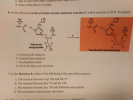 C. Asp 52 acts more likely a general cid d. None of the above is correct. 8. In the following serine protease enzyme-substrate reaction 1, which reaction is NOT included? His His Asp 102 Asp (102 57 57 CH2 CH2 Hас- H2C Ser Ser N1 (195 (195 CH2 CH2 Substrate polypeptide Tetrahedral intermediate a. General acid catalysis. b. General base catalysis. c. Nucleophilic attack. d. All of the above are involved. 9. In the Question 8, which of the following...
Some bacteria can excrete a toxin that breaks down sphingomyelin in mammalian erythrocytes, causing those red...
Some bacteria can excrete a toxin that breaks down sphingomyelin in mammalian erythrocytes, causing those red blood cells to lyse. Examination of the toxin showed it to be an enzyme that could break the phosphoester bond between sphingosine and phosphocholine (ie. the products are ceramide and phosphocholine). The mechanism of the reaction is as follows: The active site of the enzyme contains three critical residues—histidine 296, glutamate 53 and histidine 151. The glu positions a Mg+2 ion near the phosphate....
7. Lysozyme has two key catalytic residues, Glu 35 with a pKa of 5.9 and Asp...
 7. Lysozyme has two key catalytic residues, Glu 35 with a pKa of 5.9 and Asp 52 with a pKa of 4.5. If the pH optimum for this enzyme is 5.0, what does this tell you about the mechanism? a. Glu 35 acts more likely a general acid than Asp 52. b. Glu 35 acts more likely a general base than Asp 52. c. Asp 52 acts more likely a general acid than Glu 35. d. None of the above...
(i) The reaction above is purposed to occur in 3 steps. From thelist select the mechanism...
(i) The reaction above is purposed to occur in 3 steps. From thelist select the mechanism description that is associated with theindicated step (assume all steps are in the forward direction). (a) The alkyloxonium ionis protonated as the bromide ion is formed. (b) The bromide ion attacks thecarbocation. (c) The alcoholic oxygen attacks thecarbocation. (d) The alcoholic oxygen is protonated as thebromide ion is formed. (e) A water molecule attacks thecarbocation. (f) A water molecule is formed at the sametime...
Question 1 (1 point) Which of the following best describes glycogen? Question 3 (1 point) All...
 Question 1 (1 point) Which of the following best describes glycogen? Question 3 (1 point) All the protease mechanisms we discussed in class involved formation of a covalent acyl enzyme intermediate. O Alinear polymer of glucose joined by a(1,6) linkages. True False O A polymer of glucose joined by a(1,4) linkages with a(1,6) linkages every 5-10 residues. Question 4 (1 point) O A polymer of glucose joined by B(1,4) linkages with a(1,6) linkages every 5-10 residues. In the mechanism of...
Question 1 (1 point) Which of the following best describes glycogen? Question 3 (1 point) All...
 Question 1 (1 point) Which of the following best describes glycogen? Question 3 (1 point) All the protease mechanisms we discussed in class involved formation of a covalent acyl enzyme intermediate. O Alinear polymer of glucose joined by a(1,6) linkages. True False O A polymer of glucose joined by a(1,4) linkages with a(1,6) linkages every 5-10 residues. Question 4 (1 point) O A polymer of glucose joined by B(1,4) linkages with a(1,6) linkages every 5-10 residues. In the mechanism of...
Please fill in the blanks! Shown below is a proposed mechanism for the cleavage of sialic...
 Please fill in the blanks!
Shown below is a proposed mechanism for the cleavage of sialic acid by the viral enzyme neuraminidase. The kcat for the wild-type enzyme at pH 6.15,37 °C is 26.8s- Y409) Y409) (D149) (D149) онон ﹀R374-1st Step -ROH R' C-N R374 (E117) (E117) +H2O ↓ 2nd Step Y409) Y409) (D149) 8 ,0149 D149) OH OH H2N R374 (E117) (E117) Part A Describe the roles of the following amino acids in the catalytic mechanism: Glul17, Tyr409, and...
Please fill in the blanks!
Shown below is a proposed mechanism for the cleavage of sialic acid by the viral enzyme neuraminidase. The kcat for the wild-type enzyme at pH 6.15,37 °C is 26.8s- Y409) Y409) (D149) (D149) онон ﹀R374-1st Step -ROH R' C-N R374 (E117) (E117) +H2O ↓ 2nd Step Y409) Y409) (D149) 8 ,0149 D149) OH OH H2N R374 (E117) (E117) Part A Describe the roles of the following amino acids in the catalytic mechanism: Glul17, Tyr409, and...
the room 1, the steps from I lol is the rate limiting step S. In a...
 the room 1, the steps from I lol is the rate limiting step S. In a carbonic anhydrase reaction, which type(s) of catalytic mechanism(s) listed below is/are used? 7 Im-Zn20 S-E Im -H20 a. General acid/base. b. Covalent. c. Both d. None of the above. + H + H-0- Im-Zn2+0 Im H 6. Which of the following about enzyme reaction is INCORRECT? a. Acid-base reactions are sensitive to pH, since the ionization state of amino acid residues can be affected...
 C. Asp 52 acts more likely a general cid d. None of the above is correct. 8. In the following serine protease enzyme-substrate reaction 1, which reaction is NOT included? His His Asp 102 Asp (102 57 57 CH2 CH2 Hас- H2C Ser Ser N1 (195 (195 CH2 CH2 Substrate polypeptide Tetrahedral intermediate a. General acid catalysis. b. General base catalysis. c. Nucleophilic attack. d. All of the above are involved. 9. In the Question 8, which of the following...
 7. Lysozyme has two key catalytic residues, Glu 35 with a pKa of 5.9 and Asp 52 with a pKa of 4.5. If the pH optimum for this enzyme is 5.0, what does this tell you about the mechanism? a. Glu 35 acts more likely a general acid than Asp 52. b. Glu 35 acts more likely a general base than Asp 52. c. Asp 52 acts more likely a general acid than Glu 35. d. None of the above...
 Question 1 (1 point) Which of the following best describes glycogen? Question 3 (1 point) All the protease mechanisms we discussed in class involved formation of a covalent acyl enzyme intermediate. O Alinear polymer of glucose joined by a(1,6) linkages. True False O A polymer of glucose joined by a(1,4) linkages with a(1,6) linkages every 5-10 residues. Question 4 (1 point) O A polymer of glucose joined by B(1,4) linkages with a(1,6) linkages every 5-10 residues. In the mechanism of...
 Question 1 (1 point) Which of the following best describes glycogen? Question 3 (1 point) All the protease mechanisms we discussed in class involved formation of a covalent acyl enzyme intermediate. O Alinear polymer of glucose joined by a(1,6) linkages. True False O A polymer of glucose joined by a(1,4) linkages with a(1,6) linkages every 5-10 residues. Question 4 (1 point) O A polymer of glucose joined by B(1,4) linkages with a(1,6) linkages every 5-10 residues. In the mechanism of...
 Please fill in the blanks!
Shown below is a proposed mechanism for the cleavage of sialic acid by the viral enzyme neuraminidase. The kcat for the wild-type enzyme at pH 6.15,37 °C is 26.8s- Y409) Y409) (D149) (D149) онон ﹀R374-1st Step -ROH R' C-N R374 (E117) (E117) +H2O ↓ 2nd Step Y409) Y409) (D149) 8 ,0149 D149) OH OH H2N R374 (E117) (E117) Part A Describe the roles of the following amino acids in the catalytic mechanism: Glul17, Tyr409, and...
Please fill in the blanks!
Shown below is a proposed mechanism for the cleavage of sialic acid by the viral enzyme neuraminidase. The kcat for the wild-type enzyme at pH 6.15,37 °C is 26.8s- Y409) Y409) (D149) (D149) онон ﹀R374-1st Step -ROH R' C-N R374 (E117) (E117) +H2O ↓ 2nd Step Y409) Y409) (D149) 8 ,0149 D149) OH OH H2N R374 (E117) (E117) Part A Describe the roles of the following amino acids in the catalytic mechanism: Glul17, Tyr409, and...
 the room 1, the steps from I lol is the rate limiting step S. In a carbonic anhydrase reaction, which type(s) of catalytic mechanism(s) listed below is/are used? 7 Im-Zn20 S-E Im -H20 a. General acid/base. b. Covalent. c. Both d. None of the above. + H + H-0- Im-Zn2+0 Im H 6. Which of the following about enzyme reaction is INCORRECT? a. Acid-base reactions are sensitive to pH, since the ionization state of amino acid residues can be affected...
Most questions answered within 3 hours.
-
Where is the error in this code sequence?
String s1 = "Hello";
String s2 = "ello";...
asked 11 months ago -
Financial data for Joel de Paris, Inc., for last year
follow:
Joel de Paris, Inc.
Balance...
asked 11 months ago -
Consider this reaction:
Al2(SO4)3 (aq)+ BaCl3
(aq) Al2Cl6 (aq)- +
3BaSO4(s) . What is the...
asked 11 months ago -
Suppose that Savneet is considering increasing her
recent random sample from 20 car rentals to 40...
asked 11 months ago -
Trucks arrive at an unloading terminal at an average rate of 120
per hour.
Trucks arrive...
asked 11 months ago -
Why are methanol and ethanol completely soluble in water while
octanol is not very little soluble....
asked 11 months ago -
A facilities manager at a university reads in a research report
that the mean amount of...
asked 11 months ago -
When the CuSO4 is rehydrated by adding water to the anhydrous
compound, is this an endothermic...
asked 11 months ago -
A ray of sunlight is passing from diamond into crown glass; the
angle of incidence is...
asked 11 months ago -
A block of mass 0.249 kg is placed on top of a light, vertical
spring of...
asked 11 months ago -
how do the kidneys compensate in the presences of acidosis
a) trigger hyperventilate
b) reserve acid...
asked 11 months ago -
Question 501 pts
The rental rate of capital to the firm increases. Which of the
following...
asked 11 months ago