Discuss advertising to children, labeling of GMF products and the Consumer Financial Protection Board. Answer a...
Discuss advertising to children, labeling of GMF products and the Consumer Financial Protection Board. Answer a paragraph each and please cite.
Homework Answers
Advertising to children:
Children experience advertising in many forms – on TV, YouTube, apps, radio, billboards, magazines, newspapers, movies, the internet, games, text messages, social media and more. And advertising works on children. For example, the more TV a child watches, the more toys that child is likely to want and ask for. This is why it’s important for children to learn that advertisements are trying to make you buy something. Ads are trying to influence the way you think or change your mind about something. And advertisers always aim to make their products look good, perhaps even better than they really are. Advertising affects children in different ways. How children react to advertising can depend on several things, including their age, what they know or have experienced, and how much opportunity they’ve had to question and talk about what they see in the media. At 0-2 years, children can’t tell the difference between advertising and actual programs. And at 3-6 years, children: can identify advertisements and distinguish them from programs, but they don’t understand that ads are trying to sell something, tend to think of advertisements as being entertaining or helpful announcements and won’t generally be critical of the claims advertisers are making. You can limit the effects of advertising on your young child by limiting the amount of commercial TV or YouTube she watches. At 7-11 years, children can understand that advertisements are trying to sell them something, can remember advertising messages, can recognise some advertising techniques like advertisements overstating how good products are, can’t always defend themselves by questioning what advertisements are doing, might not always understand that products aren’t as good as advertisements say they are, or that advertisers might not be telling them any of the bad points. To limit the effects of advertising on school-age children, the most important thing you can do is talk about advertisements and encourage children to think about what they’re trying to do. It’s a good idea to focus on the advertisements that your child sees most often. For example, you can get your child thinking and developing a questioning attitude towards advertisers’ claims by asking him to think about what’s being advertised. That is, what’s the product in this advertisement? What is it for? Who is it for? You can also ask your child about the strategies that are being used to sell a particular product. This can help your child work out how an advertisement makes its product look good.
Labeling of GMF products :
The term “genetically modified foods” (GMF) to refer to those foods derived through the modern processes of genetic modification. The presence of GM foods and food ingredients in our diet is widespread. According to some reports, products ranging from infant formula to granola bars; and from hot dogs, soy burgers and taco shells to dog food and McDonald’s Veggie Burgers contain ingredients produced using modern biotechnology. In recent times, and especially during the last ten years, the Food and Drug Administration (FDA) has been called upon to exercise its regulatory authority with regard to both the approval and the labeling of genetically modified food products, regardless of the soundness of not requiring mandatory labeling of GMF as a class , and only permitting it voluntarily (with further restrictions to those opting for voluntary negative labeling): (1) the FDA was arguably correct in interpreting that it lacks the statutory authority to require mandatory labeling of GMF only once it had assumed the position that GMFs are, from a scientific standpoint, equivalent to regular non-GM food and; (2) whether in some instances an intermediate labeling approach could have been achieved by the FDA even within the existing statutory framework (i.e. through ingredient labeling and the requirement that non-standardized food bear its common or usual name). This could have arguably accommodated both consumer’s interest in knowing the source of the food ingested, and legitimate concerns about misleading the public with fear-triggering broad terms such as “genetically modified food” .
Several statutory sections address the labeling requirements under the FD&C Act. Principally, under section 403(a), 21 U.S.C.A. § 343(a), a food is determined to be misbranded , and therefore prohibited, if its label is “false or misleading in any particular”. In general, not only does the FD&C Act prohibit certain types of representations to be made in the label; it also requires the affirmative disclosure of certain information that it deems valuable. On the other hand, and more relevant to the GMF labeling issue, the FD&C Act affirmatively requires the disclosure of five central pieces of information, for which it authorizes the FDA to require mandatory labeling. These required statements are: (1) the statement of identity, or common or usual name of the food;(2) the list of ingredients; (3) the name and place of business of the manufacturer, packer or distributor of the food; (4) an accurate statement of the quantity of contents and; (5) nutrition information. The law states that required label information must be conspicuously displayed, in terms that the ordinary consumer is likely to read and understand under ordinary conditions of purchase and use.
References :
- The Tomato and Milk Cases
1. The kanr gene and the APH(3')II Enzyme: The Ingredient Problem
2. Recombinant Bovine Somatotropin: Material Facts and Constitutional Issues
The labeling of GMFs, whether mandatory or voluntary, will continue to be a controversial issue for years to come. The United States, the main producer and exporter of this technology, will have to maintain some regulatory flexibility to be able to respond to industry pressures, consumer concerns, and a technology in constant flux. But as was discussed in the first sections of this paper, it seems that the U.S. has to a certain degree closed the door on more aggressive labeling options, like those adopted and/or proposed in Europe. Indeed, it would seem that for the U.S. to require mandatory labeling of GMFs it would require a reworking of the framework that has been chosen to deal with these biotechnologies, possibly at a legislative level. This does not mean, however, that the FDA (the agency most directly involved with labeling requirements) does not maintain a certain degree of discretion to modify, if it deems necessary, the existing scheme. This has been recently evidenced by its current efforts to respond to consumer’s demand for transparency in the approval and marketing of genetically modified foods.
The Consumer Financial Protection Board (Answer is in relation to The Consumer Financial Protection Bureau (CFPB))
The Consumer Financial Protection Bureau (CFPB) is a regulatory agency charged with overseeing financial products and services that are offered to consumers. The CFPB is divided into several units: research, community affairs, consumer complaints, the Office of Fair Lending, and the Office of Financial Opportunity. These units work together to protect and educate consumers about the various types of financial products and services that are available. The Consumer Financial Protection Bureau (CFPB) was created by the Dodd-Frank Wall Street Reform and Consumer Protection Act of 2010. The CFPB is headed by a chief who is appointed by the President for a five-year term. The bureau is also assisted by a Consumer Advisory Council, which is composed of at least six members who are recommended by regional Federal Reserve presidents.Specifically, the CFPB helps consumer finance markets work more efficiently by providing rules, enforcing those rules and empowering consumers to take control of their personal financial lives. The CFPB works to educate and inform consumers against abusive financial practices, to supervise banks and other financial institutions, and to study data to better understand consumers and the financial markets they participate in. The overall aim of the CFPB is to facilitate the development of the consumer finance marketplace. Through this, consumers have access to transparent financial prices and risk and become aware of deceptive and abusive financial practices. The CFPB breaks down this high-level aim into four very specific strategic goals. The first goal is to prevent financial harm to consumers while promoting good financial practices. The second goal is to empower consumers to live better economic lives. The third goal is to inform the public and policymakers with data-driven analytical insights. The fourth and final goal is to further advance the CFPB's overall impact by maximizing resource productivity.
In addition to these high-level goals, the CFPB also provides financial guidance for private individuals. Student financial guides are provided for parents and students who will have to pay for college. These guides allow people to compare and contrast the various financial aids available in the market. For those who are far past college, the CFPB also provides informational resources on retirement planning. The organization can help with social security benefits and provides tips specific to the retirement situation of the individual. Finally, the CFPB can help private individuals with homeownership. On the CFPB website, it provides consumers with interest rate help, monthly payment worksheets and a loan comparison tool. For those consumers who need mortgage help, the CFPB also provides counseling on financial hardship.
Add Answer to:
Discuss advertising to children, labeling of GMF products and
the Consumer Financial Protection Board. Answer a...
In twenty years, which industry sector shows the highest spending on advertising? A) Consumer products. B)...
In twenty years, which industry sector shows the highest spending on advertising? A) Consumer products. B) Financial services. C) Health care. D) Electronics.
Market Survey, Inc. (MSI), specializes in evaluating consumer reactions to new products, services, and advertising campaigns....
 Market Survey, Inc. (MSI), specializes in evaluating consumer reactions to new products, services, and advertising campaigns. A client firm has requested MSI's assistance in ascertaining consumer reaction to a recently marketed household product. During meetings with the client, MSI agreed to conduct door- to- door personal interviews to obtain responses from households with children and households without children. In addition, MSI agreed to conduct both day and evening interviews. Specifically, the client's contract called for MSI to conduct 1000 interviews...
A consumer products company wants to measure the effectiveness of different types of advertising media in...
A consumer products company wants to measure the effectiveness of different types of advertising media in the promotion of its products. Specially, two types of advertising media are to be considered: radio and television advertising and newspaper advertising (including the cost of discount coupons). A sample of 22 cities with approximately equal population is selected for study during a test period of one month. Each city is allocated a specific expenditure level both for radio and television advertising and for newspaper advertising. The...
ASSIGNMENT Answer the following critical thinking questions: 1. Describe the common classifications of receivables. 2. Analyze...
 ASSIGNMENT Answer the following critical thinking questions: 1. Describe the common classifications of receivables. 2. Analyze and explain the use of the three inventory costing methods. 3. Evaluate and discuss how receivables and inventory are reported on the financial statements. Your submission should be a minimum of one page of content in length, answering each question with a substantive paragraph of 4-5 sentences in length. Please type the question as well as your answer. Cite any source utilized in APA...
answer questions! please need help! 1. Discuss three recent consumer behaviors that you have engaged in...
 answer questions! please need help!
1. Discuss three recent consumer behaviors that you have engaged in that could be accurately predicted based on your scores on the Big Five Personality Test. 2. Discuss three recent consumer behaviors that do not align with your scores on the Big Five Personality Test. 3. Overall, do you think your scores on the Big Five Personality Test are predictive of your behaviors as a consumer in the marketplace. Why or why not?
answer questions! please need help!
1. Discuss three recent consumer behaviors that you have engaged in that could be accurately predicted based on your scores on the Big Five Personality Test. 2. Discuss three recent consumer behaviors that do not align with your scores on the Big Five Personality Test. 3. Overall, do you think your scores on the Big Five Personality Test are predictive of your behaviors as a consumer in the marketplace. Why or why not?
Hi can anyone answer to this discussion board and please cite one website in APA that...
 Hi can anyone answer to this discussion board and please cite
one website in APA that u get the information from. Please 300
words.
Energy Drinks What do energy drinks do to the body? o How much is too much? Should the use of energy drinks be regulated? . Should children be allowed to drink energy drinks? Pregnant women? The elderly? To earn any points for this discussion, you must post your original discussion of at least 300 words, and...
Hi can anyone answer to this discussion board and please cite
one website in APA that u get the information from. Please 300
words.
Energy Drinks What do energy drinks do to the body? o How much is too much? Should the use of energy drinks be regulated? . Should children be allowed to drink energy drinks? Pregnant women? The elderly? To earn any points for this discussion, you must post your original discussion of at least 300 words, and...
Two large diversified consumer products firms (Firm A and Firm B) are about to enter the...
Two large diversified consumer products firms (Firm A and Firm B) are about to enter the market for a new pain reliever. The two firms are very similar in terms of their costs, strategic approach, and market outlook. The market demand curve for the pain reliever is given as: P = 2 – 0.000625Q where Q = QA + QB Both firms have the same constant marginal costs of production MCA = MCB = $0.50 per bottle; and fixed costs...
Clestra Corporation is a manufacturer of consumer products ranging from canned and packaged foods like spaghetti...
Clestra Corporation is a manufacturer of consumer products ranging from canned and packaged foods like spaghetti sauce and popcorn to over-the-counter health aids like toothpaste and mouthwash. Its annual worldwide revenues are just under $6 billion. Clestra brands are not among the top two in the industry in any of its product lines, each brand ranking from fourth to sixth in annual sales in countries in which it markets its products. Clestra's CEO has been discussing the company's future with its consultant,...
Can u please answer to this discussion board for me?? 46 46 Module Two discussion topic...
 Can u please answer to this discussion board for me??
46 46 Module Two discussion topic It seems like everyday a new anti-depressant is put on the market. So here are the questions for this discussion. Do we need so many anti-depressants? Can patients become addicted to them? Are they helpful? How do they work? What are some patient safety concerns when a patient starts an anti-depressant? Are there situations where patients are put on anti-depressants when it's not necessary...
Can u please answer to this discussion board for me??
46 46 Module Two discussion topic It seems like everyday a new anti-depressant is put on the market. So here are the questions for this discussion. Do we need so many anti-depressants? Can patients become addicted to them? Are they helpful? How do they work? What are some patient safety concerns when a patient starts an anti-depressant? Are there situations where patients are put on anti-depressants when it's not necessary...
The table (pictured) shows key financial data for three firms that compete in the consumer products...
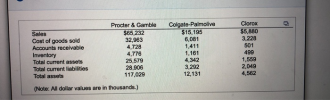 The
table (pictured) shows key financial data for three firms that
compete in the consumer products market: Proctor & Gamble,
Colgate-Palmolive, and Clorox.
a. Calculate EACH of the following ratios for ALL three
companies: current ratio, quick ratio, inventory turnover, average
collection period, total asset turnover.
b. What company is in the position of having greatest
liquidity?
c. Would you say that the three companies exhibit similar
performance or quite different performances in terms of collecting
receivables? Why do you...
The
table (pictured) shows key financial data for three firms that
compete in the consumer products market: Proctor & Gamble,
Colgate-Palmolive, and Clorox.
a. Calculate EACH of the following ratios for ALL three
companies: current ratio, quick ratio, inventory turnover, average
collection period, total asset turnover.
b. What company is in the position of having greatest
liquidity?
c. Would you say that the three companies exhibit similar
performance or quite different performances in terms of collecting
receivables? Why do you...
 Market Survey, Inc. (MSI), specializes in evaluating consumer reactions to new products, services, and advertising campaigns. A client firm has requested MSI's assistance in ascertaining consumer reaction to a recently marketed household product. During meetings with the client, MSI agreed to conduct door- to- door personal interviews to obtain responses from households with children and households without children. In addition, MSI agreed to conduct both day and evening interviews. Specifically, the client's contract called for MSI to conduct 1000 interviews...
 ASSIGNMENT Answer the following critical thinking questions: 1. Describe the common classifications of receivables. 2. Analyze and explain the use of the three inventory costing methods. 3. Evaluate and discuss how receivables and inventory are reported on the financial statements. Your submission should be a minimum of one page of content in length, answering each question with a substantive paragraph of 4-5 sentences in length. Please type the question as well as your answer. Cite any source utilized in APA...
 answer questions! please need help!
1. Discuss three recent consumer behaviors that you have engaged in that could be accurately predicted based on your scores on the Big Five Personality Test. 2. Discuss three recent consumer behaviors that do not align with your scores on the Big Five Personality Test. 3. Overall, do you think your scores on the Big Five Personality Test are predictive of your behaviors as a consumer in the marketplace. Why or why not?
answer questions! please need help!
1. Discuss three recent consumer behaviors that you have engaged in that could be accurately predicted based on your scores on the Big Five Personality Test. 2. Discuss three recent consumer behaviors that do not align with your scores on the Big Five Personality Test. 3. Overall, do you think your scores on the Big Five Personality Test are predictive of your behaviors as a consumer in the marketplace. Why or why not?
 Hi can anyone answer to this discussion board and please cite
one website in APA that u get the information from. Please 300
words.
Energy Drinks What do energy drinks do to the body? o How much is too much? Should the use of energy drinks be regulated? . Should children be allowed to drink energy drinks? Pregnant women? The elderly? To earn any points for this discussion, you must post your original discussion of at least 300 words, and...
Hi can anyone answer to this discussion board and please cite
one website in APA that u get the information from. Please 300
words.
Energy Drinks What do energy drinks do to the body? o How much is too much? Should the use of energy drinks be regulated? . Should children be allowed to drink energy drinks? Pregnant women? The elderly? To earn any points for this discussion, you must post your original discussion of at least 300 words, and...
 Can u please answer to this discussion board for me??
46 46 Module Two discussion topic It seems like everyday a new anti-depressant is put on the market. So here are the questions for this discussion. Do we need so many anti-depressants? Can patients become addicted to them? Are they helpful? How do they work? What are some patient safety concerns when a patient starts an anti-depressant? Are there situations where patients are put on anti-depressants when it's not necessary...
Can u please answer to this discussion board for me??
46 46 Module Two discussion topic It seems like everyday a new anti-depressant is put on the market. So here are the questions for this discussion. Do we need so many anti-depressants? Can patients become addicted to them? Are they helpful? How do they work? What are some patient safety concerns when a patient starts an anti-depressant? Are there situations where patients are put on anti-depressants when it's not necessary...
 The
table (pictured) shows key financial data for three firms that
compete in the consumer products market: Proctor & Gamble,
Colgate-Palmolive, and Clorox.
a. Calculate EACH of the following ratios for ALL three
companies: current ratio, quick ratio, inventory turnover, average
collection period, total asset turnover.
b. What company is in the position of having greatest
liquidity?
c. Would you say that the three companies exhibit similar
performance or quite different performances in terms of collecting
receivables? Why do you...
The
table (pictured) shows key financial data for three firms that
compete in the consumer products market: Proctor & Gamble,
Colgate-Palmolive, and Clorox.
a. Calculate EACH of the following ratios for ALL three
companies: current ratio, quick ratio, inventory turnover, average
collection period, total asset turnover.
b. What company is in the position of having greatest
liquidity?
c. Would you say that the three companies exhibit similar
performance or quite different performances in terms of collecting
receivables? Why do you...
Most questions answered within 3 hours.
-
Where is the error in this code sequence?
String s1 = "Hello";
String s2 = "ello";...
asked 11 months ago -
Financial data for Joel de Paris, Inc., for last year
follow:
Joel de Paris, Inc.
Balance...
asked 11 months ago -
Consider this reaction:
Al2(SO4)3 (aq)+ BaCl3
(aq) Al2Cl6 (aq)- +
3BaSO4(s) . What is the...
asked 11 months ago -
Suppose that Savneet is considering increasing her
recent random sample from 20 car rentals to 40...
asked 11 months ago -
Trucks arrive at an unloading terminal at an average rate of 120
per hour.
Trucks arrive...
asked 11 months ago -
Why are methanol and ethanol completely soluble in water while
octanol is not very little soluble....
asked 11 months ago -
A facilities manager at a university reads in a research report
that the mean amount of...
asked 11 months ago -
When the CuSO4 is rehydrated by adding water to the anhydrous
compound, is this an endothermic...
asked 11 months ago -
A ray of sunlight is passing from diamond into crown glass; the
angle of incidence is...
asked 11 months ago -
A block of mass 0.249 kg is placed on top of a light, vertical
spring of...
asked 11 months ago -
how do the kidneys compensate in the presences of acidosis
a) trigger hyperventilate
b) reserve acid...
asked 11 months ago -
Question 501 pts
The rental rate of capital to the firm increases. Which of the
following...
asked 11 months ago