Describe MOSFIT switching Mechanism, types, characteristics, Applications with neat diagrams. You can collect the details from...
Homework Answers
MOSFET stands for Metal-oxide-semiconductor field-effect transistor. It is a field-effect transistor (FET with an insulated gate) where the voltage at gate determines its conductivity. It is a voltage controlled device and requires only a small input current.
TYPES AND SWITCHING MECHANISM
Two types of MOSFETs are (1) depletion MOSFETs and (2) enhancements MOSFETs
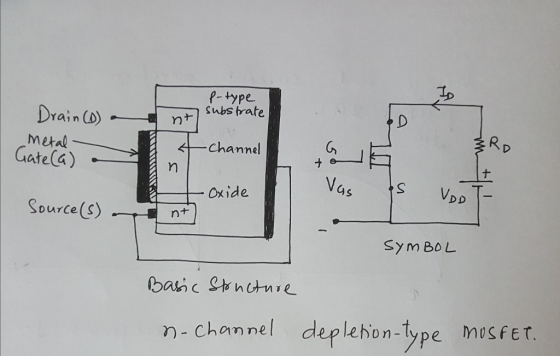
An n-channel depletion-type MOSFET is formed on a p-type silicone substrate as shown in the figure, with two heavily doped n+ silicon for very low resistance connections. The gate is isolated n channel by a thin layer of of oxide. The substrate is normally connected to the source and so it is three terminal device i.e., source, gate and drain. If gate-to-source voltage is negative, some of the electrons in the n-channel area are repelled and a depletion region is created below the oxide layer. This results in a narrower effective channel and a high resistance from the drain to source. If the gate-to-source voltage is made high enough (called pinch-off voltage),the channel becomes completely depleted and so no current flows from the drain to source.
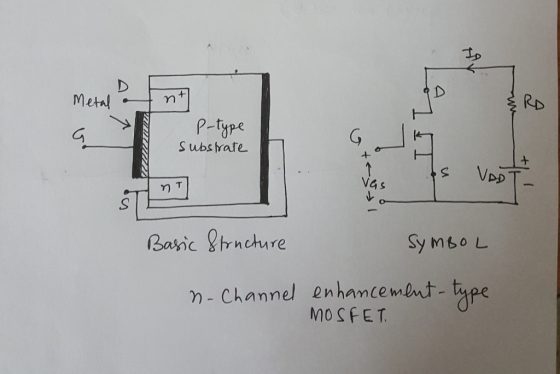
An n-channel enhancement-type MOSFET has no physical channel, as shown in the diagram. If gate-to-source voltage is positive, an induced voltage attracts the electrons from the p-substrate and accumulate them at the surface beneath the oxide layer. If gate-to source voltage is greater than or equal to a value known as threshold voltage (VT), a sufficient number of electrons are accumulated to form a virtual n-channel and the current flows from the drain to source.
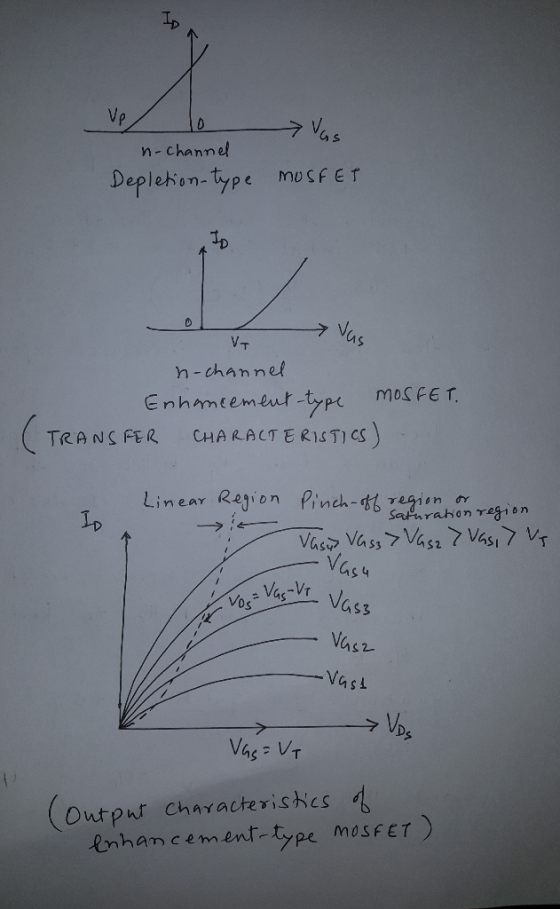
CHARACTERISTICS: There are two type of characteristics of MOSFETs - transfer characteristics and output characteristics as shown below. The transconductance, which is the ratio of drain current to gate voltage, defines the transfer characteristics. This is a very important parameter.
There are three regions of operation as shown in the output characteristics.
1. cutoff region (VGS less than or equal to VT)
2. pinch-off or saturation region ( VDS is more than or equal to VGS - VT). In this region, the drain current remains almost constant for any increase in the value of drain-to-source voltage and the MOSFETs are used in this region for voltage amplification.
3. linear region ( VDS is less than or equal to VGS - VT). In this region, the drain current varies in proportion to the drain-source voltage.
The pinch-off occurs at VDS = VGS - VT
APPLICATIONS
1. AMPLIFIER: It is excellent for amplifier applications because it has very high input impedance and requires almost no input current to control the load current.
2. SWITCHING: It can be used for switching applications because its switching speed is very high and switching timings are of the order of nanoseconds.
For the depletion-type MOSFETs. the gate voltage can be either positive or negative. However, the enhancement-type MOSFETs respond to a positive gate voltage only. The power MOSFETs are generally of the enhancement type.
Similarly, there are p-channel depletion-type and enhancement-type MOSFETs.
Add Answer to:
Describe MOSFIT switching Mechanism, types, characteristics,
Applications with neat diagrams. You can collect the details from...
Describe Power transistor and its switching Mechanism, types, characteristics, Applications with neat diagrams. *I will like...
Describe Power transistor and its switching Mechanism, types, characteristics, Applications with neat diagrams. *I will like the answer, thank you
Compare and contrast the types and applications of oral and visual presentation. Describe which applications you...
Compare and contrast the types and applications of oral and visual presentation. Describe which applications you will be using for your presentation. Discuss why you are choosing these methods, and why they will be best for your audience.
Compare and contrast the types and applications of oral and visual presentation. Describe which applications you will be...
Compare and contrast the types and applications of oral and visual presentation. Describe which applications you will be using for your presentation. Discuss why you are choosing these methods, and why they will be best for your audience.
Describe any 4 types of messages from SSD and show with diagrams
Describe any 4 types of messages from SSD and show with diagrams
(2) Discuss in details the different types of corporate strategies how you can relate this to...
 (2) Discuss in details the different types of corporate strategies how you can relate this to Lebanon companies based on the severe economic situation (give examples for each) (350-400)
Types of Clusterings. Each of the following parts describes a collection of groups. Describe each of these groups in terms of the characteristics Types of Clusterings. Each of the following parts desc...
Types of Clusterings. Each of the following parts describes a collection of groups. Describe each of these groups in terms of the characteristics Types of Clusterings. Each of the following parts describes a collection of groups. Describe each of these groups in terms of the characteristics that we applied to sets of clusters. Specifically, classify the groups as to what Types of Clusterings. Each of the following parts describes a collection of groups. Describe each of these groups in terms...
Can you please explain ( in words) the mechanism of the above scheme in details. .CN...
 Can you please explain ( in words) the mechanism of the above
scheme in details.
.CN CI N. N S CI CN then H20 HN N CI DDQ CI ОН Li S CI CN n-Bu-Li CN CI ОН N. CI I-
Can you please explain ( in words) the mechanism of the above
scheme in details.
.CN CI N. N S CI CN then H20 HN N CI DDQ CI ОН Li S CI CN n-Bu-Li CN CI ОН N. CI I-
hai can anyone help me on this question QUESTION 3 [30 Marks] a) After a part...
 hai can anyone help me on this question
QUESTION 3 [30 Marks] a) After a part is manufactured, some of its surfaces may require surface treatments in order to improve its properties and characteristics. State five methods that can be done in case hardening process for a metal. Describe in details one of case hardening process with the aid of schematic diagram of the process chosen. (15 Marks) b) One of the surface treatment method is physical vapour deposition (PVD)...
hai can anyone help me on this question
QUESTION 3 [30 Marks] a) After a part is manufactured, some of its surfaces may require surface treatments in order to improve its properties and characteristics. State five methods that can be done in case hardening process for a metal. Describe in details one of case hardening process with the aid of schematic diagram of the process chosen. (15 Marks) b) One of the surface treatment method is physical vapour deposition (PVD)...
describe how much ATP can be produced from one glucose molecule. include details?
describe how much ATP can be produced from one glucose molecule. include details?
5. Briefly describe the four types of business structures that can be used to organize agribusinesses...
 5. Briefly describe the four types of business structures that can be used to organize agribusinesses and farms. List the similarities and differences of the structures. Notes on Exercise 1: The exercise is to be completed in Microsoft Word. Use "Insert, Shapes" to draw the line diagrams. You can use a table to answer question 4. 4. Draw a line diagram to show reaction functions for two firms operating in an oligopolistic market with products that differ mostly due to...
 (2) Discuss in details the different types of corporate strategies how you can relate this to Lebanon companies based on the severe economic situation (give examples for each) (350-400)
 Can you please explain ( in words) the mechanism of the above
scheme in details.
.CN CI N. N S CI CN then H20 HN N CI DDQ CI ОН Li S CI CN n-Bu-Li CN CI ОН N. CI I-
Can you please explain ( in words) the mechanism of the above
scheme in details.
.CN CI N. N S CI CN then H20 HN N CI DDQ CI ОН Li S CI CN n-Bu-Li CN CI ОН N. CI I-
 hai can anyone help me on this question
QUESTION 3 [30 Marks] a) After a part is manufactured, some of its surfaces may require surface treatments in order to improve its properties and characteristics. State five methods that can be done in case hardening process for a metal. Describe in details one of case hardening process with the aid of schematic diagram of the process chosen. (15 Marks) b) One of the surface treatment method is physical vapour deposition (PVD)...
hai can anyone help me on this question
QUESTION 3 [30 Marks] a) After a part is manufactured, some of its surfaces may require surface treatments in order to improve its properties and characteristics. State five methods that can be done in case hardening process for a metal. Describe in details one of case hardening process with the aid of schematic diagram of the process chosen. (15 Marks) b) One of the surface treatment method is physical vapour deposition (PVD)...
 5. Briefly describe the four types of business structures that can be used to organize agribusinesses and farms. List the similarities and differences of the structures. Notes on Exercise 1: The exercise is to be completed in Microsoft Word. Use "Insert, Shapes" to draw the line diagrams. You can use a table to answer question 4. 4. Draw a line diagram to show reaction functions for two firms operating in an oligopolistic market with products that differ mostly due to...
Most questions answered within 3 hours.
-
Where is the error in this code sequence?
String s1 = "Hello";
String s2 = "ello";...
asked 10 months ago -
Financial data for Joel de Paris, Inc., for last year
follow:
Joel de Paris, Inc.
Balance...
asked 10 months ago -
Consider this reaction:
Al2(SO4)3 (aq)+ BaCl3
(aq) Al2Cl6 (aq)- +
3BaSO4(s) . What is the...
asked 10 months ago -
Suppose that Savneet is considering increasing her
recent random sample from 20 car rentals to 40...
asked 10 months ago -
Trucks arrive at an unloading terminal at an average rate of 120
per hour.
Trucks arrive...
asked 10 months ago -
Why are methanol and ethanol completely soluble in water while
octanol is not very little soluble....
asked 10 months ago -
A facilities manager at a university reads in a research report
that the mean amount of...
asked 10 months ago -
When the CuSO4 is rehydrated by adding water to the anhydrous
compound, is this an endothermic...
asked 10 months ago -
A ray of sunlight is passing from diamond into crown glass; the
angle of incidence is...
asked 10 months ago -
A block of mass 0.249 kg is placed on top of a light, vertical
spring of...
asked 10 months ago -
how do the kidneys compensate in the presences of acidosis
a) trigger hyperventilate
b) reserve acid...
asked 10 months ago -
Question 501 pts
The rental rate of capital to the firm increases. Which of the
following...
asked 10 months ago