Consider the following data drawn independently from normally distributed populations: (You may find it useful to...
Consider the following data drawn independently from normally
distributed populations: (You may find it useful to
reference the appropriate table: z table
or t table)
| x−1x−1 = 29.5 | x−2x−2 = 34.3 |
| σ12 = 88.4 | σ22 = 92.5 |
| n1 = 28 | n2 = 26 |
a. Construct the 95% confidence interval for the
difference between the population means.
(Negative values should be indicated by a
minus sign. Round all intermediate calculations to at least 4
decimal places and final answers to 2 decimal
places.)
b. Specify the competing hypotheses in order to
determine whether or not the population means differ.
-
H0: μ1 − μ2 = 0; HA: μ1 − μ2 ≠ 0
-
H0: μ1 − μ2 ≥ 0; HA: μ1 − μ2 < 0
-
H0: μ1 − μ2 ≤ 0; HA: μ1 − μ2 > 0
c. Using the confidence interval from part a, can
you reject the null hypothesis?
-
Yes, since the confidence interval does not include the hypothesized value of 0.
-
No, since the confidence interval includes the hypothesized value of 0.
-
Yes, since the confidence interval includes the hypothesized value of 0.
-
No, since the confidence interval does not include the hypothesized value of 0.
d. Interpret the results at αα = 0.05.
-
We conclude that the population means differ.
-
We cannot conclude that the population means differ.
-
We conclude that population mean 2 is greater than population mean 1.
-
We cannot conclude that population mean 2 is greater than population mean 1.
Homework Answers
Part a)
Confidence interval :-


Lower Limit = 
Lower Limit = -9.8788
Upper Limit = 
Upper Limit = 0.2788
Confidence interval is ( -9.8788 , 0.2788 )
Part b)
H0: μ1 − μ2 = 0; HA: μ1 − μ2 ≠ 0
Part c)
No, since the confidence interval includes the hypothesized value of 0.
Part d)
We cannot conclude that the population means differ.
Add Answer to:
Consider the following data drawn independently from normally
distributed populations: (You may find it useful to...
Consider the following data drawn independently from normally distributed populations: (You may find it useful to...
Consider the following data drawn independently from normally distributed populations: (You may find it useful to reference the appropriate table: z table or t table) x−1x−1 = 27.7 x−2x−2 = 30.1 σ12 = 92.8 σ22 = 87.5 n1 = 24 n2 = 33 a. Construct the 99% confidence interval for the difference between the population means. (Negative values should be indicated by a minus sign. Round all intermediate calculations to at least 4 decimal places and final answers to 2...
Consider the following data drawn independently from normally distributed populations: (You may find it useful to...
 Consider the following data drawn independently from normally distributed populations: (You may find it useful to reference the appropriate table: z table or t table) X1 = 27.1 012 = 89.5 n1 = 25 X2 = 30.3 022 = 92.3 n2 = 31 a. Construct the 90% confidence interval for the difference between the population means. (Negative values should be indicated by a minus sign. Round all intermediate calculations to at least 4 decimal places and final answers to 2...
Consider the following data drawn independently from normally distributed populations: (You may find it useful to...
 Consider the following data drawn independently from normally distributed populations: (You may find it useful to reference the appropriate table: z table or t table) 21 = 29.8 012 - 95.3 nu = 34 22 = 32.4 oz? = 91.6 ng = 29 a. Construct the 99% confidence interval for the difference between the population means. (Negative values should be indicated by a minus sign. Round all intermediate calculations to at least 4 decimal places and final answers to 2...
Consider the following competing hypotheses and accompanying sample data drawn independently from normally distributed populations. (You may find it useful to reference the appropriate table: z table or t table)
 Consider the following competing hypotheses and accompanying sample data drawn independently from normally distributed populations. (You may find it useful to reference the appropriate table: z table or t table) H0: μ1 − μ2 ≥ 0HA: μ1 − μ2 < 0 x¯1x¯1= 249x−2x−2= 262s1 = 35s2 = 23n1 = 10n2 = 10a-1. Calculate the value of the test statistic under the assumption that the population variances are equal. (Negative values should be indicated by a minus sign. Round all intermediate calculations to at least 4 decimal places and final answer to 3 decimal places.) a-2. Find the p-value. multiple choice 1p-value < 0.010.01 ≤ p-value...
Consider the following competing hypotheses and accompanying sample data drawn independently from normally distributed populations. (You...
 Consider the following competing hypotheses and accompanying sample data drawn independently from normally distributed populations. (You may find it useful to reference the appropriate table: z table or t table) Ho: H1-Hu2 0 HA: H1 Hz< e 251 252 s1 39 s=19 n1=7 n 7 a-1. Calculate the value of the test statistic under the assumption that the population variances are equal. (Negative values should be indicated by a minus sign. Round all intermediate calculations to at least 4 decimal...
Consider the following data drawn independently from normally distributed populations: (You may find it useful to...
 Consider the following data drawn independently from normally distributed populations: (You may find it useful to reference the appropriate table: z table or t table 31.6x2 26.8 σ12-91.9 σ22-90.0 120 2-26 a. Construct the 99% confidence interval for the difference between the population means Negative values should be indicated b, a minus sign. Round all intermediate calculations to at least 4 decimal places and final answers to 2 decimal places.) Confidence interval is to
Consider the following data drawn independently from normally distributed populations: Use Table 1 X2 30.6 X1...
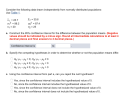 Consider the following data drawn independently from normally distributed populations: Use Table 1 X2 30.6 X1 = 25.7 022 a12 98.2 87.4 n2= 25 n1 20 a. Construct the 95% confidence interval for the difference between the population means. (Negative values should be indicated by a minus sign. Round all intermediate calculations to at least 4 decimal places and final answers to 2 decimal places.) Confidence interval is to b. Specify the competing hypotheses in order to determine whether or...
Consider the following data drawn independently from normally distributed populations: (You may find it useful to...
Consider the following data drawn independently from normally distributed populations: (You may find it useful to reference the appropriate table: z table or t table) x−1x−1 = 32.7 x−2x−2 = 25.4 σ12 = 95.5 σ22 = 91.0 n1 = 16 n2 = 21 a. Construct the 90% confidence interval for the difference between the population means. (Negative values should be indicated by a minus sign. Round all intermediate calculations to at least 4 decimal places and final answers to 2...
Consider the following data drawn independently from normally distributed populations: (You may find it useful to...
Consider the following data drawn independently from normally distributed populations: (You may find it useful to reference the appropriate table: z table or t table) x−1x−1 = 34.3 x−2x−2 = 26.0 σ12 = 89.5 σ22 = 92.8 n1 = 21 n2 = 26 a. Construct the 99% confidence interval for the difference between the population means. (Negative values should be indicated by a minus sign. Round all intermediate calculations to at least 4 decimal places and final answers to 2...
Il = 27.7 2 = 92.8 y = 24 2 = 30.1 0 = 87.5 n2...
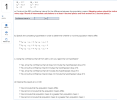 Il = 27.7 2 = 92.8 y = 24 2 = 30.1 0 = 87.5 n2 = 33 a. Construct the 99% confidence interval for the difference between the population means. (Negative values should be indica minus sign. Round all intermediate calculations to at least 4 decimal places and final answers to 2 decimal places.) points Confidence interval is eBook b. Specify the competing hypotheses In order to determine whether or not the population means differ. References He: M1 -...
 Consider the following data drawn independently from normally distributed populations: (You may find it useful to reference the appropriate table: z table or t table) X1 = 27.1 012 = 89.5 n1 = 25 X2 = 30.3 022 = 92.3 n2 = 31 a. Construct the 90% confidence interval for the difference between the population means. (Negative values should be indicated by a minus sign. Round all intermediate calculations to at least 4 decimal places and final answers to 2...
 Consider the following data drawn independently from normally distributed populations: (You may find it useful to reference the appropriate table: z table or t table) 21 = 29.8 012 - 95.3 nu = 34 22 = 32.4 oz? = 91.6 ng = 29 a. Construct the 99% confidence interval for the difference between the population means. (Negative values should be indicated by a minus sign. Round all intermediate calculations to at least 4 decimal places and final answers to 2...
 Consider the following competing hypotheses and accompanying sample data drawn independently from normally distributed populations. (You may find it useful to reference the appropriate table: z table or t table) Ho: H1-Hu2 0 HA: H1 Hz< e 251 252 s1 39 s=19 n1=7 n 7 a-1. Calculate the value of the test statistic under the assumption that the population variances are equal. (Negative values should be indicated by a minus sign. Round all intermediate calculations to at least 4 decimal...
 Consider the following data drawn independently from normally distributed populations: (You may find it useful to reference the appropriate table: z table or t table 31.6x2 26.8 σ12-91.9 σ22-90.0 120 2-26 a. Construct the 99% confidence interval for the difference between the population means Negative values should be indicated b, a minus sign. Round all intermediate calculations to at least 4 decimal places and final answers to 2 decimal places.) Confidence interval is to
 Consider the following data drawn independently from normally distributed populations: Use Table 1 X2 30.6 X1 = 25.7 022 a12 98.2 87.4 n2= 25 n1 20 a. Construct the 95% confidence interval for the difference between the population means. (Negative values should be indicated by a minus sign. Round all intermediate calculations to at least 4 decimal places and final answers to 2 decimal places.) Confidence interval is to b. Specify the competing hypotheses in order to determine whether or...
 Il = 27.7 2 = 92.8 y = 24 2 = 30.1 0 = 87.5 n2 = 33 a. Construct the 99% confidence interval for the difference between the population means. (Negative values should be indica minus sign. Round all intermediate calculations to at least 4 decimal places and final answers to 2 decimal places.) points Confidence interval is eBook b. Specify the competing hypotheses In order to determine whether or not the population means differ. References He: M1 -...
Most questions answered within 3 hours.
-
Where is the error in this code sequence?
String s1 = "Hello";
String s2 = "ello";...
asked 10 months ago -
Financial data for Joel de Paris, Inc., for last year
follow:
Joel de Paris, Inc.
Balance...
asked 10 months ago -
Consider this reaction:
Al2(SO4)3 (aq)+ BaCl3
(aq) Al2Cl6 (aq)- +
3BaSO4(s) . What is the...
asked 10 months ago -
Suppose that Savneet is considering increasing her
recent random sample from 20 car rentals to 40...
asked 10 months ago -
Trucks arrive at an unloading terminal at an average rate of 120
per hour.
Trucks arrive...
asked 10 months ago -
Why are methanol and ethanol completely soluble in water while
octanol is not very little soluble....
asked 10 months ago -
A facilities manager at a university reads in a research report
that the mean amount of...
asked 10 months ago -
When the CuSO4 is rehydrated by adding water to the anhydrous
compound, is this an endothermic...
asked 10 months ago -
A ray of sunlight is passing from diamond into crown glass; the
angle of incidence is...
asked 10 months ago -
A block of mass 0.249 kg is placed on top of a light, vertical
spring of...
asked 10 months ago -
how do the kidneys compensate in the presences of acidosis
a) trigger hyperventilate
b) reserve acid...
asked 10 months ago -
Question 501 pts
The rental rate of capital to the firm increases. Which of the
following...
asked 10 months ago