TLC eluent for benzophenone. I am doing a lab that involved purifying benzophenone that contains traces...
TLC eluent for benzophenone. I am doing a lab that involved purifying benzophenone that contains traces of benzoic acid. I will be dissolving the impure sample of benzophenone with diethyl ether first, then NaOh, then separating the layers. I will then take the organic layer and wash with NaOH again, then wash with water. After recrystallizing the product and drying the product, what will i use as an eluent for the TLC chamber? I am going to run a TLC plate containing the impure starting material, the crude product, and the pure product. What will i use for the eluent and also to dissolve the samples to spot on the plate?
Homework Answers

Add Answer to:
TLC eluent for benzophenone. I am doing a lab that involved
purifying benzophenone that contains traces...
Objective To extract essential oils and other natural products from the leaves of mentha spicata L....
Objective To extract essential oils and other natural products from the leaves of mentha spicata L. . Reactions Not applicable Procedure 1. Weigh 1.0 g of leaves and place them in a glass mortar. Grind the material until a more or less homogenous mass is obtained. Transfer the ground material into a 100 mL beaker, add a stir bar and 10 mL of water and 10 mL of diethyl ether. Cover the beaker with a watch glass and stir vigorously for 10 minutes...
I did Grignard lab in class last week and I took a tlc for it with...
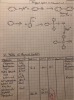 I did Grignard lab in class last week and I took a tlc for it
with the recrystallized product of Triphenylmethanol, the petroleum
ether extract and the crude product. I am trying to understand what
I am supposed to understand from this TLC. below are pictures of my
lab procedures and my TLC plate.
38r H30 Tate of scal contet dl Toxis キlammak lo 104 Flam
I did Grignard lab in class last week and I took a tlc for it
with the recrystallized product of Triphenylmethanol, the petroleum
ether extract and the crude product. I am trying to understand what
I am supposed to understand from this TLC. below are pictures of my
lab procedures and my TLC plate.
38r H30 Tate of scal contet dl Toxis キlammak lo 104 Flam
using pictures and a maximum of 10 words, explain why an oven-dried 5-ml conical vial and...
 using pictures and a maximum of 10 words, explain why an oven-dried
5-ml conical vial and drying tube(step 1 and 2 of part 1) are used
in the reaction. do both please! also the notebook pages are the
procedure
(1) Using pictures and a maximum of 10 words, explain why an oven-dried 5-ml conical vial and drying tube (step 1 and 2 of Part 1) are used in the reaction. (2) After the addition of benzophenone to the mixture of...
using pictures and a maximum of 10 words, explain why an oven-dried
5-ml conical vial and drying tube(step 1 and 2 of part 1) are used
in the reaction. do both please! also the notebook pages are the
procedure
(1) Using pictures and a maximum of 10 words, explain why an oven-dried 5-ml conical vial and drying tube (step 1 and 2 of Part 1) are used in the reaction. (2) After the addition of benzophenone to the mixture of...
Let's assume you have a mixture of equal parts benzoic acid, sand and toluene that are...
Let's assume you have a mixture of equal parts benzoic acid, sand and toluene that are intimately mixed together (the crude material is a mixture of solid and liquid). Propose a procedure to separate these three components using any of the chemicals commonly available (you've used all of the "common" chemicals in the lab by now) in the organic chemistry teaching laboratories and observing the typical limitations with the instruments and techniques (such as not being able to distill or...
Hi can someone help me with my pre lab theory questions (1,2,3) on rate of elution...
 Hi can someone help me with my pre lab theory questions (1,2,3)
on rate of elution or Rf? Here is some background below. Please
help explain as many as possible (1-3)! I dont really get the
relation ships in this lab, thank you!
1. What factors affect the rate of elution in organic compounds? 2. Explain what is the relationship between polarities of compounds (polar/non- polar compound) and rate of elution (Rf). 3. Explain what is the relationship between solvent...
Hi can someone help me with my pre lab theory questions (1,2,3)
on rate of elution or Rf? Here is some background below. Please
help explain as many as possible (1-3)! I dont really get the
relation ships in this lab, thank you!
1. What factors affect the rate of elution in organic compounds? 2. Explain what is the relationship between polarities of compounds (polar/non- polar compound) and rate of elution (Rf). 3. Explain what is the relationship between solvent...
please answer the prelab excercise:) I tried doing it but I did not get very far Experiment 7: Grignard Reactio...
 please answer the prelab excercise:) I tried doing it but I did not
get very far
Experiment 7: Grignard Reaction. Introduction Discovered by French chemist Victor Grignard, the reaction that now bears his name is an example of the preparation of an organometallic reagent. In this lab, phenylmagnesium bromide is the Grignard of interest, and it will be added to an aldehyde to produce an alcohol. Lab Objectives 1. To study organometallic reagents in general. benzophenone. 2. To prepare phenylmagnesium...
please answer the prelab excercise:) I tried doing it but I did not
get very far
Experiment 7: Grignard Reaction. Introduction Discovered by French chemist Victor Grignard, the reaction that now bears his name is an example of the preparation of an organometallic reagent. In this lab, phenylmagnesium bromide is the Grignard of interest, and it will be added to an aldehyde to produce an alcohol. Lab Objectives 1. To study organometallic reagents in general. benzophenone. 2. To prepare phenylmagnesium...
QUESTIONS TO ANSWER: Prepare a table of all chemicals used with the structure and purpose of...
 QUESTIONS TO ANSWER:
Prepare a table of all chemicals used with the structure and
purpose of each.
Calculate the theoretical yield by finding limiting reactant of
the experiment by converting reactants to product (remember to show
all calculations used)
Calculate the percent yield using the limiting reactant
Calculate the Rf for triphenylmethanol. If there are two dots,
determine which one is triphenylmethanol.. ( I did not provide
data. Please let me know how I Would do this if I did)...
QUESTIONS TO ANSWER:
Prepare a table of all chemicals used with the structure and
purpose of each.
Calculate the theoretical yield by finding limiting reactant of
the experiment by converting reactants to product (remember to show
all calculations used)
Calculate the percent yield using the limiting reactant
Calculate the Rf for triphenylmethanol. If there are two dots,
determine which one is triphenylmethanol.. ( I did not provide
data. Please let me know how I Would do this if I did)...
Grignard Reaction with a Ketone: Triphenylmethanol Introduction: The purpose of this lab is to prepare phenylmagnesium...
Grignard Reaction with a Ketone: Triphenylmethanol Introduction: The purpose of this lab is to prepare phenylmagnesium bromide, a Grignard reagent, and react it with benzophenone to give triphenylmethanol. Grignard reagents are very reactive and must be synthesized in an environment free of water or any other source of potential proton donor. Once made, the Grignard reagent will do a nucleophilic attack on the carbonyl carbon of the ketone, benzophenone. The result is an alkoxide that is then protonated to give...
QUESTION: Write a flow scheme for the work-up. THE WORK UP:
 QUESTION:
Write a flow scheme for the work-up.
THE WORK UP:
C. Work-up (save all layers) and Isolation of Product MgBrCl Benzoic acid Transfer the mixture into a test tube. Rinse the beaker with about 3 mL of regular (not anhydrous) diethyl ether and pour the washings into the test tube. There should be two distinct layers in the test tube Remove the aqueous layer (to be discarded) and shake the ether layer with about 2 mL of 3 M...
QUESTION:
Write a flow scheme for the work-up.
THE WORK UP:
C. Work-up (save all layers) and Isolation of Product MgBrCl Benzoic acid Transfer the mixture into a test tube. Rinse the beaker with about 3 mL of regular (not anhydrous) diethyl ether and pour the washings into the test tube. There should be two distinct layers in the test tube Remove the aqueous layer (to be discarded) and shake the ether layer with about 2 mL of 3 M...
Determine the yield limiting reagent and the theoretical yield for the following multistep synthesis from the reaction of ethyl acetoacetate. Draw the chemical complete chemical reaction and mechanism...
Determine the yield limiting reagent and the theoretical yield for the following multistep synthesis from the reaction of ethyl acetoacetate. Draw the chemical complete chemical reaction and mechanism of Product C (determined to be 4-hydroxy-4 4-diphenylbutan-2-one) to Product E provided the procedure below. Procedure Step 4B [Product C to Product E] Place product [C] (0.5 g) in a 50 mL round bottomed flask, add acetone (15 mL), and concentrated HCl (2.5 mL). Boil under reflux on a water bath for...
 I did Grignard lab in class last week and I took a tlc for it
with the recrystallized product of Triphenylmethanol, the petroleum
ether extract and the crude product. I am trying to understand what
I am supposed to understand from this TLC. below are pictures of my
lab procedures and my TLC plate.
38r H30 Tate of scal contet dl Toxis キlammak lo 104 Flam
I did Grignard lab in class last week and I took a tlc for it
with the recrystallized product of Triphenylmethanol, the petroleum
ether extract and the crude product. I am trying to understand what
I am supposed to understand from this TLC. below are pictures of my
lab procedures and my TLC plate.
38r H30 Tate of scal contet dl Toxis キlammak lo 104 Flam
 using pictures and a maximum of 10 words, explain why an oven-dried
5-ml conical vial and drying tube(step 1 and 2 of part 1) are used
in the reaction. do both please! also the notebook pages are the
procedure
(1) Using pictures and a maximum of 10 words, explain why an oven-dried 5-ml conical vial and drying tube (step 1 and 2 of Part 1) are used in the reaction. (2) After the addition of benzophenone to the mixture of...
using pictures and a maximum of 10 words, explain why an oven-dried
5-ml conical vial and drying tube(step 1 and 2 of part 1) are used
in the reaction. do both please! also the notebook pages are the
procedure
(1) Using pictures and a maximum of 10 words, explain why an oven-dried 5-ml conical vial and drying tube (step 1 and 2 of Part 1) are used in the reaction. (2) After the addition of benzophenone to the mixture of...
 Hi can someone help me with my pre lab theory questions (1,2,3)
on rate of elution or Rf? Here is some background below. Please
help explain as many as possible (1-3)! I dont really get the
relation ships in this lab, thank you!
1. What factors affect the rate of elution in organic compounds? 2. Explain what is the relationship between polarities of compounds (polar/non- polar compound) and rate of elution (Rf). 3. Explain what is the relationship between solvent...
Hi can someone help me with my pre lab theory questions (1,2,3)
on rate of elution or Rf? Here is some background below. Please
help explain as many as possible (1-3)! I dont really get the
relation ships in this lab, thank you!
1. What factors affect the rate of elution in organic compounds? 2. Explain what is the relationship between polarities of compounds (polar/non- polar compound) and rate of elution (Rf). 3. Explain what is the relationship between solvent...
 please answer the prelab excercise:) I tried doing it but I did not
get very far
Experiment 7: Grignard Reaction. Introduction Discovered by French chemist Victor Grignard, the reaction that now bears his name is an example of the preparation of an organometallic reagent. In this lab, phenylmagnesium bromide is the Grignard of interest, and it will be added to an aldehyde to produce an alcohol. Lab Objectives 1. To study organometallic reagents in general. benzophenone. 2. To prepare phenylmagnesium...
please answer the prelab excercise:) I tried doing it but I did not
get very far
Experiment 7: Grignard Reaction. Introduction Discovered by French chemist Victor Grignard, the reaction that now bears his name is an example of the preparation of an organometallic reagent. In this lab, phenylmagnesium bromide is the Grignard of interest, and it will be added to an aldehyde to produce an alcohol. Lab Objectives 1. To study organometallic reagents in general. benzophenone. 2. To prepare phenylmagnesium...
 QUESTIONS TO ANSWER:
Prepare a table of all chemicals used with the structure and
purpose of each.
Calculate the theoretical yield by finding limiting reactant of
the experiment by converting reactants to product (remember to show
all calculations used)
Calculate the percent yield using the limiting reactant
Calculate the Rf for triphenylmethanol. If there are two dots,
determine which one is triphenylmethanol.. ( I did not provide
data. Please let me know how I Would do this if I did)...
QUESTIONS TO ANSWER:
Prepare a table of all chemicals used with the structure and
purpose of each.
Calculate the theoretical yield by finding limiting reactant of
the experiment by converting reactants to product (remember to show
all calculations used)
Calculate the percent yield using the limiting reactant
Calculate the Rf for triphenylmethanol. If there are two dots,
determine which one is triphenylmethanol.. ( I did not provide
data. Please let me know how I Would do this if I did)...
 QUESTION:
Write a flow scheme for the work-up.
THE WORK UP:
C. Work-up (save all layers) and Isolation of Product MgBrCl Benzoic acid Transfer the mixture into a test tube. Rinse the beaker with about 3 mL of regular (not anhydrous) diethyl ether and pour the washings into the test tube. There should be two distinct layers in the test tube Remove the aqueous layer (to be discarded) and shake the ether layer with about 2 mL of 3 M...
QUESTION:
Write a flow scheme for the work-up.
THE WORK UP:
C. Work-up (save all layers) and Isolation of Product MgBrCl Benzoic acid Transfer the mixture into a test tube. Rinse the beaker with about 3 mL of regular (not anhydrous) diethyl ether and pour the washings into the test tube. There should be two distinct layers in the test tube Remove the aqueous layer (to be discarded) and shake the ether layer with about 2 mL of 3 M...
Most questions answered within 3 hours.
-
Where is the error in this code sequence?
String s1 = "Hello";
String s2 = "ello";...
asked 10 months ago -
Financial data for Joel de Paris, Inc., for last year
follow:
Joel de Paris, Inc.
Balance...
asked 10 months ago -
Consider this reaction:
Al2(SO4)3 (aq)+ BaCl3
(aq) Al2Cl6 (aq)- +
3BaSO4(s) . What is the...
asked 10 months ago -
Suppose that Savneet is considering increasing her
recent random sample from 20 car rentals to 40...
asked 10 months ago -
Trucks arrive at an unloading terminal at an average rate of 120
per hour.
Trucks arrive...
asked 10 months ago -
Why are methanol and ethanol completely soluble in water while
octanol is not very little soluble....
asked 10 months ago -
A facilities manager at a university reads in a research report
that the mean amount of...
asked 10 months ago -
When the CuSO4 is rehydrated by adding water to the anhydrous
compound, is this an endothermic...
asked 10 months ago -
A ray of sunlight is passing from diamond into crown glass; the
angle of incidence is...
asked 10 months ago -
A block of mass 0.249 kg is placed on top of a light, vertical
spring of...
asked 10 months ago -
how do the kidneys compensate in the presences of acidosis
a) trigger hyperventilate
b) reserve acid...
asked 10 months ago -
Question 501 pts
The rental rate of capital to the firm increases. Which of the
following...
asked 10 months ago