Determine the velocity of a medicine ball ( m = 8.0 kg) with a wavelength of...
Determine the velocity of a medicine ball ( m = 8.0 kg) with a wavelength of 1.33 × 10 -35 m.
Homework Answers

Add Answer to:
Determine the velocity of a medicine ball ( m = 8.0 kg) with a
wavelength of...
A 2.0 kg ball moving east with a velocity of 5.0 m/s collides with a 8.0...
A 2.0 kg ball moving east with a velocity of 5.0 m/s collides with a 8.0 kg ball moving west with velocity 2.0 m/s. After collision, the ball of mass 2.0 kg moves with a velocity of 2.0 m/s towards east, what is the velocity of the second ball?
Calculate the de Broglie wavelength of a 0.40 kg ball moving with a constant velocity of...
Calculate the de Broglie wavelength of a 0.40 kg ball moving with a constant velocity of 26m/s (about 60 mi/h) ________ m
just need letter answer no need for explanation e. 5. Which of the following represents the Lewis structure for S2-?...
 just need letter answer no need for explanation
e. 5. Which of the following represents the Lewis structure for S2-? a. b. d. S2- 6. Determine the velocity of a medicine ball (m= 10.0 kg) with a wavelength of c. S22 e. 1.33 x 10⁻³⁵ m. a. 12.3 m/s b. 8.81 m/s 6.44 m/s c. d. 2.21 m/s 4.98 m/s
just need letter answer no need for explanation
e. 5. Which of the following represents the Lewis structure for S2-? a. b. d. S2- 6. Determine the velocity of a medicine ball (m= 10.0 kg) with a wavelength of c. S22 e. 1.33 x 10⁻³⁵ m. a. 12.3 m/s b. 8.81 m/s 6.44 m/s c. d. 2.21 m/s 4.98 m/s
2. A ball (m = 5 kg) travels to the right with a intial velocity of...
 2. A ball (m = 5 kg) travels to the right with a intial velocity of 10 m/s and hits a stationary ball (M = 15 kg). They undergo a perfectly elastic collision. (a) What is the velocity after the collision of ball 17 (12 points) (b) What is the velocity after the collision of ball 2? (11 points)
A tennis ball is thrown vertically upward with an initial velocity of +8.0 m/s. (a) what...
A tennis ball is thrown vertically upward with an initial velocity of +8.0 m/s. (a) what will the ball's speed be when it returns to its starting point? (b) how long will the ball take to reach its starting point? 6) 1. A ball is projected horizontally from the top of a 92m high cliff with an initial speed of 19.8m/s. Determine a)horizontal displacement, b) Final speed before hitting the ground
QUESTION 2 14.2858 poin An 8.0 kg object moving with an initial velocity of 8.0 m/s...
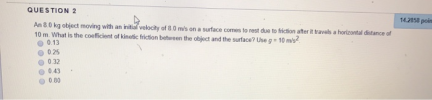 QUESTION 2 14.2858 poin An 8.0 kg object moving with an initial velocity of 8.0 m/s on a surface comes to rest due to friction after it travels a horizontal distance of 10 m. What is the coefficient of kinetic friction between the object and the surface? Use g 0.13 10 m/s 0.25 O 0.32 O 0.43 0.80
A 10 kg medicine ball is thrown at a 40 kg ice-skater at rest. If the...
A 10 kg medicine ball is thrown at a 40 kg ice-skater at rest. If the ball’s speed is 5 m/s, what is the total momentum of the combination of the ball and the skater right after she catches the ball and holds on to it? a. 15 kgm/s b. 10 kgm/s c. 50 kgm/s d. 40 kgm/s e. None of these How fast would the ice-skater of the previous question move after catching the ball ? a. 5 m/s...
A ball of mass 0.195 kg with a velocity of 1.5 m/s meets a ball of...
 A ball of mass 0.195 kg with a velocity of 1.5 m/s meets a ball of mass 0.299 kg with a velocity of-039i m/s in a head-on, elastic collision (a) Find their velocities after the collision. m/s m/s (b) Find the velocity of their center of mass before and after the collision. Vom, bfore 0.383 aat0.383 m/s m/s
A 3.6-kg steel ball traveling at 8.0 m/s hits a wall at an angle of ?...
 A 3.6-kg steel ball traveling
at 8.0 m/s hits a wall at an angle of ? = 61.0o as shown in the
figure. It bounces off the wall with the same speed and same angle.
If the ball was in contact with the wall for 0.14 seconds, what was
the magnitude of the average force exerted on the ball by the
wall?
A 3.6-kg steel ball traveling
at 8.0 m/s hits a wall at an angle of ? = 61.0o as shown in the
figure. It bounces off the wall with the same speed and same angle.
If the ball was in contact with the wall for 0.14 seconds, what was
the magnitude of the average force exerted on the ball by the
wall?
A ball of mass 0.205 kg with a velocity of 1.54 î m/s meets a ball...
A ball of mass 0.205 kg with a velocity of 1.54 î m/s meets a ball of mass 0.299 kg with a velocity of -0.393 î m/s in a head-on, elastic collision. (a) Find their velocities after the collision. (b) Find the velocity of their center of mass before and after the collision.
 just need letter answer no need for explanation
e. 5. Which of the following represents the Lewis structure for S2-? a. b. d. S2- 6. Determine the velocity of a medicine ball (m= 10.0 kg) with a wavelength of c. S22 e. 1.33 x 10⁻³⁵ m. a. 12.3 m/s b. 8.81 m/s 6.44 m/s c. d. 2.21 m/s 4.98 m/s
just need letter answer no need for explanation
e. 5. Which of the following represents the Lewis structure for S2-? a. b. d. S2- 6. Determine the velocity of a medicine ball (m= 10.0 kg) with a wavelength of c. S22 e. 1.33 x 10⁻³⁵ m. a. 12.3 m/s b. 8.81 m/s 6.44 m/s c. d. 2.21 m/s 4.98 m/s
 2. A ball (m = 5 kg) travels to the right with a intial velocity of 10 m/s and hits a stationary ball (M = 15 kg). They undergo a perfectly elastic collision. (a) What is the velocity after the collision of ball 17 (12 points) (b) What is the velocity after the collision of ball 2? (11 points)
 QUESTION 2 14.2858 poin An 8.0 kg object moving with an initial velocity of 8.0 m/s on a surface comes to rest due to friction after it travels a horizontal distance of 10 m. What is the coefficient of kinetic friction between the object and the surface? Use g 0.13 10 m/s 0.25 O 0.32 O 0.43 0.80
 A ball of mass 0.195 kg with a velocity of 1.5 m/s meets a ball of mass 0.299 kg with a velocity of-039i m/s in a head-on, elastic collision (a) Find their velocities after the collision. m/s m/s (b) Find the velocity of their center of mass before and after the collision. Vom, bfore 0.383 aat0.383 m/s m/s
 A 3.6-kg steel ball traveling
at 8.0 m/s hits a wall at an angle of ? = 61.0o as shown in the
figure. It bounces off the wall with the same speed and same angle.
If the ball was in contact with the wall for 0.14 seconds, what was
the magnitude of the average force exerted on the ball by the
wall?
A 3.6-kg steel ball traveling
at 8.0 m/s hits a wall at an angle of ? = 61.0o as shown in the
figure. It bounces off the wall with the same speed and same angle.
If the ball was in contact with the wall for 0.14 seconds, what was
the magnitude of the average force exerted on the ball by the
wall?
Most questions answered within 3 hours.
-
Where is the error in this code sequence?
String s1 = "Hello";
String s2 = "ello";...
asked 11 months ago -
Financial data for Joel de Paris, Inc., for last year
follow:
Joel de Paris, Inc.
Balance...
asked 11 months ago -
Consider this reaction:
Al2(SO4)3 (aq)+ BaCl3
(aq) Al2Cl6 (aq)- +
3BaSO4(s) . What is the...
asked 11 months ago -
Suppose that Savneet is considering increasing her
recent random sample from 20 car rentals to 40...
asked 11 months ago -
Trucks arrive at an unloading terminal at an average rate of 120
per hour.
Trucks arrive...
asked 11 months ago -
Why are methanol and ethanol completely soluble in water while
octanol is not very little soluble....
asked 11 months ago -
A facilities manager at a university reads in a research report
that the mean amount of...
asked 11 months ago -
When the CuSO4 is rehydrated by adding water to the anhydrous
compound, is this an endothermic...
asked 11 months ago -
A ray of sunlight is passing from diamond into crown glass; the
angle of incidence is...
asked 11 months ago -
A block of mass 0.249 kg is placed on top of a light, vertical
spring of...
asked 11 months ago -
how do the kidneys compensate in the presences of acidosis
a) trigger hyperventilate
b) reserve acid...
asked 11 months ago -
Question 501 pts
The rental rate of capital to the firm increases. Which of the
following...
asked 11 months ago