a) Explain clearly why an object need not "be rotating" in order to have a moment...
a) Explain clearly why an object need not "be rotating" in order to have a moment of inertia, and give an example. (Hint: Can you calculate the moment of inertia, whether or not the object is rotating?)
b) Explain clearly why an object need not "be rotating" in order to have a nonzero angular momentum, and give an example. (Hint: use L = r x p.)
Homework Answers
a) the moment of inertia is not a property due to motion instead it is a property that decides the effect of mass and dimensions on motion, its the same as mass, an object need not be accelerated in order to have mass but mass plays a role in acceleration , a=F/m.. likewise moment of inertia depends only on mass, and the location of axis of rotation, and both of these have nothing to do with a body at rest or rotating.
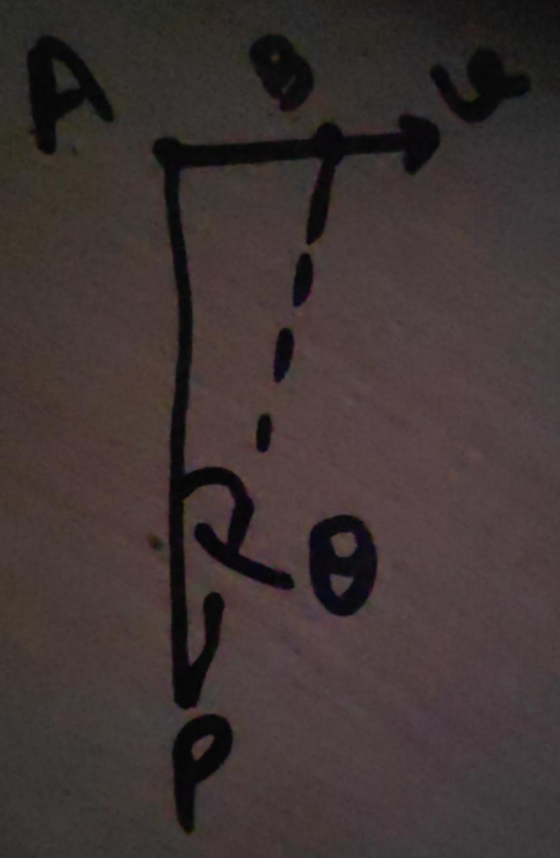
b) again angular momentum is not confined to rotating bodies, any body that can describe an angle with the line joining a point (about which angular momentum is to be found) , so a body moving in a straight line can also describe an angle and thus have angular momentum.. and moreover the value Mvr does not involve angular velocity.. while moving from A to B in a straight line an angle can still be described about point P. thus have angular momentum
Add Answer to:
a) Explain clearly why an object need not "be rotating" in order
to have a moment...
You are given that the “heart shaped object” in Fig. 4 has a moment of inertia...
 You are given that the “heart
shaped object” in Fig. 4 has a moment of inertia I = 0.5kgm2. Use
this to calculate
the change in angular momentum L of the object in 4s. Hint: L⃗ =
⃗τ∆t.
(b) This question deals with angular momentum conservation. Two
boys of mass 100 kg each stand at the center of a rotating
merry-go-round (MGR) in the shape of a disk of radius 1 m and mass
10 kg. The platform rotates at...
You are given that the “heart
shaped object” in Fig. 4 has a moment of inertia I = 0.5kgm2. Use
this to calculate
the change in angular momentum L of the object in 4s. Hint: L⃗ =
⃗τ∆t.
(b) This question deals with angular momentum conservation. Two
boys of mass 100 kg each stand at the center of a rotating
merry-go-round (MGR) in the shape of a disk of radius 1 m and mass
10 kg. The platform rotates at...
We know the heart shaped object has a moment of inertia of I = 0.5kgm^2. Calculate...
 We know the heart shaped object has a moment of inertia of I =
0.5kgm^2. Calculate the change in angular momentum (L) of the
object in 5s (~L=~τ∆t). This question deals with angular momentum
conservation. Two girls of mass 100 kg each stand at the center of
a rotating merry-go-round (MGR) in the shape of a disk of radius 1
m and mass 10 kg. The platform rotates atω= 0.40 rad/s. Let’s call
this configuration instant A.
A) Determine the...
We know the heart shaped object has a moment of inertia of I =
0.5kgm^2. Calculate the change in angular momentum (L) of the
object in 5s (~L=~τ∆t). This question deals with angular momentum
conservation. Two girls of mass 100 kg each stand at the center of
a rotating merry-go-round (MGR) in the shape of a disk of radius 1
m and mass 10 kg. The platform rotates atω= 0.40 rad/s. Let’s call
this configuration instant A.
A) Determine the...
Q1. See the course content for a short review of moment of inertia where you will...
 Q1. See the course content for a short review of moment of inertia where you will also find a problem solving video on this topic. . Find the moment of inertia of a uniform thin rod with mass M and length L rotating about its center (a thin rod is a 1D object; in the figure the rod has a thickness for clarity): For this problem, use a coordinate axis with its origin at the rod's center and let the...
1. All of the objects below are rotating with an angular velocity of 2 rpm. They...
 1. All of the objects below are rotating with an angular velocity of 2 rpm. They each have a mass of 15 kg and a radius of 0.3 m. For each object a) calculate the moment of inertia. Rank in order from smallest to largest. b) calculate the rotational kinetic energy. Rank in order from smallest to largest. c) calculate the angular momentum. Rank in order from smallest to largest. Solid cylinder or disc, symmetry axis Hoop about symmetry axis...
1) The parallel axis theorem provides a useful way to calculate the moment of inertia I...
1) The parallel axis theorem provides a useful way to calculate the moment of inertia I about an arbitrary axis. The theorem states that I = Icm + Mh2, where Icm is the moment of inertia of the object relative to an axis that passes through the center of mass and is parallel to the axis of interest, M is the total mass of the object, and h is the perpendicular distance between the two axes. Use this theorem and...
2) Moment of Inertia for Multiple Objects We have loosely defined the moment of inertia as...
 2) Moment of Inertia for Multiple Objects We have loosely defined the moment of inertia as the difficulty or resistance encountered when trying to change an object's rotational motion. What if we were trying to rotation a combination of objects? a. Suppose you have a very light cloth pouch, and you place an apple of mass M=200 grams in it. You tighten up the satchel and start to swing it around, with the string in the satchel making a length...
need help on C. Conservation of angular momentum A spherical star with radius R1 7.96 x...
 need help on C.
Conservation of angular momentum A spherical star with radius R1 7.96 x 10 km and rotating with angular speed (o 3,92 x 10s rad/s suddenly collapses into a neutron star. The neutron star emits a beam of X-rays directed radially outward that can be seen by an observatory on the earth r 4.55 x 10⁴ km from the star. The X-ray beam sweeps past the earth with a tangential speed v 7.40 x 10 km/s each...
need help on C.
Conservation of angular momentum A spherical star with radius R1 7.96 x 10 km and rotating with angular speed (o 3,92 x 10s rad/s suddenly collapses into a neutron star. The neutron star emits a beam of X-rays directed radially outward that can be seen by an observatory on the earth r 4.55 x 10⁴ km from the star. The X-ray beam sweeps past the earth with a tangential speed v 7.40 x 10 km/s each...
Please explain clearly. I need to know each steps reasons. 5) (Kepler's Problem) Suppose that a...
 Please explain clearly. I need to know each steps
reasons.
5) (Kepler's Problem) Suppose that a particle is moving in three dimensions under the influence of the force k F=- where k is a positive constant. (a) Find the torque acting on the particle with respect to the origin. Is angular momentum conserved? Show that the magnitude of the angular momentum is given by l = mr2ė. (b) Using Newton's second law, show that the momentum of the particle is...
Please explain clearly. I need to know each steps
reasons.
5) (Kepler's Problem) Suppose that a particle is moving in three dimensions under the influence of the force k F=- where k is a positive constant. (a) Find the torque acting on the particle with respect to the origin. Is angular momentum conserved? Show that the magnitude of the angular momentum is given by l = mr2ė. (b) Using Newton's second law, show that the momentum of the particle is...
Heres example 10.2 (3) (30 points) In Example 10.2, the moment of inertia tensor for a...
 Heres example 10.2
(3) (30 points) In Example 10.2, the moment of inertia tensor for a uniform solid cube of mass Mand side a is calculated for rotation about a corner of the cube. It also worked out the angular momentum of the cube when rotated about the x-axis - see Equation 10.51. (a) Find the total kinetic energy of the cube when rotated about the x-axis. (b) Example 10.4 finds the principal axes of this cube. It shows that...
Heres example 10.2
(3) (30 points) In Example 10.2, the moment of inertia tensor for a uniform solid cube of mass Mand side a is calculated for rotation about a corner of the cube. It also worked out the angular momentum of the cube when rotated about the x-axis - see Equation 10.51. (a) Find the total kinetic energy of the cube when rotated about the x-axis. (b) Example 10.4 finds the principal axes of this cube. It shows that...
please help with ALL a-g thanks in advance:) HW 6.1. Briefly answer the following questions. a)...
 please help with ALL a-g
thanks in advance:)
HW 6.1. Briefly answer the following questions. a) A clock is mounted on the wall. As you look at it, what is the direction of the angular velocity vector of the second hand? What is the value of the angular acceleration of the second hand? b) If the angular acceleration of a rigid body is zero, what is the functional form of the angular velocity? c) What if another planet the same...
please help with ALL a-g
thanks in advance:)
HW 6.1. Briefly answer the following questions. a) A clock is mounted on the wall. As you look at it, what is the direction of the angular velocity vector of the second hand? What is the value of the angular acceleration of the second hand? b) If the angular acceleration of a rigid body is zero, what is the functional form of the angular velocity? c) What if another planet the same...
 You are given that the “heart
shaped object” in Fig. 4 has a moment of inertia I = 0.5kgm2. Use
this to calculate
the change in angular momentum L of the object in 4s. Hint: L⃗ =
⃗τ∆t.
(b) This question deals with angular momentum conservation. Two
boys of mass 100 kg each stand at the center of a rotating
merry-go-round (MGR) in the shape of a disk of radius 1 m and mass
10 kg. The platform rotates at...
You are given that the “heart
shaped object” in Fig. 4 has a moment of inertia I = 0.5kgm2. Use
this to calculate
the change in angular momentum L of the object in 4s. Hint: L⃗ =
⃗τ∆t.
(b) This question deals with angular momentum conservation. Two
boys of mass 100 kg each stand at the center of a rotating
merry-go-round (MGR) in the shape of a disk of radius 1 m and mass
10 kg. The platform rotates at...
 We know the heart shaped object has a moment of inertia of I =
0.5kgm^2. Calculate the change in angular momentum (L) of the
object in 5s (~L=~τ∆t). This question deals with angular momentum
conservation. Two girls of mass 100 kg each stand at the center of
a rotating merry-go-round (MGR) in the shape of a disk of radius 1
m and mass 10 kg. The platform rotates atω= 0.40 rad/s. Let’s call
this configuration instant A.
A) Determine the...
We know the heart shaped object has a moment of inertia of I =
0.5kgm^2. Calculate the change in angular momentum (L) of the
object in 5s (~L=~τ∆t). This question deals with angular momentum
conservation. Two girls of mass 100 kg each stand at the center of
a rotating merry-go-round (MGR) in the shape of a disk of radius 1
m and mass 10 kg. The platform rotates atω= 0.40 rad/s. Let’s call
this configuration instant A.
A) Determine the...
 Q1. See the course content for a short review of moment of inertia where you will also find a problem solving video on this topic. . Find the moment of inertia of a uniform thin rod with mass M and length L rotating about its center (a thin rod is a 1D object; in the figure the rod has a thickness for clarity): For this problem, use a coordinate axis with its origin at the rod's center and let the...
 1. All of the objects below are rotating with an angular velocity of 2 rpm. They each have a mass of 15 kg and a radius of 0.3 m. For each object a) calculate the moment of inertia. Rank in order from smallest to largest. b) calculate the rotational kinetic energy. Rank in order from smallest to largest. c) calculate the angular momentum. Rank in order from smallest to largest. Solid cylinder or disc, symmetry axis Hoop about symmetry axis...
 2) Moment of Inertia for Multiple Objects We have loosely defined the moment of inertia as the difficulty or resistance encountered when trying to change an object's rotational motion. What if we were trying to rotation a combination of objects? a. Suppose you have a very light cloth pouch, and you place an apple of mass M=200 grams in it. You tighten up the satchel and start to swing it around, with the string in the satchel making a length...
 need help on C.
Conservation of angular momentum A spherical star with radius R1 7.96 x 10 km and rotating with angular speed (o 3,92 x 10s rad/s suddenly collapses into a neutron star. The neutron star emits a beam of X-rays directed radially outward that can be seen by an observatory on the earth r 4.55 x 10⁴ km from the star. The X-ray beam sweeps past the earth with a tangential speed v 7.40 x 10 km/s each...
need help on C.
Conservation of angular momentum A spherical star with radius R1 7.96 x 10 km and rotating with angular speed (o 3,92 x 10s rad/s suddenly collapses into a neutron star. The neutron star emits a beam of X-rays directed radially outward that can be seen by an observatory on the earth r 4.55 x 10⁴ km from the star. The X-ray beam sweeps past the earth with a tangential speed v 7.40 x 10 km/s each...
 Please explain clearly. I need to know each steps
reasons.
5) (Kepler's Problem) Suppose that a particle is moving in three dimensions under the influence of the force k F=- where k is a positive constant. (a) Find the torque acting on the particle with respect to the origin. Is angular momentum conserved? Show that the magnitude of the angular momentum is given by l = mr2ė. (b) Using Newton's second law, show that the momentum of the particle is...
Please explain clearly. I need to know each steps
reasons.
5) (Kepler's Problem) Suppose that a particle is moving in three dimensions under the influence of the force k F=- where k is a positive constant. (a) Find the torque acting on the particle with respect to the origin. Is angular momentum conserved? Show that the magnitude of the angular momentum is given by l = mr2ė. (b) Using Newton's second law, show that the momentum of the particle is...
 Heres example 10.2
(3) (30 points) In Example 10.2, the moment of inertia tensor for a uniform solid cube of mass Mand side a is calculated for rotation about a corner of the cube. It also worked out the angular momentum of the cube when rotated about the x-axis - see Equation 10.51. (a) Find the total kinetic energy of the cube when rotated about the x-axis. (b) Example 10.4 finds the principal axes of this cube. It shows that...
Heres example 10.2
(3) (30 points) In Example 10.2, the moment of inertia tensor for a uniform solid cube of mass Mand side a is calculated for rotation about a corner of the cube. It also worked out the angular momentum of the cube when rotated about the x-axis - see Equation 10.51. (a) Find the total kinetic energy of the cube when rotated about the x-axis. (b) Example 10.4 finds the principal axes of this cube. It shows that...
 please help with ALL a-g
thanks in advance:)
HW 6.1. Briefly answer the following questions. a) A clock is mounted on the wall. As you look at it, what is the direction of the angular velocity vector of the second hand? What is the value of the angular acceleration of the second hand? b) If the angular acceleration of a rigid body is zero, what is the functional form of the angular velocity? c) What if another planet the same...
please help with ALL a-g
thanks in advance:)
HW 6.1. Briefly answer the following questions. a) A clock is mounted on the wall. As you look at it, what is the direction of the angular velocity vector of the second hand? What is the value of the angular acceleration of the second hand? b) If the angular acceleration of a rigid body is zero, what is the functional form of the angular velocity? c) What if another planet the same...
Most questions answered within 3 hours.
-
Where is the error in this code sequence?
String s1 = "Hello";
String s2 = "ello";...
asked 10 months ago -
Financial data for Joel de Paris, Inc., for last year
follow:
Joel de Paris, Inc.
Balance...
asked 10 months ago -
Consider this reaction:
Al2(SO4)3 (aq)+ BaCl3
(aq) Al2Cl6 (aq)- +
3BaSO4(s) . What is the...
asked 10 months ago -
Suppose that Savneet is considering increasing her
recent random sample from 20 car rentals to 40...
asked 10 months ago -
Trucks arrive at an unloading terminal at an average rate of 120
per hour.
Trucks arrive...
asked 10 months ago -
Why are methanol and ethanol completely soluble in water while
octanol is not very little soluble....
asked 10 months ago -
A facilities manager at a university reads in a research report
that the mean amount of...
asked 10 months ago -
When the CuSO4 is rehydrated by adding water to the anhydrous
compound, is this an endothermic...
asked 10 months ago -
A ray of sunlight is passing from diamond into crown glass; the
angle of incidence is...
asked 10 months ago -
A block of mass 0.249 kg is placed on top of a light, vertical
spring of...
asked 10 months ago -
how do the kidneys compensate in the presences of acidosis
a) trigger hyperventilate
b) reserve acid...
asked 10 months ago -
Question 501 pts
The rental rate of capital to the firm increases. Which of the
following...
asked 10 months ago