An ideal gas has spherical molecules with a diameter of 3x10^-10 m. When the temperature is...
An ideal gas has spherical molecules with a diameter of 3x10^-10 m. When the temperature is 20 °C, under how much pressure the mean-free path of molecules is equal to 50 cm?
Homework Answers
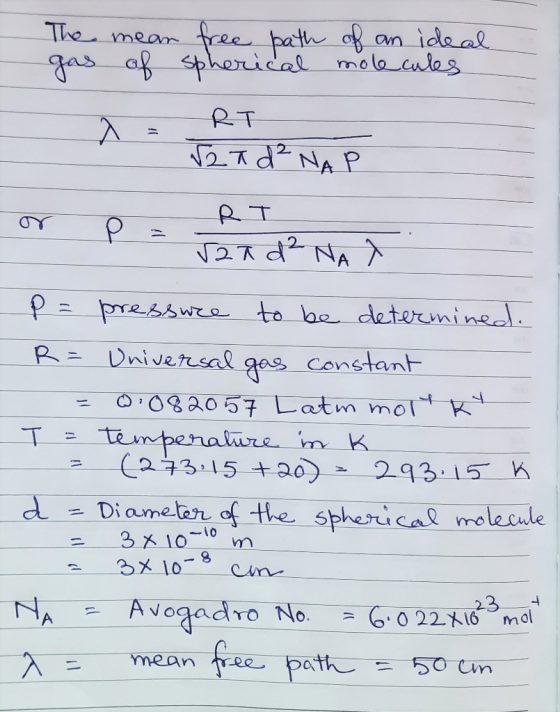
The values of square root of 2 = 1.414 and Pi = 3.143
Therefore, P = (0.082057 L atm mol-1 K-1 X 293.15 K) / [1.414 X 3.143 X (3 X 10 -8 cm)2 X 6.022 X 1023 mol-1 X 50 cm]
= 24.055 L atm / 12043.34 X 107 cm2 X cm ( all other units cancel outs in numerator and denominator)
=0.001997 X 10⁷ atm ( the unit L = cm3 in numerator cancel outs with denominator )
~ 2.0 X 10¹⁰ atm
Answer: The pressure will be 2.0 X 10¹⁰ atm
Add Answer to:
An ideal gas has spherical molecules with a diameter of 3x10^-10
m. When the temperature is...
What would the pressure, P , of an ideal gas be if the mean free path...
What would the pressure, P , of an ideal gas be if the mean free path was 115 cm ? Assume the gas is at room temperature, T = 20.0 ∘ C , and the diameter of the molecule is d = 1.50 × 10 − 10 m
12 liters of gas under a pressure of 12 atm flows into a spherical ballon with...
 12 liters of gas under a pressure of 12 atm flows into a
spherical ballon with a diameter of 50 cm. If the temperature
remains constant in the process, What is the pressure in the
balloon
4. 12 moles of ammonia (NH3) are confined at a volume of 0.12 m' and a pressure of 3.0 x 10 Pa. What is the temperature of this gas? What is the rms velocity of the molecules in sample?
12 liters of gas under a pressure of 12 atm flows into a
spherical ballon with a diameter of 50 cm. If the temperature
remains constant in the process, What is the pressure in the
balloon
4. 12 moles of ammonia (NH3) are confined at a volume of 0.12 m' and a pressure of 3.0 x 10 Pa. What is the temperature of this gas? What is the rms velocity of the molecules in sample?
An ideal gas with a fixed number of molecules is maintained at a constant temperature. At...
 An ideal gas with a fixed number of molecules is maintained at a constant temperature. At a pressure of 2X10^5 Pa , the volume of the gas is 6 m\ What is he gas when the pressure is increased by 4 times?
Using ideal gas law. Calculate the temperature of hydrogen molecules, when their average speed is 100...
Using ideal gas law. Calculate the temperature of hydrogen molecules, when their average speed is 100 meters/second, under one atmosphere pressure and volume of 22.4 liters.
1a. . If the temperature of an ideal gas is raised from 10 °C to 210...
1a. . If the temperature of an ideal gas is raised from 10 °C to 210 °C, how many times faster is the new average (rms) speed of the gas molecules? _______ times b. What is the volume occupied by 3.50 g of hydrogen gas under a pressure of 2.80 atm and a temperature of 21 °C? ______m³
The ideal gas law relates the temperature, pressure and volume of an ideal gas. Suppose the...
The ideal gas law relates the temperature, pressure and volume of an ideal gas. Suppose the gas inside a particular balloon has an absolute pressure of 3.15×10⁵ Pa and occupies a volume of 5.33×10⁻³ m3 at a temperature of 16.7°C. How many moles of gas are inside the balloon? (do not enter units) How many molecules of gas are inside the balloon? (do not enter units)
In a certain particle accelerator, protons travel around a circular path of diameter D in an evacuated chamber, whose residual gas is at temperature T and pressure p. Assuming T is given in Kelvin an...
 In a certain particle accelerator, protons travel around a circular path of diameter D in an evacuated chamber, whose residual gas is at temperature T and pressure p. Assuming T is given in Kelvin and p in pascals, calculate the number n of gas molecules per cubic meter under these conditions, what is the mean free path λ of the gas molecules if the molecular diameter is d. State your answers in terms of the given variables, using the Boltzmann...
1. (a) How many molecules are present in a sample of an ideal gas that occupies...
1. (a) How many molecules are present in a sample of an ideal gas that occupies a volume of 2.10 cm3, is at a temperature of 20°C, and is at atmospheric pressure? (b) How many molecules of the gas are present if the volume and temperature are the same as in part (a), but the pressure is now 3.00 ✕ 10−11 Pa (an extremely good vacuum)? 2. An air bubble released by a submersible vehicle, 120 m below the surface...
An ideal gas at temperature 50 degrees C is confined to a box of volume 0.1...
An ideal gas at temperature 50 degrees C is confined to a box of volume 0.1 m^3. a. What is the average kinetic energy of the particles in the gas? b. If there are 10^25 particles in the gas, how much energy does it contain? c. If there are 10^25 particles in the box, what is the pressure of the gas?
Calculate molar volume of an ideal gas in m^3 at room temperature and pressure (or RTP)....
 Calculate molar volume of an ideal gas in m^3 at room temperature and pressure (or RTP). Id other words, calculate how much volume one mole of an ideal gas at 1.01 times 10^5 Pa and 298 K takes up. Then convert it to liters (l), where 1 t - 0.001 m^3 Measured at 18.00 C, a lead rod has a length of 52.44 cm, and an iron rod has a length of 52.61 cm. Both rods are heated to 86.0...
 12 liters of gas under a pressure of 12 atm flows into a
spherical ballon with a diameter of 50 cm. If the temperature
remains constant in the process, What is the pressure in the
balloon
4. 12 moles of ammonia (NH3) are confined at a volume of 0.12 m' and a pressure of 3.0 x 10 Pa. What is the temperature of this gas? What is the rms velocity of the molecules in sample?
12 liters of gas under a pressure of 12 atm flows into a
spherical ballon with a diameter of 50 cm. If the temperature
remains constant in the process, What is the pressure in the
balloon
4. 12 moles of ammonia (NH3) are confined at a volume of 0.12 m' and a pressure of 3.0 x 10 Pa. What is the temperature of this gas? What is the rms velocity of the molecules in sample?
 An ideal gas with a fixed number of molecules is maintained at a constant temperature. At a pressure of 2X10^5 Pa , the volume of the gas is 6 m\ What is he gas when the pressure is increased by 4 times?
 In a certain particle accelerator, protons travel around a circular path of diameter D in an evacuated chamber, whose residual gas is at temperature T and pressure p. Assuming T is given in Kelvin and p in pascals, calculate the number n of gas molecules per cubic meter under these conditions, what is the mean free path λ of the gas molecules if the molecular diameter is d. State your answers in terms of the given variables, using the Boltzmann...
 Calculate molar volume of an ideal gas in m^3 at room temperature and pressure (or RTP). Id other words, calculate how much volume one mole of an ideal gas at 1.01 times 10^5 Pa and 298 K takes up. Then convert it to liters (l), where 1 t - 0.001 m^3 Measured at 18.00 C, a lead rod has a length of 52.44 cm, and an iron rod has a length of 52.61 cm. Both rods are heated to 86.0...
Most questions answered within 3 hours.
-
Where is the error in this code sequence?
String s1 = "Hello";
String s2 = "ello";...
asked 10 months ago -
Financial data for Joel de Paris, Inc., for last year
follow:
Joel de Paris, Inc.
Balance...
asked 10 months ago -
Consider this reaction:
Al2(SO4)3 (aq)+ BaCl3
(aq) Al2Cl6 (aq)- +
3BaSO4(s) . What is the...
asked 10 months ago -
Suppose that Savneet is considering increasing her
recent random sample from 20 car rentals to 40...
asked 10 months ago -
Trucks arrive at an unloading terminal at an average rate of 120
per hour.
Trucks arrive...
asked 10 months ago -
Why are methanol and ethanol completely soluble in water while
octanol is not very little soluble....
asked 10 months ago -
A facilities manager at a university reads in a research report
that the mean amount of...
asked 10 months ago -
When the CuSO4 is rehydrated by adding water to the anhydrous
compound, is this an endothermic...
asked 10 months ago -
A ray of sunlight is passing from diamond into crown glass; the
angle of incidence is...
asked 10 months ago -
A block of mass 0.249 kg is placed on top of a light, vertical
spring of...
asked 10 months ago -
how do the kidneys compensate in the presences of acidosis
a) trigger hyperventilate
b) reserve acid...
asked 10 months ago -
Question 501 pts
The rental rate of capital to the firm increases. Which of the
following...
asked 10 months ago