7. A student has performed three experiments examining the kinetic behavior of an enzyme at three...
7. A student has performed three experiments examining the kinetic behavior of an enzyme at three different temperatures. The student has determined the rate constant describing the reaction at each temperature, summarized below. Please use these data to calculate an activation energy and pre-exponential factor for the reaction in question.
|
Temperature (C) |
Apparent Rate Constant (s-1) |
|
10 |
0.3 |
|
20 |
0.6 |
|
30 |
0.9 |
Homework Answers


Add Answer to:
7. A student has performed three experiments examining the
kinetic behavior of an enzyme at three...
The rate of a certain reaction was studied at various temperatures. The table shows temperature (T)...
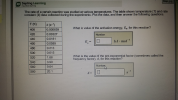 The rate of a certain reaction was studied at various
temperatures. The table shows temperature (T) and rate constant (k)
data collected during the experiments. Plot the data, and then
answer the following questions.
What is value of the activation energy, Ea, for this
reaction?
What is the value of the pre-exponential factor (sometimes
called the frequency factor), A, for this reaction?
The rate of a certain reaction was studied at various
temperatures. The table shows temperature (T) and rate constant (k)
data collected during the experiments. Plot the data, and then
answer the following questions.
What is value of the activation energy, Ea, for this
reaction?
What is the value of the pre-exponential factor (sometimes
called the frequency factor), A, for this reaction?
The rate of a certain reaction was studied at various temperatures. The table shows temperature (?)...
The rate of a certain reaction was studied at various temperatures. The table shows temperature (?) and rate constant (?) data collected during the experiments. Plot the data to answer the questions. What is the value of the activation energy, ?a , for this reaction? ? (?) ? (?−1) (400, 0.0000173) (420, 0.000127) (440, 0.000773) (460, 0.00403) (480, 0.0183) (500, 0.0738) (520, 0.267) (540, 0.879) (560, 2.66) (580, 7.43) ?a= ______ . kJ⋅mol−1 What is the value of the pre‑exponential...
An uncatalyzed reaction has a rate of 4.4 x 10⁻⁷ s–1 at room temperature (25 °C)....
An uncatalyzed reaction has a rate of 4.4 x 10⁻⁷ s–1 at room temperature (25 °C). When an enzyme is added the rate is 3.1 x 10⁴ s–1. If the height of the activation barrier for the uncatalyzed rate is 28.6 kcal/mol, what is the height of the activation barrier for the catalyzed rate? Report your answer in terms of kcal/mol to the nearest tenths. Also, assume the pre-exponential terms for the uncatalyzed and catalyzed reactions are the same.
Question 5 and 6 Determine and report the rate law for the reaction of iodide and...
 Question 5 and 6
Determine and report the rate law for the reaction of iodide and persul fate ions. Show all calculations and justifications. 2 3.Based on the rate law that you determined above, calculate the values and units of k for: a. the three initial rates experiments in Part A, b. the one initial rates experiment at a different temperature in Part B. 4Use your two experiments done at different temperatures to determine the activation energy Ea and the...
Question 5 and 6
Determine and report the rate law for the reaction of iodide and persul fate ions. Show all calculations and justifications. 2 3.Based on the rate law that you determined above, calculate the values and units of k for: a. the three initial rates experiments in Part A, b. the one initial rates experiment at a different temperature in Part B. 4Use your two experiments done at different temperatures to determine the activation energy Ea and the...
I need the answers in details with explanation thanks in advance! first question: second question: 7)...
 I need the answers in details with explanation
thanks in advance!
first question:
second question:
7) The reaction (CH3)3CBr + OH → (CH3)3COH + Br in a certain solvent is first order with respect to (CH3)3CBr and zero order with respect to OH-. In several experiments, the rate constant k was determined at different temperatures. A plot of In(k) versus 1/T was constructed resulting in a straight line with a slope of -1.10 X 10⁴ K and y-intercept of 33.5....
I need the answers in details with explanation
thanks in advance!
first question:
second question:
7) The reaction (CH3)3CBr + OH → (CH3)3COH + Br in a certain solvent is first order with respect to (CH3)3CBr and zero order with respect to OH-. In several experiments, the rate constant k was determined at different temperatures. A plot of In(k) versus 1/T was constructed resulting in a straight line with a slope of -1.10 X 10⁴ K and y-intercept of 33.5....
Preview File Edit View Go Tools Window Help $ 88% Fri 4:10 AM Q E Screen...
 Preview File Edit View Go Tools Window Help $ 88% Fri 4:10 AM Q E Screen Shot 2020-03-19 at 9.10.34 PM IQ Û Z @ Q Search Lab 2 - Rates of Chemica...eactions The rate of a certain reaction was studied at various temperatures. The table shows temperature (T) and rate constant (k) data collected during the experiments. Plot the data to answer the questions. What is the value of the activation energy, E, for this reaction? T(K) 1ks-1) 400...
1) The rate constant for the reaction 2 N,Os(9) = 4 NO (9) + O2(9) is...
 1) The rate constant for the reaction 2 N,Os(9) = 4 NO (9) + O2(9) is reported in units of sl. What is the overall order of the reaction? 2) The rate law for a reaction was reported as rate=k[A] [B][C] with molar concentrations in moles per cubic decimetre and time in seconds. What are the units of k? 3) The rate constant for the pseudo first-order acid- catalysed hydrolysis of glucose is 4.07' 10-s. Calculate the half-life for the...
Rodrigo is an enzyme engineer. He wants to know which of four peptide substrates is bound...
 Rodrigo is an enzyme engineer. He wants to know which of four peptide substrates is bound most tightly by his engineered enzyme. Which value should he measure and pay attention to? Km KCAT Vo Both A and B kcat, [S], and [E]t Rodrigo's enzyme was assayed with three substrates (A, B, and C). The SAME enzyme concentration used was for each of the three reactions. The results of the three experiments are plotted as Lineweaver-Burke plots below. Considering what you...
Need help with the first picture. Data provided in pictures #2 & #3 Determining the Activation...
 Need help with the first picture. Data provided in pictures #2
& #3
Determining the Activation Energy and Collision Frequency Factor for Reaction 1 Part 1. Transfer the reaction rate for runs 9.12 from Data Sheet 3. Then calculate the rate constant (R) at each temperature based on the reaction orders determined in parts and Record the results in Tables * = 18,0 ->15.0416"5,0216" Equation 6 ->25 10 2. Calculate the natural logarithm of the rate constant. In ) and...
Need help with the first picture. Data provided in pictures #2
& #3
Determining the Activation Energy and Collision Frequency Factor for Reaction 1 Part 1. Transfer the reaction rate for runs 9.12 from Data Sheet 3. Then calculate the rate constant (R) at each temperature based on the reaction orders determined in parts and Record the results in Tables * = 18,0 ->15.0416"5,0216" Equation 6 ->25 10 2. Calculate the natural logarithm of the rate constant. In ) and...
Can you please answer the question. They are the same question but with clarification/requirements to go...
 Can you please answer the question. They are the same question
but with clarification/requirements to go with it.
36. The dissolution of quartz in H2O can be represented by the following reaction: SiO2 (s) + 2H2O → H4SiO4 (aq) Rimstidt and Barnes (1980) determined the reaction rate for the dissolution of quartz as a function of temperature. Their data are listed in the following table: Temperatures and Reaction Rates for the Dissolution of Quartz T(°C) k(sec-1) 65 105 145 170...
Can you please answer the question. They are the same question
but with clarification/requirements to go with it.
36. The dissolution of quartz in H2O can be represented by the following reaction: SiO2 (s) + 2H2O → H4SiO4 (aq) Rimstidt and Barnes (1980) determined the reaction rate for the dissolution of quartz as a function of temperature. Their data are listed in the following table: Temperatures and Reaction Rates for the Dissolution of Quartz T(°C) k(sec-1) 65 105 145 170...
 The rate of a certain reaction was studied at various
temperatures. The table shows temperature (T) and rate constant (k)
data collected during the experiments. Plot the data, and then
answer the following questions.
What is value of the activation energy, Ea, for this
reaction?
What is the value of the pre-exponential factor (sometimes
called the frequency factor), A, for this reaction?
The rate of a certain reaction was studied at various
temperatures. The table shows temperature (T) and rate constant (k)
data collected during the experiments. Plot the data, and then
answer the following questions.
What is value of the activation energy, Ea, for this
reaction?
What is the value of the pre-exponential factor (sometimes
called the frequency factor), A, for this reaction?
 Question 5 and 6
Determine and report the rate law for the reaction of iodide and persul fate ions. Show all calculations and justifications. 2 3.Based on the rate law that you determined above, calculate the values and units of k for: a. the three initial rates experiments in Part A, b. the one initial rates experiment at a different temperature in Part B. 4Use your two experiments done at different temperatures to determine the activation energy Ea and the...
Question 5 and 6
Determine and report the rate law for the reaction of iodide and persul fate ions. Show all calculations and justifications. 2 3.Based on the rate law that you determined above, calculate the values and units of k for: a. the three initial rates experiments in Part A, b. the one initial rates experiment at a different temperature in Part B. 4Use your two experiments done at different temperatures to determine the activation energy Ea and the...
 I need the answers in details with explanation
thanks in advance!
first question:
second question:
7) The reaction (CH3)3CBr + OH → (CH3)3COH + Br in a certain solvent is first order with respect to (CH3)3CBr and zero order with respect to OH-. In several experiments, the rate constant k was determined at different temperatures. A plot of In(k) versus 1/T was constructed resulting in a straight line with a slope of -1.10 X 10⁴ K and y-intercept of 33.5....
I need the answers in details with explanation
thanks in advance!
first question:
second question:
7) The reaction (CH3)3CBr + OH → (CH3)3COH + Br in a certain solvent is first order with respect to (CH3)3CBr and zero order with respect to OH-. In several experiments, the rate constant k was determined at different temperatures. A plot of In(k) versus 1/T was constructed resulting in a straight line with a slope of -1.10 X 10⁴ K and y-intercept of 33.5....
 Preview File Edit View Go Tools Window Help $ 88% Fri 4:10 AM Q E Screen Shot 2020-03-19 at 9.10.34 PM IQ Û Z @ Q Search Lab 2 - Rates of Chemica...eactions The rate of a certain reaction was studied at various temperatures. The table shows temperature (T) and rate constant (k) data collected during the experiments. Plot the data to answer the questions. What is the value of the activation energy, E, for this reaction? T(K) 1ks-1) 400...
 1) The rate constant for the reaction 2 N,Os(9) = 4 NO (9) + O2(9) is reported in units of sl. What is the overall order of the reaction? 2) The rate law for a reaction was reported as rate=k[A] [B][C] with molar concentrations in moles per cubic decimetre and time in seconds. What are the units of k? 3) The rate constant for the pseudo first-order acid- catalysed hydrolysis of glucose is 4.07' 10-s. Calculate the half-life for the...
 Rodrigo is an enzyme engineer. He wants to know which of four peptide substrates is bound most tightly by his engineered enzyme. Which value should he measure and pay attention to? Km KCAT Vo Both A and B kcat, [S], and [E]t Rodrigo's enzyme was assayed with three substrates (A, B, and C). The SAME enzyme concentration used was for each of the three reactions. The results of the three experiments are plotted as Lineweaver-Burke plots below. Considering what you...
 Need help with the first picture. Data provided in pictures #2
& #3
Determining the Activation Energy and Collision Frequency Factor for Reaction 1 Part 1. Transfer the reaction rate for runs 9.12 from Data Sheet 3. Then calculate the rate constant (R) at each temperature based on the reaction orders determined in parts and Record the results in Tables * = 18,0 ->15.0416"5,0216" Equation 6 ->25 10 2. Calculate the natural logarithm of the rate constant. In ) and...
Need help with the first picture. Data provided in pictures #2
& #3
Determining the Activation Energy and Collision Frequency Factor for Reaction 1 Part 1. Transfer the reaction rate for runs 9.12 from Data Sheet 3. Then calculate the rate constant (R) at each temperature based on the reaction orders determined in parts and Record the results in Tables * = 18,0 ->15.0416"5,0216" Equation 6 ->25 10 2. Calculate the natural logarithm of the rate constant. In ) and...
 Can you please answer the question. They are the same question
but with clarification/requirements to go with it.
36. The dissolution of quartz in H2O can be represented by the following reaction: SiO2 (s) + 2H2O → H4SiO4 (aq) Rimstidt and Barnes (1980) determined the reaction rate for the dissolution of quartz as a function of temperature. Their data are listed in the following table: Temperatures and Reaction Rates for the Dissolution of Quartz T(°C) k(sec-1) 65 105 145 170...
Can you please answer the question. They are the same question
but with clarification/requirements to go with it.
36. The dissolution of quartz in H2O can be represented by the following reaction: SiO2 (s) + 2H2O → H4SiO4 (aq) Rimstidt and Barnes (1980) determined the reaction rate for the dissolution of quartz as a function of temperature. Their data are listed in the following table: Temperatures and Reaction Rates for the Dissolution of Quartz T(°C) k(sec-1) 65 105 145 170...
Most questions answered within 3 hours.
-
Where is the error in this code sequence?
String s1 = "Hello";
String s2 = "ello";...
asked 10 months ago -
Financial data for Joel de Paris, Inc., for last year
follow:
Joel de Paris, Inc.
Balance...
asked 10 months ago -
Consider this reaction:
Al2(SO4)3 (aq)+ BaCl3
(aq) Al2Cl6 (aq)- +
3BaSO4(s) . What is the...
asked 10 months ago -
Suppose that Savneet is considering increasing her
recent random sample from 20 car rentals to 40...
asked 10 months ago -
Trucks arrive at an unloading terminal at an average rate of 120
per hour.
Trucks arrive...
asked 10 months ago -
Why are methanol and ethanol completely soluble in water while
octanol is not very little soluble....
asked 10 months ago -
A facilities manager at a university reads in a research report
that the mean amount of...
asked 10 months ago -
When the CuSO4 is rehydrated by adding water to the anhydrous
compound, is this an endothermic...
asked 10 months ago -
A ray of sunlight is passing from diamond into crown glass; the
angle of incidence is...
asked 10 months ago -
A block of mass 0.249 kg is placed on top of a light, vertical
spring of...
asked 10 months ago -
how do the kidneys compensate in the presences of acidosis
a) trigger hyperventilate
b) reserve acid...
asked 10 months ago -
Question 501 pts
The rental rate of capital to the firm increases. Which of the
following...
asked 10 months ago