Your friend John intends to drive your 1000-kg car at a speed of 25m/s around a...
Your friend John intends to drive your 1000-kg car at a speed of 25m/s around a horizontal curve whose radius is 100 m. You know the coefficient of static friction between the tires and the road is 0.350. Will John be able to drive your car around the 100m radius? Explain your answer.
Homework Answers
To avoid the car to slip the centripetal force around the curve should be equal to the force of friction.
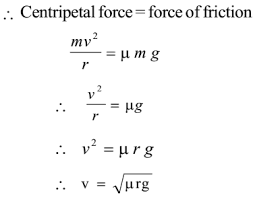
Given v = 25 m/s
 =
= 
Since given velocity is greater than the safe speed hence John will not be able to drive around the 100 m radius
Add Answer to:
Your friend John intends to drive your 1000-kg car at a speed of
25m/s around a...
Your friend John intends to drive your 1000-kg car at a speed of 25 m/s around...
Your friend John intends to drive your 1000-kg car at a speed of 25 m/s around a horizontal curve whose radius is 100 m. You know that the coefficient of static friction between the tires and the road is .350. Will John be able to drive your car around the 100 m radius? Explain you answer.
A curve of radius 70 m is banked so that a 1000 kg car traveling at...
A curve of radius 70 m is banked so that a 1000 kg car traveling at 60 km/h can round it even if the road is so icy that the coefficient of static friction is approximately zero. The acceleration of gravity is 9.81 m/s 2 . a) Find the minimum speed at which a car can travel around this curve without skidding if the coefficient of static friction between the road and the tires is 0.2 b) Find the maximum...
1) A car with mass m = 1000 kg is traveling around a circular curve of...
1) A car with mass m = 1000 kg is traveling around a circular curve of radius r = 990 m when it begins to rain. The coefficients of static friction between the road and tires is μd = 0.66 when dry and μw = 0.26 when wet. a) Write an expression for the maximum magnitude of the force of static friction Ff acting on the car if μs is the coefficient of friction. b) What is the maximum tangential...
Is it safe to drive your 1600-kg car at a speed 27 m/s around a level...
 Is it safe to drive your 1600-kg car at a speed 27 m/s around a
level highway curve of radius 150 m if the effective coefficient of
static friction between teh car and the road is 0.40? Use the
method outlined below in bold to solve the problem: (Please show
all work/explanations)
Visual Representation: Sketch the Situation
described in the problem
Physical Situation: Write in words any
assumptions made regarding objects and interactions
Physical Representation: Indicate the direction
of acceleration...
Is it safe to drive your 1600-kg car at a speed 27 m/s around a
level highway curve of radius 150 m if the effective coefficient of
static friction between teh car and the road is 0.40? Use the
method outlined below in bold to solve the problem: (Please show
all work/explanations)
Visual Representation: Sketch the Situation
described in the problem
Physical Situation: Write in words any
assumptions made regarding objects and interactions
Physical Representation: Indicate the direction
of acceleration...
A test driver attempts to drive a car with constant speed around a horizontal circular track...
A test driver attempts to drive a car with constant speed around a horizontal circular track of radius R = 200 m. The coefficient of static friction of the tires perpendicular to the direction in which the car is traveling is µs = 0.05. Give the shortest possible lap time the driver can achieve.
You are driving your car along a flat, curved road; the curve in the road is...
You are driving your car along a flat, curved road; the curve in the road is a segment of a circle with radius 50 meters. (We call this a "radius of curvature"). How fast can the car drive around the curve if the coefficient of static friction between the tires and the road is 1.0 (tires on dry pavement)? What if the coefficient of friction is 0.2 (tires on ice)?
A 960-kg race car can drive around an unbanked turn at a maximum speed of 45...
A 960-kg race car can drive around an unbanked turn at a maximum speed of 45 m/s without slipping. The turn has a radius of 160 m. Air flowing over the car's wing exerts a downward-pointing force (called the downforce) of 13000 N on the car. (a) What is the coefficient of static friction between the track and the car's tires? (b) What would be the maximum speed if no downforce acted on the car?
A 810-kg race car can drive around an unbanked turn at a maximum speed of 40...
 A 810-kg race car can drive around an unbanked turn at a maximum speed of 40 m/s without slipping. The turn has a radius of 120 m. Air flowing over the car's wing exerts a downward-pointing force (called the downforce) of 9200 N on the car. What is the coefficient of static friction between the track and the car's tires? What would be the maximum speed if no downforce acted on the car?
A 860-kg race car can drive around an unbanked turn at a maximum speed of 44...
A 860-kg race car can drive around an unbanked turn at a maximum speed of 44 m/s without slipping. The turn has a radius of 140 m. Air flowing over the car's wing exerts a downward-pointing force (called the downforce) of 11000 N on the car. (a) What is the coefficient of static friction between the track and the car's tires? (b) What would be the maximum speed if no downforce acted on the car?
A 900-kg race car can drive around an unbanked turn at a maximum speed of 42...
A 900-kg race car can drive around an unbanked turn at a maximum speed of 42 m/s without slipping. The turn has a radius of 170 m. Air flowing over the car's wing exerts a downward-pointing force (called the downforce) of 10000 N on the car. (a) What is the coefficient of static friction between the track and the car's tires? (b) What would be the maximum speed if no downforce acted on the car?
 Is it safe to drive your 1600-kg car at a speed 27 m/s around a
level highway curve of radius 150 m if the effective coefficient of
static friction between teh car and the road is 0.40? Use the
method outlined below in bold to solve the problem: (Please show
all work/explanations)
Visual Representation: Sketch the Situation
described in the problem
Physical Situation: Write in words any
assumptions made regarding objects and interactions
Physical Representation: Indicate the direction
of acceleration...
Is it safe to drive your 1600-kg car at a speed 27 m/s around a
level highway curve of radius 150 m if the effective coefficient of
static friction between teh car and the road is 0.40? Use the
method outlined below in bold to solve the problem: (Please show
all work/explanations)
Visual Representation: Sketch the Situation
described in the problem
Physical Situation: Write in words any
assumptions made regarding objects and interactions
Physical Representation: Indicate the direction
of acceleration...
 A 810-kg race car can drive around an unbanked turn at a maximum speed of 40 m/s without slipping. The turn has a radius of 120 m. Air flowing over the car's wing exerts a downward-pointing force (called the downforce) of 9200 N on the car. What is the coefficient of static friction between the track and the car's tires? What would be the maximum speed if no downforce acted on the car?
Most questions answered within 3 hours.
-
Where is the error in this code sequence?
String s1 = "Hello";
String s2 = "ello";...
asked 11 months ago -
Financial data for Joel de Paris, Inc., for last year
follow:
Joel de Paris, Inc.
Balance...
asked 11 months ago -
Consider this reaction:
Al2(SO4)3 (aq)+ BaCl3
(aq) Al2Cl6 (aq)- +
3BaSO4(s) . What is the...
asked 11 months ago -
Suppose that Savneet is considering increasing her
recent random sample from 20 car rentals to 40...
asked 11 months ago -
Trucks arrive at an unloading terminal at an average rate of 120
per hour.
Trucks arrive...
asked 11 months ago -
Why are methanol and ethanol completely soluble in water while
octanol is not very little soluble....
asked 11 months ago -
A facilities manager at a university reads in a research report
that the mean amount of...
asked 11 months ago -
When the CuSO4 is rehydrated by adding water to the anhydrous
compound, is this an endothermic...
asked 11 months ago -
A ray of sunlight is passing from diamond into crown glass; the
angle of incidence is...
asked 11 months ago -
A block of mass 0.249 kg is placed on top of a light, vertical
spring of...
asked 11 months ago -
how do the kidneys compensate in the presences of acidosis
a) trigger hyperventilate
b) reserve acid...
asked 11 months ago -
Question 501 pts
The rental rate of capital to the firm increases. Which of the
following...
asked 11 months ago