Using a quasi-static P-V diagram, show how you would calculate the work done by/on an ideal...
Using a quasi-static P-V diagram, show how you would calculate the work done by/on an ideal gas. Prove your answer mathematically.
Homework Answers

Add Answer to:
Using a quasi-static P-V diagram, show how you would calculate
the work done by/on an ideal...
As shown below, calculate the work done by the gas in the quasi-static processes represented by...
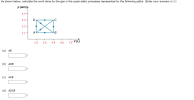 As shown below, calculate the work done by the gas in the quasi-static processes represented by the following paths. (Enter your answers in J.) p (atm) 1.5 3.0 4.5 6.0 7.5 V (L) (a) AB (b) ADB Dj (c) ACB (d) ADCB
As shown below, calculate the work done by the gas in the quasi-static processes represented by...
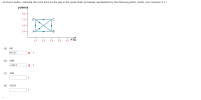 As shown below, calculate the work done by the gas in the quasi-static processes represented by the following paths. (Enter your answers in J.) p (atm) 9.6 DR عام 1.3 2.6 3.9 5.2 6.5 V (L) (a) AB 843.87 (b) ADB -14322 (c) ACB (d) ADCB
As shown below, calculate the work done by the gas in the quasi-static processes represented by...
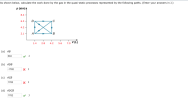 As shown below, calculate the work done by the gas in the quasi-static processes represented by the following paths. (Enter your answers in .) p (atm)4 8.4 6.3 4.2 2.1 1.4 2.8 4.25.6 7.0 V(L) (a) AB 594 (b) ADB 1782X (c) ACB 1782 (d) ADCE 1782
An ideal gas is taken through a quasi-static process described by P = αV2, with α...
An ideal gas is taken through a quasi-static process described by P = αV2, with α = 7.00 atm/m6, as shown in the figure. The gas is expanded to twice its original volume of 1.00 m3. How much work (in MJ) is done on the expanding gas in this process?
a) An ideal gas is taken through a quasi-static process described by ρ-α 2 with a...
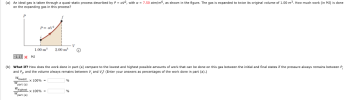 a) An ideal gas is taken through a quasi-static process described by ρ-α 2 with a = 7.50 atm m , as shown in the figure. The gas is expanded to t ce its original volume of 1.00 m3 How much work in is done on the expanding gas in this process? P-aV 1.00 m3 2.00m O (b) What If? How does the work done in part (a) compare to the lowest and highest possible amounts of work that can...
Problem #2 An ideal gas is taken through a quasi-statie process described by P(V)= With a...
 Problem #2 An ideal gas is taken through a quasi-statie process described by P(V)= With a = 1.00 atm/mº, as shown in the figure. The gas is expanded to three times its original volume of 1.00 m'. How much work is done on the expanding was in this process? PV = V I lm3 3m3 V
Figure 2.4 shows a cyclic path in the P -V diagram of an ideal gas. The...
 Figure 2.4 shows a cyclic path in the P -V diagram of an ideal
gas. The result is that the net work done on the gas is the
negative of the area enclosed by the path
.
Assume that the gas is ideal with N particles and calculate the
energy transfer by heating in each step of the process. Then
explain why the net work done on the gas is negative and show that
the net change of the internal...
Figure 2.4 shows a cyclic path in the P -V diagram of an ideal
gas. The result is that the net work done on the gas is the
negative of the area enclosed by the path
.
Assume that the gas is ideal with N particles and calculate the
energy transfer by heating in each step of the process. Then
explain why the net work done on the gas is negative and show that
the net change of the internal...
In a quasi-static isobaric expansion, 375 J of work are done by the gas. If the...
In a quasi-static isobaric expansion, 375 J of work are done by the gas. If the gas pressure is 0.70 atm, what is the fractional increase in the volume of the gas, assuming it was originally at 25.0 L?
PLEASE SHOW YOUR WORK. THANK YOU. (a) Find the work done by an ideal gas as...
 PLEASE SHOW YOUR WORK. THANK YOU.
(a) Find the work done by an ideal gas as it expands
from point A to point B along the path shown in
the figure.
_____MJ
(b) How much work is done by the gas if it compressed from
B to A along the same path?
____ MJ
P ( kPa) 1200 1100 1000 900 800 700 600 500 400 300 200 100 v (m2) 1 2 3 4 5 6 7 8 9
PLEASE SHOW YOUR WORK. THANK YOU.
(a) Find the work done by an ideal gas as it expands
from point A to point B along the path shown in
the figure.
_____MJ
(b) How much work is done by the gas if it compressed from
B to A along the same path?
____ MJ
P ( kPa) 1200 1100 1000 900 800 700 600 500 400 300 200 100 v (m2) 1 2 3 4 5 6 7 8 9
Part A - Process 1 → 2 20.0 kJkJ work has done to compress the ideal...
 Part A - Process 1 → 2
20.0 kJkJ work has done to compress the ideal gas from
V1 = 0.75 m3m3 at P1 = 0.950
atmatm to make V2. Calculate the final volume
V2.
Express your answer using three significant figures.
Part B
What is the change in the internal energy of the gas during this
whole process from 1→3?
Express your answer using three significant figures.
Part C
What is the total heat flow from the gas during this...
Part A - Process 1 → 2
20.0 kJkJ work has done to compress the ideal gas from
V1 = 0.75 m3m3 at P1 = 0.950
atmatm to make V2. Calculate the final volume
V2.
Express your answer using three significant figures.
Part B
What is the change in the internal energy of the gas during this
whole process from 1→3?
Express your answer using three significant figures.
Part C
What is the total heat flow from the gas during this...
 As shown below, calculate the work done by the gas in the quasi-static processes represented by the following paths. (Enter your answers in J.) p (atm) 1.5 3.0 4.5 6.0 7.5 V (L) (a) AB (b) ADB Dj (c) ACB (d) ADCB
 As shown below, calculate the work done by the gas in the quasi-static processes represented by the following paths. (Enter your answers in J.) p (atm) 9.6 DR عام 1.3 2.6 3.9 5.2 6.5 V (L) (a) AB 843.87 (b) ADB -14322 (c) ACB (d) ADCB
 As shown below, calculate the work done by the gas in the quasi-static processes represented by the following paths. (Enter your answers in .) p (atm)4 8.4 6.3 4.2 2.1 1.4 2.8 4.25.6 7.0 V(L) (a) AB 594 (b) ADB 1782X (c) ACB 1782 (d) ADCE 1782
 a) An ideal gas is taken through a quasi-static process described by ρ-α 2 with a = 7.50 atm m , as shown in the figure. The gas is expanded to t ce its original volume of 1.00 m3 How much work in is done on the expanding gas in this process? P-aV 1.00 m3 2.00m O (b) What If? How does the work done in part (a) compare to the lowest and highest possible amounts of work that can...
 Problem #2 An ideal gas is taken through a quasi-statie process described by P(V)= With a = 1.00 atm/mº, as shown in the figure. The gas is expanded to three times its original volume of 1.00 m'. How much work is done on the expanding was in this process? PV = V I lm3 3m3 V
 Figure 2.4 shows a cyclic path in the P -V diagram of an ideal
gas. The result is that the net work done on the gas is the
negative of the area enclosed by the path
.
Assume that the gas is ideal with N particles and calculate the
energy transfer by heating in each step of the process. Then
explain why the net work done on the gas is negative and show that
the net change of the internal...
Figure 2.4 shows a cyclic path in the P -V diagram of an ideal
gas. The result is that the net work done on the gas is the
negative of the area enclosed by the path
.
Assume that the gas is ideal with N particles and calculate the
energy transfer by heating in each step of the process. Then
explain why the net work done on the gas is negative and show that
the net change of the internal...
 PLEASE SHOW YOUR WORK. THANK YOU.
(a) Find the work done by an ideal gas as it expands
from point A to point B along the path shown in
the figure.
_____MJ
(b) How much work is done by the gas if it compressed from
B to A along the same path?
____ MJ
P ( kPa) 1200 1100 1000 900 800 700 600 500 400 300 200 100 v (m2) 1 2 3 4 5 6 7 8 9
PLEASE SHOW YOUR WORK. THANK YOU.
(a) Find the work done by an ideal gas as it expands
from point A to point B along the path shown in
the figure.
_____MJ
(b) How much work is done by the gas if it compressed from
B to A along the same path?
____ MJ
P ( kPa) 1200 1100 1000 900 800 700 600 500 400 300 200 100 v (m2) 1 2 3 4 5 6 7 8 9
 Part A - Process 1 → 2
20.0 kJkJ work has done to compress the ideal gas from
V1 = 0.75 m3m3 at P1 = 0.950
atmatm to make V2. Calculate the final volume
V2.
Express your answer using three significant figures.
Part B
What is the change in the internal energy of the gas during this
whole process from 1→3?
Express your answer using three significant figures.
Part C
What is the total heat flow from the gas during this...
Part A - Process 1 → 2
20.0 kJkJ work has done to compress the ideal gas from
V1 = 0.75 m3m3 at P1 = 0.950
atmatm to make V2. Calculate the final volume
V2.
Express your answer using three significant figures.
Part B
What is the change in the internal energy of the gas during this
whole process from 1→3?
Express your answer using three significant figures.
Part C
What is the total heat flow from the gas during this...
Most questions answered within 3 hours.
-
Where is the error in this code sequence?
String s1 = "Hello";
String s2 = "ello";...
asked 10 months ago -
Financial data for Joel de Paris, Inc., for last year
follow:
Joel de Paris, Inc.
Balance...
asked 10 months ago -
Consider this reaction:
Al2(SO4)3 (aq)+ BaCl3
(aq) Al2Cl6 (aq)- +
3BaSO4(s) . What is the...
asked 10 months ago -
Suppose that Savneet is considering increasing her
recent random sample from 20 car rentals to 40...
asked 10 months ago -
Trucks arrive at an unloading terminal at an average rate of 120
per hour.
Trucks arrive...
asked 10 months ago -
Why are methanol and ethanol completely soluble in water while
octanol is not very little soluble....
asked 10 months ago -
A facilities manager at a university reads in a research report
that the mean amount of...
asked 10 months ago -
When the CuSO4 is rehydrated by adding water to the anhydrous
compound, is this an endothermic...
asked 10 months ago -
A ray of sunlight is passing from diamond into crown glass; the
angle of incidence is...
asked 10 months ago -
A block of mass 0.249 kg is placed on top of a light, vertical
spring of...
asked 10 months ago -
how do the kidneys compensate in the presences of acidosis
a) trigger hyperventilate
b) reserve acid...
asked 10 months ago -
Question 501 pts
The rental rate of capital to the firm increases. Which of the
following...
asked 10 months ago