Compare and contrast the Platyhelminthes (flatworm), nematodes, and annelid body plans. How are these worms the same,...
Compare and contrast the Platyhelminthes (flatworm), nematodes, and annelid body plans. How are these worms the same, and how are they different. Include special features of each, such as circulatory systems, digestive systems, segmentation, waste removal, and general body plans.
Homework Answers
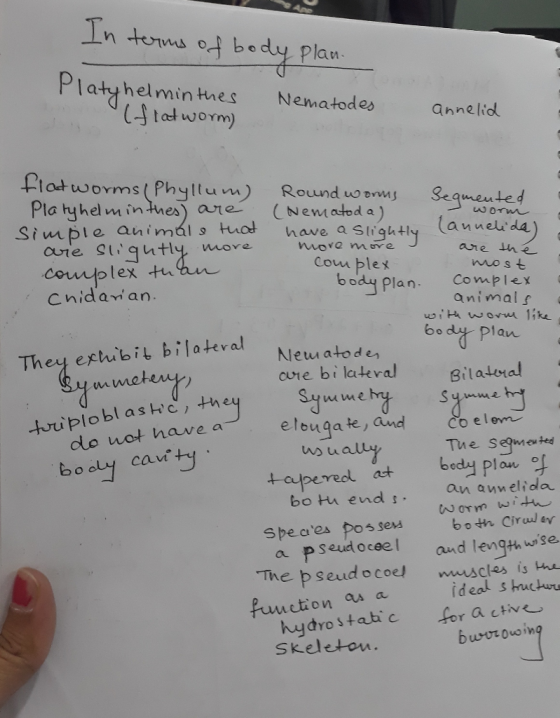
DIFFERENCE AMONG THESE 3 PHYLLUM includes –
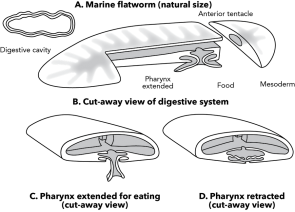
Platyhelminthes – 1.flatworms have a digestive system with only a single opening into the digestive cavity, but in independently living marine flatworms the cavity branches into all parts of the body 2. These flatworms feed through a pharynx. A pharynx is a long, tubular mouthpart that extends from the body, surrounds the food, and tears it into very fine pieces 3. Cells lining the digestive cavity finish digesting the food. Then the dissolved nutrients move to other cells of the body. Undigested food passes back out through the mouth, as in the cnidarians. Parasitic tapeworms usually absorb their nutrients directly from the host, while parasitic (Digestive system )
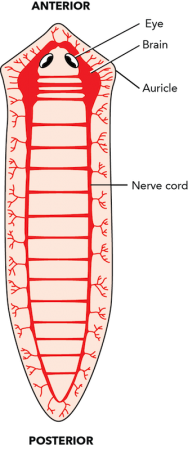
4. Like most self-propelling animals, independent-living flatworms have a central nervous system. A central nervous system consists of a mass of nerve cells, called a ganglion, (in more complex organisms, the ganglion evolves into a brain) in the anterior part of the body, and a nerve cord extending from the brain toward the posterior end of the body 5. Sensory cells in the head detect changes in the environment. In free-living flatworms, sensory cells that respond to light are clustered in two eyespots in the head. Sensory cells that detect water currents, solid objects, and chemicals are in two flap-like projections on the head called auricles. In self-propelling animals, these sensory organs in the head are the first part of the animal that encounters new surroundings. The ganglion receives information from the sensory structures and sends signals to other parts of the body along two strands of nerve cells running toward the tail. Because the nerve strands are connected by cross-strands in the shape of a stepladder, this kind of nervous system is often called a “nerve ladder.”( Nervous system )
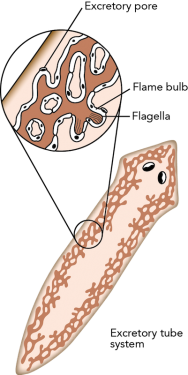
6. The excretory system removes waste products and excess water from tissues of flatworms. Flatworms have a surprisingly elaborate system to rid the body of wastes 7. This network runs the length of the animal on each side and opens to the outside through small pores in the posterior region of the body. Connected to the tubes are tiny cells that move wastes and water from the tissues into the tubes. These cells contain flagella that beat back and forth, creating a current of fluid that constantly moves toward the excretory pores. Under a microscope, the flagellar movement looks like a flickering fire, and the structure is called a flame bulb.(excretory system)
Flatworms have no circulatory system. Animals without a circulatory system have limited abilities to deliver oxygen and nutrients to their body cells because of the way that molecules behave. As molecules spread through water, they become less concentrated as they move away from their source. This is known as diffusion.
Nematodes –
Body plan- Nematodaroundworms(Also: nematodes) Roundworms (nematodes) are bilaterally symmetrical, worm-like organisms that are surrounded by a strong, flexible noncellular layer called a cuticle. Their body plan is simple. The cuticle is secreted by and covers a layer of epidermal cells.
- Nematodes are bilaterally symmetrical. They take their name from their round body cross-sectional shape. Unlike the flatworms in which food and waste enter and exit from the same opening, nematodes have a complete digestive system. An animal with a complete digestive system has a mouth at one end, a long tube with specialized parts in the middle, and an end point at the other end. 2. Complete digestive systems are seen in more complex organisms and offer many advantages over the flatworm’s method of digestion. With a complete digestive system, an animal can eat while its previous meal digests. Parts of the digestive system can specialize to do different jobs, digesting food in stages 3. As the food moves along, it is broken into molecules and absorbed by the cells lining the tube. Muscles surrounding the tube contract, squeezing the food and pushing it along in a process called peristalsis. Indigestible wastes pass out through the end point. (Digestive system) 4. nematodes are slender, and they are covered by a protective cuticle. A cuticle is a waxy covering secreted by the epidermis or outermost cellular tissue. Because of this covering, gas exchange cannot occur directly across the skin as in flatworms. Rather, gas exchange and waste excretion in nematodes occur by diffusion across the wall of the gut. Although nematodes do have a space in the body between the digestive tract and the body wall, it is not lined with tissue and is not considered to be a true coelom. Thus, nematodes are sometimes referred to as pseudocoelomates (Absorption and circulation ) 5. Most worms have two bands of muscles: longitudinal muscles that run the length of the body and circular muscles that form circular bands around the body. Unlike other worms that have two bands of muscles, nematodes only have longitudinal muscles. This explains their characteristic thrashing movement, as they can move only by contracting the long muscles on either side of their body and wriggling forward.6. The nervous system of nematodes consists of a set of nerves that run the length of the body and connect to anterior ganglia. Free-living nematodes are capable of sensing light with ocelli, and most nematodes have fairly complex chemosensory abilities. Most nematodes are not hermaphrodites, with both sexes in one individual, but are known as dioecious—having individuals of separate sexes. Their chemosensory abilities are very helpful, as they rely on pheromones to locate potential mates.

Annelida
The worms in the phylum Annelida (from the Latin root word annulus meaning ring) typically have complex segmented bodies
- Tubeworms are sessile polychaetes that live in tubes that they build by secreting the tube material. The tubes, attached to rocks or embedded in sand or mud, maybe leathery, calcareous, or sand-covered depending on the worm species. Tubeworms feed by extending tentacles from the tube. Bits of food move along grooves in the tentacles to the mouth. Some tubeworms retract their tentacles when food lands on them. Tubeworms use their parapodia to create currents of water that flow through the tubes to aid in respiration and help clean the tubes. By contrast, the free-living or mobile polychaete worms have a proboscis that can extend from their mouths to catch prey. This is a feeding organ that is often armed with small teeth or jaws on its tip. With their active lifestyle and good defenses, free-moving polychaetes can make their living in a variety of habitats such as mud, sand, sponges, live corals, and algae.
annelids have a mesoderm with muscle, a central nervous system, and an excretory system. Each of these systems is more complex in the annelid than in flatworms or nematodes. In addition to a more specialized complete digestive system, annelid worms have also evolved body features not found in flatworms or nematodes. These features appear in some form in all larger, more complex animals:
- a coelom, a body cavity between the digestive tube and the external body wall that is lined with tissue
- a circulatory system consisting of a series of tubes (vessels) filled with fluid (blood) to transport dissolved nutrients, oxygen, and waste products rapidly and efficiently the coelom is a fluid-filled cavity lying between the digestive tube and the outer body tube and surrounded by mesodermal tissue. The digestive tube lies inside the outer body tube. This arrangement is called “tube-within-a-tube construction” . The fluid in the coelom supports the soft tissues of the body wall much as it does in the hydrostatic skeleton of cnidarians. Mesodermal muscles in the wall of the body tube and digestive tube can put pressure on the fluid to aid in movement. In the body wall of the annelids are two types of muscles: circular and longitudinal. When the circular muscles contract, the segment gets longer and narrower. When the longitudinal muscles contract, the segment gets shorter and fatter. These contractions produce the crawling movement of worms. Recall that nematodes lack circular muscles, and can only move by contracting their longitudinal muscles, thus thrashing and wriggling rather than crawling. The setae along the body of polychaetes stick in the substrate, holding parts of the worm in place while other parts move forward. 3. Annelids have a closed circulatory system in which blood is pumped along by muscles in blood vessels. Blood flows through the microscopic capillaries, picking up food molecules from the digestive tract and oxygen from the skin and transporting them to the cells of the body. The parapodia, the flaps on the sides of the segments, increase the surface area of the skin for respiration. In an efficient circulatory system like this, an animal’s internal tissues need not be close to its digestive and respiratory organs because the blood delivers nutrients and oxygen. Such a system lets animals grow much larger than possible in the flatworms, which must rely on diffusion. (circulatory system)
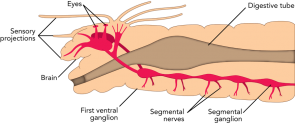
- The nervous system is also more complex in annelids than in other worm-like phyla. Annelids have a simple brain organ consisting of a pair of nerve clusters in the head region (Fig. 3.49). Nerves link the brain to sensory organs in the head that detect the environment in front of the worm. Earthworms are eyeless, but polychaete annelids have eyes that can distinguish between light and dark. Some polychaete worm eyes can even detect shapes. Nerves also extend from the brain around the digestive tube and along the ventral surface. A ganglion or cluster of nerve cells operates the organs in each segment.(nervous system)
The excretory system of annelid worms consists of a pair of small tubes in each segment. These tubes, called nephridia(from the Greek root word nephrusmeaning kidney), are open at both ends. They filter coelomic fluid, which contains useful nutrient molecules along with waste molecules. As the fluid moves through the tube, useful molecules return to the coelom, and waste molecules pass into the water. Although this system appears less complex than a flatworm’s, nephridia are actually a more efficient method of handling waste products because they filter fluid, keeping useful molecules inside the body(excretory system)
In term of the circulatory system - Platyhelminthes - no circulatory system
Nematode - complete circulatory system
Annelida - closed circulatory system
Add Answer to:
Compare and contrast the Platyhelminthes (flatworm),
nematodes, and annelid body plans. How are these worms
the same,...
Compare and Contrast (how are they the same and how are they different) Primary/Direct with Secondary/Indirect...
Compare and Contrast (how are they the same and how are they different) Primary/Direct with Secondary/Indirect Active Transport and simple diffusion with facilitated diffusion. Explain which specific molecules would use each type of transport and what the concentration gradient would be.
Compare and Contrast (how are they the same and how are they different) Primary/Direct with Secondary/Indirect...
Compare and Contrast (how are they the same and how are they different) Primary/Direct with Secondary/Indirect Active Transport and simple diffusion with facilitated diffusion. Explain which specific molecules would use each type of transport and what the concentration gradient would be.
bio 170 organismal bio lab need help filling out last 4 questions! Phylum Porifera Cnidaria Platyhelminthes...
 bio 170 organismal bio lab
need help filling out last 4 questions!
Phylum Porifera Cnidaria Platyhelminthes Place Nematoda Filesios Mollusca octopus wa Annelida Arthropoda bulacan Echinodermata which Chordata un sca anon coral anthozoa serung des with Publu urhlong 1 FP gar telletish portuguese man of war/ hydrozoa sea pansy Ianthozoa wacht www Looks Lice nce Phylum Platyhelminthes these are the flatworms. They have soft, elongated bodies and exhibit several advances over cnidarians. They have three distinct tissue layers (triploblastic construction),...
bio 170 organismal bio lab
need help filling out last 4 questions!
Phylum Porifera Cnidaria Platyhelminthes Place Nematoda Filesios Mollusca octopus wa Annelida Arthropoda bulacan Echinodermata which Chordata un sca anon coral anthozoa serung des with Publu urhlong 1 FP gar telletish portuguese man of war/ hydrozoa sea pansy Ianthozoa wacht www Looks Lice nce Phylum Platyhelminthes these are the flatworms. They have soft, elongated bodies and exhibit several advances over cnidarians. They have three distinct tissue layers (triploblastic construction),...
My topic is diabetes 597690/viewContent/7888874/View The Science of Popular Diets The Impact of Nutrition Practices on...
 My
topic is diabetes
597690/viewContent/7888874/View The Science of Popular Diets The Impact of Nutrition Practices on Human Wellness Understanding the Dietary Needs of Special Populations Consider that up until this point in Module 2, we have been focused on the nutritional needs and diet plans for healthy, adult individuals. The AMDRS used to calculate caloric needs have been determined to fit a general population of these individuals. In addition, there has been little need to consider deficiencies or toxicities of...
My
topic is diabetes
597690/viewContent/7888874/View The Science of Popular Diets The Impact of Nutrition Practices on Human Wellness Understanding the Dietary Needs of Special Populations Consider that up until this point in Module 2, we have been focused on the nutritional needs and diet plans for healthy, adult individuals. The AMDRS used to calculate caloric needs have been determined to fit a general population of these individuals. In addition, there has been little need to consider deficiencies or toxicities of...
10. Write a one-page summary of the attached paper? INTRODUCTION Many problems can develop in activated...
10. Write a one-page summary of the attached paper? INTRODUCTION Many problems can develop in activated sludge operation that adversely affect effluent quality with origins in the engineering, hydraulic and microbiological components of the process. The real "heart" of the activated sludge system is the development and maintenance of a mixed microbial culture (activated sludge) that treats wastewater and which can be managed. One definition of a wastewater treatment plant operator is a "bug farmer", one who controls the aeration...
Using the book, write another paragraph or two: write 170 words: Q: Compare the assumptions of...
 Using the book, write another paragraph or two: write 170
words:
Q: Compare the assumptions of physician-centered and
collaborative communication. How is the caregiver’s role different
in each model? How is the patient’s role different?
Answer: Physical-centered communication involves the specialists
taking control of the conversation. They decide on the topics of
discussion and when to end the process. The patient responds to the
issues raised by the caregiver and acts accordingly. On the other
hand, Collaborative communication involves a...
Using the book, write another paragraph or two: write 170
words:
Q: Compare the assumptions of physician-centered and
collaborative communication. How is the caregiver’s role different
in each model? How is the patient’s role different?
Answer: Physical-centered communication involves the specialists
taking control of the conversation. They decide on the topics of
discussion and when to end the process. The patient responds to the
issues raised by the caregiver and acts accordingly. On the other
hand, Collaborative communication involves a...
I need help with my very last assignment of this term PLEASE!!, and here are the instructions: After reading Chapter T...
 I need help with my very last assignment of this term
PLEASE!!, and here are the instructions: After reading Chapter Two,
“Keys to Successful IT Governance,” from Roger Kroft and Guy
Scalzi’s book entitled, IT Governance in Hospitals and Health
Systems, please refer to the following assignment instructions
below.
This chapter consists of interviews with executives
identifying mistakes that are made when governing healthcare
information technology (IT). The chapter is broken down into
subheadings listing areas of importance to understand...
I need help with my very last assignment of this term
PLEASE!!, and here are the instructions: After reading Chapter Two,
“Keys to Successful IT Governance,” from Roger Kroft and Guy
Scalzi’s book entitled, IT Governance in Hospitals and Health
Systems, please refer to the following assignment instructions
below.
This chapter consists of interviews with executives
identifying mistakes that are made when governing healthcare
information technology (IT). The chapter is broken down into
subheadings listing areas of importance to understand...
SYNOPSIS The product manager for coffee development at Kraft Canada must decide whether to introduce the...
 SYNOPSIS The product manager for coffee development at Kraft Canada must decide whether to introduce the company's new line of single-serve coffee pods or to await results from the product's launch in the United States. Key strategic decisions include choosing the target market to focus on and determining the value proposition to emphasize. Important questions are also raised in regard to how the new product should be branded, the flavors to offer, whether Kraft should use traditional distribution channels or...
10. The Beck & Watson article is a Group of answer choices quantitative study qualitative study...
 10. The Beck & Watson article is a
Group of answer choices
quantitative study
qualitative study
11. Beck & Watson examined participants' experiences and
perceptions using what type of research design?
Group of answer choices
particpant obersvation
phenomenology
12. Select the participants in the Beck & Watson study
Group of answer choices
Caucasian women with 2-4 children
Caucasian pregnant women
13. In the Beck & Watson study, data was collected via
a(n)
Group of answer choices
internet study
focus group...
10. The Beck & Watson article is a
Group of answer choices
quantitative study
qualitative study
11. Beck & Watson examined participants' experiences and
perceptions using what type of research design?
Group of answer choices
particpant obersvation
phenomenology
12. Select the participants in the Beck & Watson study
Group of answer choices
Caucasian women with 2-4 children
Caucasian pregnant women
13. In the Beck & Watson study, data was collected via
a(n)
Group of answer choices
internet study
focus group...
14. Select the number of participants in the Beck & Watson study Group of answer choices...
 14. Select the number of participants in the Beck & Watson
study
Group of answer choices
8
13
22
35
15. Beck & Watson determined their final sample size via
Group of answer choices
coding
saturation
triangulation
ethnography
16.Through their study, Beck & Watson determined
Group of answer choices
after a traumatic birth, subsequent births have no troubling
effects
after a traumatic birth, subsequent births brought fear, terror,
anxiety, and dread
Subsequent Childbirth After a Previous Traumatic Birth Beck, Cheryl...
14. Select the number of participants in the Beck & Watson
study
Group of answer choices
8
13
22
35
15. Beck & Watson determined their final sample size via
Group of answer choices
coding
saturation
triangulation
ethnography
16.Through their study, Beck & Watson determined
Group of answer choices
after a traumatic birth, subsequent births have no troubling
effects
after a traumatic birth, subsequent births brought fear, terror,
anxiety, and dread
Subsequent Childbirth After a Previous Traumatic Birth Beck, Cheryl...
 bio 170 organismal bio lab
need help filling out last 4 questions!
Phylum Porifera Cnidaria Platyhelminthes Place Nematoda Filesios Mollusca octopus wa Annelida Arthropoda bulacan Echinodermata which Chordata un sca anon coral anthozoa serung des with Publu urhlong 1 FP gar telletish portuguese man of war/ hydrozoa sea pansy Ianthozoa wacht www Looks Lice nce Phylum Platyhelminthes these are the flatworms. They have soft, elongated bodies and exhibit several advances over cnidarians. They have three distinct tissue layers (triploblastic construction),...
bio 170 organismal bio lab
need help filling out last 4 questions!
Phylum Porifera Cnidaria Platyhelminthes Place Nematoda Filesios Mollusca octopus wa Annelida Arthropoda bulacan Echinodermata which Chordata un sca anon coral anthozoa serung des with Publu urhlong 1 FP gar telletish portuguese man of war/ hydrozoa sea pansy Ianthozoa wacht www Looks Lice nce Phylum Platyhelminthes these are the flatworms. They have soft, elongated bodies and exhibit several advances over cnidarians. They have three distinct tissue layers (triploblastic construction),...
 My
topic is diabetes
597690/viewContent/7888874/View The Science of Popular Diets The Impact of Nutrition Practices on Human Wellness Understanding the Dietary Needs of Special Populations Consider that up until this point in Module 2, we have been focused on the nutritional needs and diet plans for healthy, adult individuals. The AMDRS used to calculate caloric needs have been determined to fit a general population of these individuals. In addition, there has been little need to consider deficiencies or toxicities of...
My
topic is diabetes
597690/viewContent/7888874/View The Science of Popular Diets The Impact of Nutrition Practices on Human Wellness Understanding the Dietary Needs of Special Populations Consider that up until this point in Module 2, we have been focused on the nutritional needs and diet plans for healthy, adult individuals. The AMDRS used to calculate caloric needs have been determined to fit a general population of these individuals. In addition, there has been little need to consider deficiencies or toxicities of...
 Using the book, write another paragraph or two: write 170
words:
Q: Compare the assumptions of physician-centered and
collaborative communication. How is the caregiver’s role different
in each model? How is the patient’s role different?
Answer: Physical-centered communication involves the specialists
taking control of the conversation. They decide on the topics of
discussion and when to end the process. The patient responds to the
issues raised by the caregiver and acts accordingly. On the other
hand, Collaborative communication involves a...
Using the book, write another paragraph or two: write 170
words:
Q: Compare the assumptions of physician-centered and
collaborative communication. How is the caregiver’s role different
in each model? How is the patient’s role different?
Answer: Physical-centered communication involves the specialists
taking control of the conversation. They decide on the topics of
discussion and when to end the process. The patient responds to the
issues raised by the caregiver and acts accordingly. On the other
hand, Collaborative communication involves a...
 I need help with my very last assignment of this term
PLEASE!!, and here are the instructions: After reading Chapter Two,
“Keys to Successful IT Governance,” from Roger Kroft and Guy
Scalzi’s book entitled, IT Governance in Hospitals and Health
Systems, please refer to the following assignment instructions
below.
This chapter consists of interviews with executives
identifying mistakes that are made when governing healthcare
information technology (IT). The chapter is broken down into
subheadings listing areas of importance to understand...
I need help with my very last assignment of this term
PLEASE!!, and here are the instructions: After reading Chapter Two,
“Keys to Successful IT Governance,” from Roger Kroft and Guy
Scalzi’s book entitled, IT Governance in Hospitals and Health
Systems, please refer to the following assignment instructions
below.
This chapter consists of interviews with executives
identifying mistakes that are made when governing healthcare
information technology (IT). The chapter is broken down into
subheadings listing areas of importance to understand...
 SYNOPSIS The product manager for coffee development at Kraft Canada must decide whether to introduce the company's new line of single-serve coffee pods or to await results from the product's launch in the United States. Key strategic decisions include choosing the target market to focus on and determining the value proposition to emphasize. Important questions are also raised in regard to how the new product should be branded, the flavors to offer, whether Kraft should use traditional distribution channels or...
 10. The Beck & Watson article is a
Group of answer choices
quantitative study
qualitative study
11. Beck & Watson examined participants' experiences and
perceptions using what type of research design?
Group of answer choices
particpant obersvation
phenomenology
12. Select the participants in the Beck & Watson study
Group of answer choices
Caucasian women with 2-4 children
Caucasian pregnant women
13. In the Beck & Watson study, data was collected via
a(n)
Group of answer choices
internet study
focus group...
10. The Beck & Watson article is a
Group of answer choices
quantitative study
qualitative study
11. Beck & Watson examined participants' experiences and
perceptions using what type of research design?
Group of answer choices
particpant obersvation
phenomenology
12. Select the participants in the Beck & Watson study
Group of answer choices
Caucasian women with 2-4 children
Caucasian pregnant women
13. In the Beck & Watson study, data was collected via
a(n)
Group of answer choices
internet study
focus group...
 14. Select the number of participants in the Beck & Watson
study
Group of answer choices
8
13
22
35
15. Beck & Watson determined their final sample size via
Group of answer choices
coding
saturation
triangulation
ethnography
16.Through their study, Beck & Watson determined
Group of answer choices
after a traumatic birth, subsequent births have no troubling
effects
after a traumatic birth, subsequent births brought fear, terror,
anxiety, and dread
Subsequent Childbirth After a Previous Traumatic Birth Beck, Cheryl...
14. Select the number of participants in the Beck & Watson
study
Group of answer choices
8
13
22
35
15. Beck & Watson determined their final sample size via
Group of answer choices
coding
saturation
triangulation
ethnography
16.Through their study, Beck & Watson determined
Group of answer choices
after a traumatic birth, subsequent births have no troubling
effects
after a traumatic birth, subsequent births brought fear, terror,
anxiety, and dread
Subsequent Childbirth After a Previous Traumatic Birth Beck, Cheryl...
Most questions answered within 3 hours.
-
Where is the error in this code sequence?
String s1 = "Hello";
String s2 = "ello";...
asked 10 months ago -
Financial data for Joel de Paris, Inc., for last year
follow:
Joel de Paris, Inc.
Balance...
asked 10 months ago -
Consider this reaction:
Al2(SO4)3 (aq)+ BaCl3
(aq) Al2Cl6 (aq)- +
3BaSO4(s) . What is the...
asked 10 months ago -
Suppose that Savneet is considering increasing her
recent random sample from 20 car rentals to 40...
asked 10 months ago -
Trucks arrive at an unloading terminal at an average rate of 120
per hour.
Trucks arrive...
asked 10 months ago -
Why are methanol and ethanol completely soluble in water while
octanol is not very little soluble....
asked 10 months ago -
A facilities manager at a university reads in a research report
that the mean amount of...
asked 10 months ago -
When the CuSO4 is rehydrated by adding water to the anhydrous
compound, is this an endothermic...
asked 10 months ago -
A ray of sunlight is passing from diamond into crown glass; the
angle of incidence is...
asked 10 months ago -
A block of mass 0.249 kg is placed on top of a light, vertical
spring of...
asked 10 months ago -
how do the kidneys compensate in the presences of acidosis
a) trigger hyperventilate
b) reserve acid...
asked 10 months ago -
Question 501 pts
The rental rate of capital to the firm increases. Which of the
following...
asked 10 months ago